

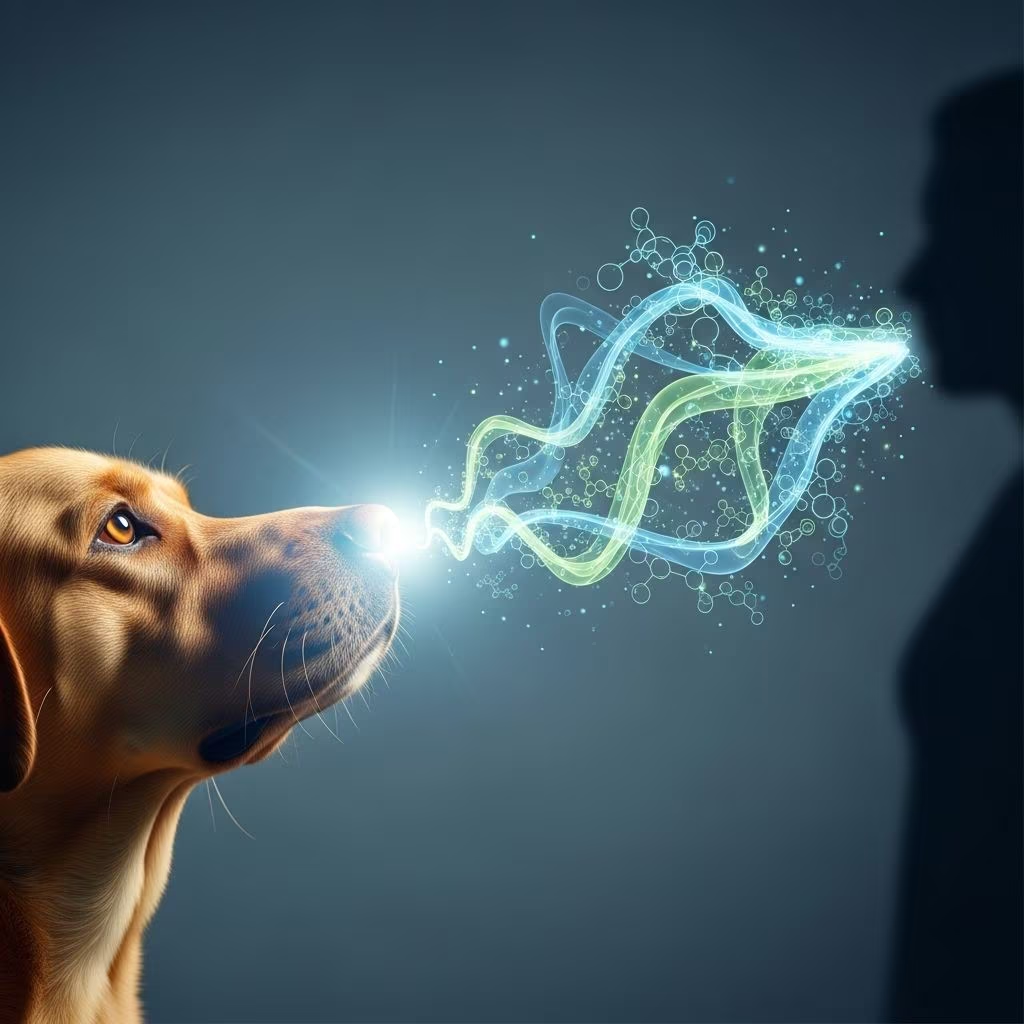
Dogs possess an extraordinary olfactory system that allows them to detect subtle chemical signals emitted by humans, including potential pheromones and stress-related odors. Scientific studies confirm that canines can differentiate human scents associated with emotional states, leveraging their superior sense of smell far beyond human capabilities.
The Power of a Dog’s Nose: Anatomical Superiority
A dog’s olfactory prowess stems from specialized anatomy. Canines have over 100 million sensory receptor sites in their nasal cavity, compared to just 6 million in humans. The brain region dedicated to smell analysis is about 40 times larger in dogs relative to body size.
This setup enables dogs to process odor molecules with exceptional efficiency. Their olfactory membranes are vastly larger—akin to a handkerchief versus a postage stamp in humans—allowing detection of faint scents like fingerprints even after exposure to rain and dust.
- Key anatomical features: Expanded nasal turbinates increase surface area for scent capture.
- Receptor density: Up to 300 million in some breeds, enhancing sensitivity 1,000 to 10,000 times over humans.
- Brain allocation: 40 times more neural tissue for odor processing than in people.
These adaptations make dogs ideal for perceiving the world primarily through smell, interpreting chemical cues that convey vital information about their environment and companions.
Understanding Pheromones and Chemosignals in Humans and Dogs
Pheromones are chemical substances released by an individual that trigger specific behavioral or physiological responses in others of the same species. In humans, these signals are subtler and less understood, often linked to volatile organic compounds (VOCs) in sweat and breath.
Dogs, while sharing some pheromone communication traits with other mammals, rely more on their main olfactory system than a specialized vomeronasal organ (VNO). Research shows that key pheromone receptor families in the VNO are significantly reduced in dogs compared to rodents, suggesting the primary nose handles most pheromonal detection.
| Aspect | Humans | Dogs |
|---|---|---|
| Pheromone Production | Subtle VOCs via sweat/breath | Stronger signals, main nose dominant |
| Detection Organ | Limited VNO function | Primary olfaction over VNO |
| Sensitivity | Basic odor perception | 1,000x+ human levels |
Human chemosignals, including those tied to emotions, become detectable to dogs through changes in body chemistry, bridging interspecies communication.
Scientific Evidence: Dogs Sensing Human Stress and Emotions
Peer-reviewed studies demonstrate dogs’ ability to distinguish human odors from baseline (relaxed) versus stressed states. In a double-blind, controlled experiment using breath and sweat samples, dogs accurately identified stress odors at above-chance levels (p < 0.001).
The protocol involved a three-alternative forced-choice scent-wheel task. Dogs trained on known odor differences progressed to discriminating within-person samples: neutral versus psychologically stressed. Success rates exceeded 80%, confirming VOC changes from stress are perceptible.
Another study exposed untrained dogs to stress odors (high cortisol samples), resulting in cautious behaviors compared to relaxed scents. This held even with unfamiliar humans, indicating innate detection via adrenaline and cortisol-induced chemical shifts.
- Stress indicators detected: Elevated cortisol, altered breath/sweat VOCs.
- Behavioral responses: Increased caution, avoidance in dogs.
- Paradigm reliability: Double-blind to prevent cueing, positive reinforcement training.
These findings extend prior work on interspecies chemosignals, showing dogs pick up fear and happiness odors without visual or auditory aids.
Role of the Vomeronasal Organ in Canine Pheromone Detection
Traditionally viewed as the pheromone hub in rodents, the VNO’s role diminishes in dogs. Genomic analysis reveals decimated receptor families in canine VNOs, implying reliance on the main olfactory epithelium for pheromonal cues.
This shift explains dogs’ sophisticated scent-based social interactions despite keen smell. “As elaborate as dogs’ pheromonal system seems, it could be that the main nose underlies this communication,” notes researcher Robert Lane.
Implications challenge rodent-centric models, highlighting species-specific adaptations in non-rodent mammals.
Practical Applications: From Therapy to Detection Work
Dogs’ sensitivity to human pheromones and stress signals opens doors in therapeutic and service roles. Emotional support dogs detect anxiety spikes via scent, aiding PTSD patients by providing timely comfort.
Training paradigms mirror medical detection: dogs learn to alert on target odors amid distractors, transferable to human stress chemosignals. Success in baseline-stress discrimination supports scalability.
Real-world uses:
- PTSD service dogs alerting to owner stress.
- Anxiety detection in clinical settings.
- Search-and-rescue, identifying stressed survivors via scent.
Owners benefit too—dogs respond empathetically, strengthening bonds through chemical empathy.
Factors Affecting Detection Accuracy
Several variables influence canine performance:
| Factor | Impact | Mitigation |
|---|---|---|
| Sample Freshness | Degraded VOCs reduce accuracy | Use fresh collections, controlled storage |
| Environmental Odors | Distractors like owner scents | Double-blind protocols, clean setups |
| Dog Training Level | Untrained show caution; trained excel | |
| Breed Variations | Scent hounds superior | Breed-specific selection |
Controlled studies minimize confounds like ‘tagging’ (dog adding own scent), ensuring reliable results.
Human-Dog Bond Enhanced by Scent Communication
Dogs recognize familiar humans by scent alone, even distinguishing identical twins. Reciprocally, humans can identify their dogs’ scents, underscoring mutual olfactory recognition.
This bidirectional sensing fosters empathy. Dogs mirror human emotions via chemosignals, behaving more stressfully around anxious owners and relaxed around happy ones.
Limitations and Future Research Directions
While compelling, research gaps persist. Most studies focus on acute stress; chronic emotions need exploration. Inter-breed differences and long-term training efficacy warrant investigation.
Advancing paradigms to real-time detection could revolutionize service dog applications. Genomic studies on human pheromones may clarify exact compounds dogs target.
Frequently Asked Questions (FAQs)
Can all dogs smell human pheromones equally?
No, scent hounds like Bloodhounds excel due to higher receptor counts, but all breeds surpass humans.
Do dogs smell fear specifically?
Yes, fear alters sweat/breath via cortisol/adrenaline, prompting cautious dog responses.
Is the VNO essential for dogs sensing humans?
Limited; main nose dominates pheromone detection in dogs.
Can I train my dog to detect my stress?
Yes, using scent-wheel methods with your samples under controlled stress induction.
What breeds are best for emotional detection?
Any trainable dog, but Labradors and Goldens common in service roles for temperament.
References
- New Findings Center on Human Pheromones — Wesleyan Connection. 2005-01-31. https://newsletter.blogs.wesleyan.edu/2005/01/31/0105pheromone-htm/
- Dogs can discriminate between human baseline and psychological stress condition odours — PLOS ONE. 2022. https://journals.plos.org/plosone/article?id=10.1371/journal.pone.0274143
- Dogs can smell when humans are stressed, study suggests — National Library of Medicine. N/A. https://www.ncbi.nlm.nih.gov/search/research-news/17259
- Can dogs really smell fear? A vet weighs in. — Popular Science. N/A. https://www.popsci.com/environment/dogs-sense-fear/
- A nose 1,000 times better than ours — University of Alaska Fairbanks. N/A. https://www.uaf.edu/news/a-nose-1000-times-better-than-ours.php
- How Dogs Use Smell to Perceive the World — VCA Animal Hospitals. N/A. https://vcahospitals.com/know-your-pet/how-dogs-use-smell-to-perceive-the-world
- The Ability of Humans to Recognize Their Dogs by Scent Alone — Psychology Today. 2021-11. https://www.psychologytoday.com/us/blog/canine-corner/202111/the-ability-humans-recognize-their-dogs-scent-alone



