

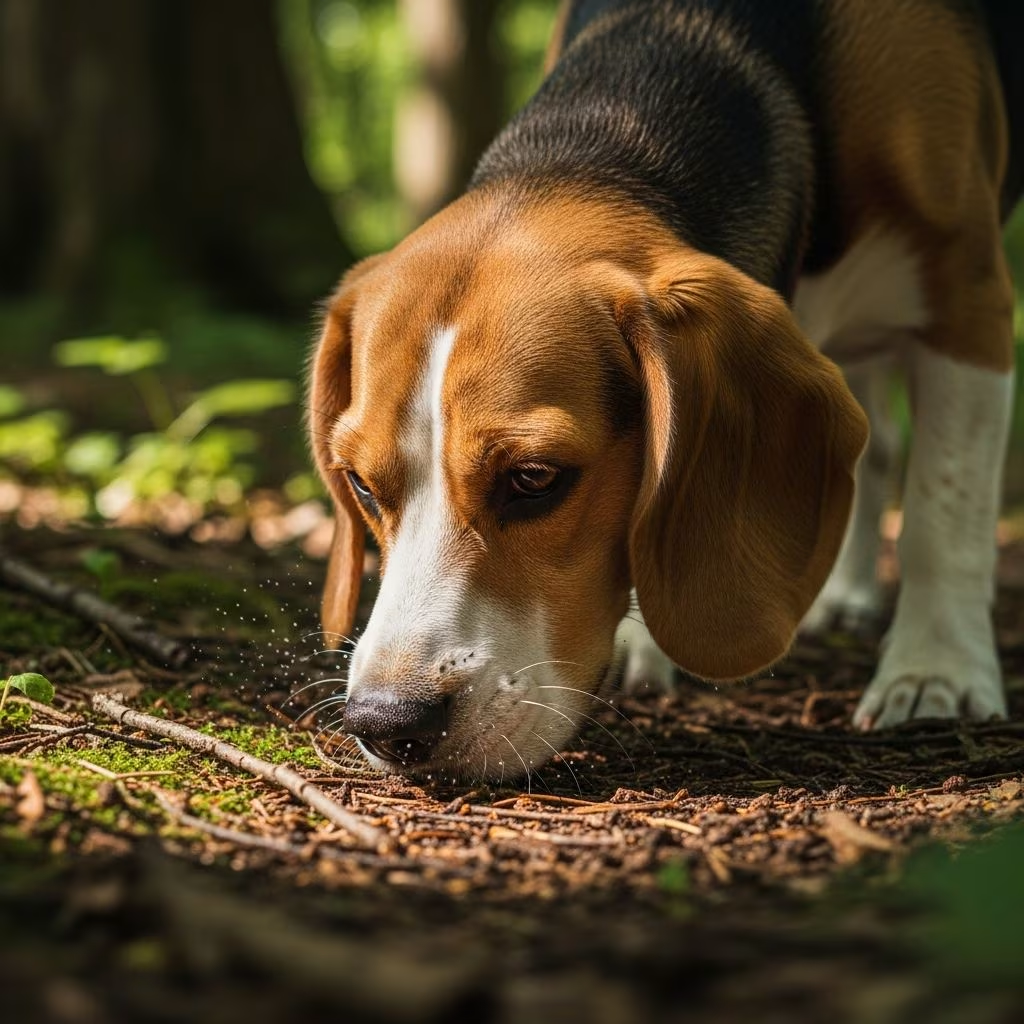
Dogs possess an extraordinary sense of smell that allows them to detect odors buried several feet underground, with detection capabilities reaching parts per trillion concentrations depending on the scent, soil conditions, and individual dog.
The Science Behind Canine Olfactory Power
At the core of a dog’s sniffing prowess lies a vastly superior olfactory system compared to humans. While humans have about 6 million olfactory receptors, dogs boast between 125 million and 300 million, with breeds like Bloodhounds at the upper end. This abundance of receptors, combined with a brain region dedicated to smell that’s 40 times larger than ours, enables dogs to process scents with unparalleled precision.
Each olfactory receptor cell in a dog’s nose expresses a single type of receptor, and detecting a specific odor requires activating a unique combination of these receptors. Nasal airflow in dogs is specially adapted, with turbulent patterns that enhance odor capture efficiency. Genetic factors also play a role; dogs have fewer non-functional olfactory receptor genes (about 20% pseudogenes) compared to humans (over 50%), and breed-specific variations influence scenting ability.
How Scents Travel Through Soil to Reach Dogs
Soil acts as a filter for odors, but volatile compounds can migrate upward through pores, cracks, and moisture channels. Factors like soil type, moisture content, temperature, and burial depth determine how effectively scents escape. Sandy or loamy soils allow better diffusion than dense clay, and recent burials release stronger volatiles initially, fading over time.
- Soil Permeability: Porous soils permit faster odor diffusion, enabling detection from greater depths.
- Moisture Levels: Wet soil can trap scents but also create pathways for vapor movement.
- Temperature Gradients: Warmer surface temperatures draw odors upward from cooler depths.
- Time Since Burial: Fresh scents are more detectable; decomposition produces new volatiles over time.
Studies indicate dogs can pick up these faint traces even when diluted millions of times by soil matrices.
Measured Olfactory Detection Thresholds in Dogs
Scientific experiments quantify dogs’ sensitivity using controlled odor concentrations. In one study, dogs detected amyl acetate (a common test odor) at thresholds from 40 parts per billion (ppb) to 1.5 parts per trillion (ppt), roughly 30 to 20,000 times more sensitive than prior lab methods. This was achieved with positive reinforcement training in natural search scenarios, highlighting training’s impact on performance.
| Dog ID | Threshold Range | Accuracy at Lowest Level |
|---|---|---|
| Dog 1-5 | 30 ppb – 10 ppt | >80% |
| Dog 6-10 | 5 ppb – 1.5 ppt | 81.71% average |
Inter-dog variability persists despite uniform training, attributed to factors like perceptual learning and individual physiology. These thresholds translate to real-world underground detection, where scents are similarly diluted.
Breed Differences in Underground Scenting Ability
Not all dogs smell equally underground. Scent hounds like Bloodhounds, with up to 300 million receptors, excel at trailing buried or faint odors due to loose skin folds that trap scents and long ears that fan air toward the nose. Labrador Retrievers and German Shepherds dominate working roles for their trainability and balanced scenting.
- Bloodhound: Premier trackers; large nasal cavity enhances vapor capture.
- Beagle: Compact but potent; effective for shallow burials.
- Labrador: Versatile; high success in cadaver and explosive detection.
Genetic polymorphisms in olfactory genes contribute to these differences, making some breeds innately superior for deep-earth scent work.
Brain Processing: How Dogs Interpret Underground Odors
Dogs don’t just detect scents; their brains analyze them sophisticatedly. Recent Israeli research used laser-based optical sensors and AI to monitor brain activity in the olfactory bulb, hippocampus, and amygdala during scent exposure. The amygdala showed distinct patterns for scents like garlic, alcohol, menthol, and marijuana, linking smell to memory and emotion.
fMRI studies confirm activation in the olfactory bulb for novel scents and the caudate nucleus for familiar ones, aiding discrimination of buried odors from background soil smells. This neural processing allows dogs to pinpoint sources amid distractions.
Real-World Applications of Underground Scent Detection
Dogs routinely detect buried items in critical scenarios. In search-and-rescue, they locate avalanche victims or earthquake survivors under rubble equivalent to several feet of soil, with field accuracy of 30-81%. Cadaver dogs find remains buried up to 6 feet deep, guided by decomposition gases.
Other uses include:
- Explosives & Drugs: Detecting landmines or buried narcotics with ppt sensitivity.
- Pest Control: Identifying invasive species like earthworms via underground pheromones.
- Medical Detection: Spotting diseases in soil-contaminated samples at 82-94% accuracy.
- Agriculture: Locating water leaks or contaminants buried in fields.
Training Methods to Enhance Underground Detection
Effective training mimics real conditions: bury target scents at varying depths in different soils, using positive reinforcement like toys or food. Start shallow (6 inches) and progress to 3-6 feet, incorporating distractions like weather changes.
- Imprint the odor using pure samples.
- Introduce soil burial in controlled boxes.
- Graduate to outdoor fields with aging scents.
- Test in operational simulations with handlers.
Non-restrained, reward-based methods yield the lowest thresholds, outperforming punishment-based approaches.
Factors Affecting Detection Depth and Reliability
Several variables influence how far underground dogs can smell:
| Factor | Impact on Detection | Optimal Conditions |
|---|---|---|
| Wind | Disperses surface vapors | Calm, downwind approach |
| Rain | Washes away or mobilizes scents | Dry or post-rain for peaks |
| Age of Scent | Fades over weeks/months | Fresh burials easiest |
| Handler Influence | Cues can bias results |
Dogs maintain over 80% accuracy even at threshold levels, comparable to accelerant or explosive tasks.
Limitations and Future Research Directions
While impressive, dogs aren’t infallible. False positives/negatives occur due to scent masking by soil microbes or extreme dilutions. Aging affects reliability, as older dogs may lose sensitivity. Ongoing research explores AI-assisted training and hybrid human-dog teams for deeper detections.
Advances in understanding brain responses via non-invasive optics could refine selection and training.
Frequently Asked Questions (FAQs)
How deep underground can a dog smell?
Typically 2-6 feet for fresh scents in permeable soil, varying by breed, training, and conditions.
Which dog breed is best for underground scent detection?
Bloodhounds lead, followed by Labs and Shepherds for their receptor count and trainability.
Can any dog be trained to detect buried odors?
Yes, but breeds with strong genetics excel; consistent training is key.
Do environmental factors hinder underground smelling?
Yes, heavy rain, wind, or dry soil can reduce vapor escape, but trained dogs adapt.
How accurate are dogs at detecting underground explosives?
Field trials show 80-90% accuracy, outperforming many machines.
References
- Canine Olfactory Thresholds to Amyl Acetate in a Biomedical Detection Context — Frontiers in Veterinary Science. 2018-11-29. https://www.frontiersin.org/journals/veterinary-science/articles/10.3389/fvets.2018.00345/full
- Israeli scientists decode how dogs smell using lasers and AI — The Jerusalem Post. 2023-10-01. https://www.jpost.com/health-and-wellness/article-848144
- Canine Olfaction: Physiology, Behavior, and Possibilities for Practical Applications — Animals (PMC). 2021-08-27. https://pmc.ncbi.nlm.nih.gov/articles/PMC8388720/
- The Incredible Sense of Smell in the Dog — Brandner Veterinary Services. 2023-01-15. https://brandnervet.com/articles/general/418766-the-incredible-sense-of-smell-in-the-dog



