

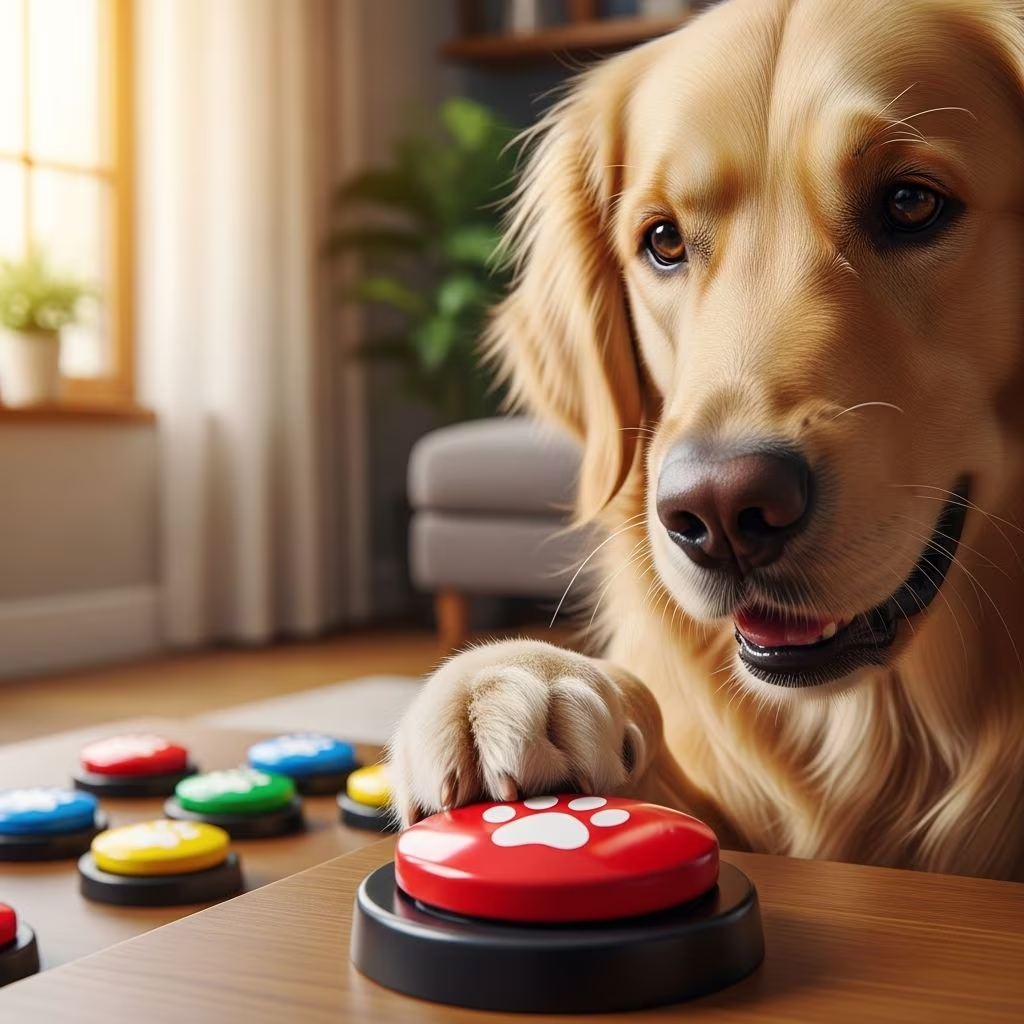
Videos of dogs “talking” with speech buttons have captured millions of views: a paw taps “outside”, then “play”, and suddenly it feels like we are chatting with another species. A new, large-scale scientific study now suggests that, at least for some dogs, these button presses are more than a cute trick — they can form meaningful, non-random combinations.
This article breaks down the new research on speech-button–using dogs, explains how the study worked, what the scientists really found, and what it does (and does not) mean for your dog’s ability to “talk.”
What Are Dog Speech Buttons and Soundboards?
Dog speech buttons are small devices that play a prerecorded word or short phrase when pressed. Many owners arrange multiple buttons on a mat or board — often called a soundboard — so that dogs can press different buttons to “say” words like “outside,” “play,” “food,” “water,” or “help.”
In technical terms, this setup is often described as a form of augmentative interspecies communication (AIC) — an adaptation of augmentative and alternative communication tools used in humans (for example, tablets that speak for nonverbal children) to support communication between species.
- Buttons = individual words or short phrases.
- Soundboard = the full collection of buttons laid out together.
- Goal = allow dogs to express needs, preferences, and possibly more complex ideas.
Companies such as FluentPet provide standardized button kits and a companion app that records each press, along with the time and context, creating valuable data for researchers.
The New Study on Dogs Combining Words
The study described in the original article was published in the journal Scientific Reports and conducted by researchers at the University of California San Diego’s Comparative Cognition Lab. They wanted to know whether dogs using speech buttons could:
- Combine more than one button in a single “utterance.”
- Use combinations in a way that was not random.
- Go beyond simply copying whatever buttons their humans were pressing.
How the Study Was Set Up
To investigate these questions, the researchers collected real-world data from households already training their dogs to use FluentPet soundboards.
- The research period lasted about 21 months.
- Data came from the FluentPet mobile app, where pet parents logged button presses.
- They included only dogs with at least 200 logged interactions, ending up with 152 dogs in the final analysis.
- In total, the team examined nearly 195,000 soundboard interactions produced by dogs.
They also had data on which buttons humans pressed on the boards. This allowed them to compare dog and human button use to test whether dogs were merely imitating their owners’ patterns.
Key Findings: Dogs Do Use Multi-Button “Phrases”
One of the most striking outcomes was that a substantial number of interactions involved more than one button.
- Almost 30% of all recorded interactions were multi-button sequences — more than one button pressed close together in time.
- These combinations often involved words related to needs or desires, like “outside,” “potty,” “food,” and “water.”
The researchers used statistical models and computer simulations to compare the observed patterns of button combinations with what would be expected by random chance. They found that:
- Certain two-word combinations happened significantly more often than chance would predict.
- Examples included combinations like “outside”+“potty” and “food”+“water.”
- These patterns suggest that many dogs were not just hitting random buttons but using specific pairings in meaningful contexts.
| Button 1 | Button 2 | Likely Meaning | Frequency Pattern |
|---|---|---|---|
| “outside” | “potty” | Request to go out to relieve themselves | More common than expected by chance |
| “food” | “water” | Request involving basic resources (meal, bowl refill) | More common than random sequences |
| “outside” | “play” | Desire to play outdoors | Representative of play-related combos |
According to the lead author, Amalia P. M. Bastos, the results indicate that owner-trained dogs were pressing buttons in a non-accidental and non-random way. That is a higher bar than merely “sometimes getting it right.”
Are Dogs Just Copying Their Humans?
One common criticism of social-media “talking dog” videos is that dogs might simply be mimicking their owners: pressing whichever buttons they have seen humans use most often. The researchers therefore compared the frequency of individual buttons used by people and by dogs within the same household.
They found that:
- Humans and dogs tended to favor different buttons.
- There was only a minimal association between the specific buttons people pressed and those that dogs pressed.
- For instance, owners often used socially expressive buttons like “I love you,” while dogs more frequently pressed practical, need-related buttons such as “outside” or “play.”
This pattern supports the idea that dogs were not simply copying their humans’ behavior. Instead, they tended to use buttons that aligned with their own priorities and needs, even when these differed from their owners’ favorite buttons.
Do Dogs Understand the Words on the Buttons?
Showing that dogs press buttons in non-random combinations is only part of the story. It is also important to know whether dogs actually understand the meaning of the spoken words produced by the buttons.
A separate experimental study, also involving the UC San Diego Comparative Cognition Lab, tested how dogs responded when humans pressed particular buttons on a soundboard. In controlled settings, researchers and pet parents pressed buttons corresponding to play, outside, or food-related words and observed dogs’ behavior immediately afterward.
- Across experiments, dogs showed play behaviors about seven times more often after hearing a “play” button than after hearing other buttons.
- Similarly, they showed more outside-related behaviors after hearing an “outside” button.
- These behaviors occurred regardless of whether the cue came from a human voice or from the soundboard button.
These findings suggest that many dogs do pay attention to the word labels on buttons and are not simply reacting to human body language or contextual clues. However:
- Dogs in the study did not reliably show more food-related behaviors after food cues in all conditions, indicating that understanding may vary by word type.
- Researchers emphasize that this is an early step and does not prove that dogs understand all button words as humans do.
How Far Does This Go? Limits and Open Questions
Even with promising results, scientists are careful not to overstate what has been shown. The current data support the idea that many soundboard-trained dogs:
- Use buttons in non-random ways.
- Produce meaningful two-word combinations more often than chance.
- Respond to certain button words (like “play” and “outside”) with appropriate behaviors.
But there are still significant open questions:
- Grammar vs. associations: Two-word sequences like “outside”+“potty” do not necessarily mean dogs grasp grammar; they may be combining two associated concepts in a learned pattern.
- Past and future events: It is not yet clear whether dogs can use buttons to refer to things absent in time, such as something that happened earlier in the day or a future walk.
- Creativity and recursion: Researchers wonder whether some dogs may eventually combine three or more concepts to create novel “sentences,” but this goes beyond current evidence.
Researchers also caution that the dogs in these studies come from highly motivated households, often with dedicated training and strong human–animal bonds. Their performance may not represent all dogs.
Why This Matters for Dog–Human Relationships
Despite the limitations, the findings provide exciting possibilities for everyday dog owners. As senior researcher Federico Rossano notes, soundboards may enable dogs to communicate their needs more precisely, which can strengthen the bond between pets and their people.
Potential benefits include:
- Clearer requests: Instead of scratching at the door, a dog might press “outside” or “outside”+“park.”
- Reduced frustration: Dogs that can signal specific needs (like “help” or “toy”) may experience less stress and show fewer problem behaviors.
- Enrichment and mental stimulation: Learning to use buttons requires attention and learning, which can provide cognitive exercise for many dogs.
At the same time, scientists studying the phenomenon emphasize that these tools do not replace traditional communication signals — body posture, facial expression, vocalizations, and routine training remain central to understanding and living with dogs.
Thinking of Trying Speech Buttons with Your Dog?
If you are curious about teaching your dog to use speech buttons, evidence-based practice and realistic expectations are key. Current studies suggest some dogs can learn and use soundboards in structured ways, but not every dog will become a social-media star or regularly produce multi-word combinations.
Practical Tips Inspired by the Research
- Start with core needs: Begin with a few high-value, concrete words like “outside,” “play,” “food,” or “water.” These were among the most commonly and meaningfully used buttons in the study.
- Be consistent: Always press the same button before the same event (for example, press “outside” every time you open the back door) so your dog can learn a stable association.
- Pair with normal cues: Say the word aloud as you press the button and provide the corresponding action as quickly as practical.
- Watch for patterns: Over time, look for non-random use — repeated sequences that fit the situation — as researchers did with combinations like “outside”+“potty.”
- Keep expectations reasonable: The current evidence supports intentional, meaningful use for some dogs, but does not show full human-like language.
Frequently Asked Questions (FAQs)
Q: Does this study prove that dogs have human-like language?
A: No. The study shows that many soundboard-trained dogs press certain buttons and two-button combinations more often than expected by chance and in ways that fit real-world contexts. This suggests intentional communication, but not full human-like language, grammar, or abstract reasoning.
Q: Are dogs just pressing buttons for treats?
A: Motivation for rewards definitely plays a role in training, but analyses of button-press patterns indicate that dogs produce specific word combinations linked to needs (like going outside or eliminating) more often than random behavior would predict. In controlled tests, they also respond appropriately to button words even when treats are not immediately visible.
Q: How many words can dogs learn on a soundboard?
A: The number varies widely. Some dogs in ongoing studies reportedly use dozens of buttons, while others mainly rely on a small core vocabulary. Systematic research is still underway to determine typical word counts and which types of words are easiest for dogs to learn.
Q: Can all dogs learn to use speech buttons?
A: There is no evidence that all dogs can or will use soundboards fluently. Success appears to depend on factors like training consistency, individual temperament, age, and the human–dog relationship. Even without buttons, dogs already communicate effectively through body language and conventional cues.
Q: Is this just an internet fad, or serious science?
A: Viral videos sparked public interest, but researchers have now published peer-reviewed studies using large datasets and controlled experiments. At the same time, scientists recognize that this is an early stage of research, with many questions still unresolved and some skepticism remaining in the academic community.
References
- Dogs use two-word button combos to communicate, study shows — Phys.org / University of California San Diego. 2024-12-03. https://phys.org/news/2024-12-dogs-word-button-combos-communicate.html
- Dogs Are Able to Combine Words Using Speech Buttons, New Study Finds — Kinship. 2024-12-04. https://www.kinship.com/dog-behavior/speech-buttons-study-dogs-can-combine-words
- How do soundboard-trained dogs respond to human button presses and speech? — PLOS ONE (Bastos APM et al.). 2024-08-14. https://journals.plos.org/plosone/article?id=10.1371/journal.pone.0307189
- Dogs Really Do Understand Speech Buttons, New Study Finds — Kinship. 2024-08-20. https://www.kinship.com/dog-behavior/dog-speech-buttons-news
- A new global study allows dogs to ‘talk’ to their owners by pressing buttons that say human words — The World / GBH. 2025-04-25. https://theworld.org/stories/2025/04/25/a-new-global-study-allows-dogs-to-talk-to-their-owners-by-pressing-buttons-that-say-human-words
- Talking Dogs: The Paradoxes Inherent in the Cultural Phenomenon of “Talking” Animals in Mass Media — Animals (MDPI). 2024-07-10. https://pmc.ncbi.nlm.nih.gov/articles/PMC11591343/
- New study suggests dogs can ‘talk’ to their owners, understand and combine concepts — NewsChannel9. 2024-12-05. https://newschannel9.com/news/offbeat/study-dogs-talk-owners-understand-talking-communicate-dog-pet-animals-pets-puppy-buttons-button-stella-tiktok-online-research-communication-science-research-scientists-researchers-discovery-discover



