

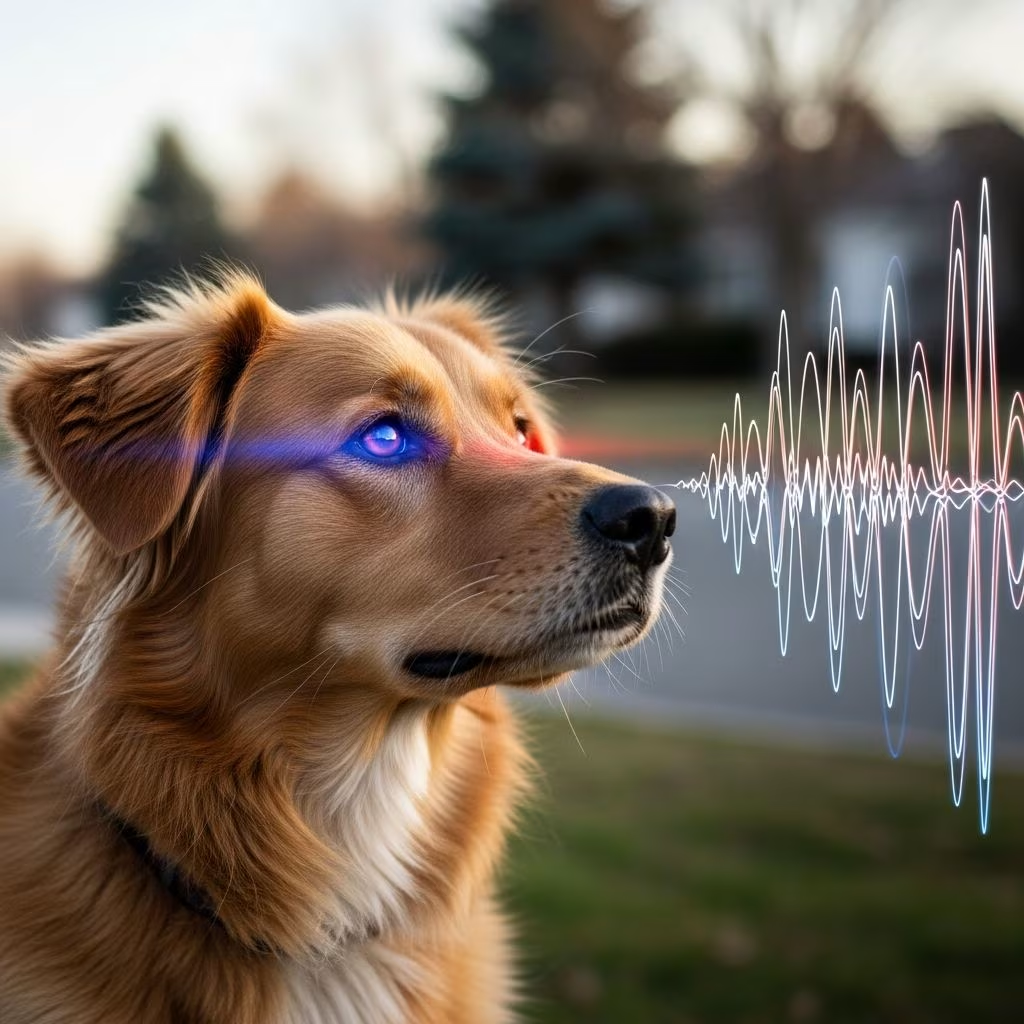
One of the most striking canine behaviors is the sudden, melodic howl that erupts when a siren wails in the distance. This piercing response has puzzled pet owners for generations, blending ancient instincts with modern urban sounds. Far from random noise-making, a dog’s howl at sirens often stems from deep evolutionary roots, acute hearing capabilities, and emotional expressions. Understanding this phenomenon not only deepens our bond with our furry companions but also helps address potential underlying issues like anxiety or discomfort.
The Evolutionary Echo: From Wolves to Domestic Dogs
Domestic dogs share a direct lineage with wolves, diverging over 15,000 years ago through domestication processes. Wolves employ howling as a vital long-distance communication tool, signaling location, rallying the pack, or defending territory across vast wilderness areas. This primal vocalization persists in modern dogs, manifesting in shorter, less resonant forms suited to smaller territories like backyards or homes.
Dr. Elliott Garber, a veterinarian, notes that while dogs no longer roam expansive wilds, the instinct to vocalize remains hardwired, triggered by sounds mimicking pack calls. Sirens, with their undulating pitches, closely resemble wolf howls, prompting dogs to ‘join the chorus’ instinctively. This isn’t mere mimicry; it’s a social bonding mechanism inherited from ancestors who used it to maintain group cohesion.
Sound Science: Why Sirens Specifically Trigger Howls
Dogs possess superior auditory senses compared to humans. They detect frequencies up to 45,000–67,000 Hz, far beyond the human limit of 20,000 Hz, and can hear sounds four times farther away. Their mobile ears act like radar dishes, pinpointing noises from all directions with precision.
Sirens produce high-pitched, wavering tones around 1,000–3,000 Hz, overlapping with a dog’s vocal range and howl frequencies. Scientific analysis reveals sirens were designed this way partly because their pitch echoes canine howls, making them effective alerts for both humans and animals. Dogs may interpret these as:
- Calls from distant pack members: Mistaking the siren for a lonely wolf or dog seeking connection.
- Territorial intrusions: Perceiving the sound as an invader challenging their domain, prompting a defensive response.
- High-pitch resonance: Simply reacting to the sustained, piercing quality that stimulates their inner ‘singer’.
This response reinforces itself: as the siren fades (often after passing), the dog assumes their howl ‘drove it away,’ perpetuating the habit.
Breed-Specific Tendencies: Who Howls Loudest?
Not all dogs react equally to sirens. Breeds with stronger wolf genetic ties or hunting histories are prime howlers. A study highlights ancient and hound breeds as most prone:
| Breed Category | Examples | Howling Likelihood | Reason |
|---|---|---|---|
| Northern/Sled Dogs | Siberian Husky, Alaskan Malamute | High | Close wolf ancestry; vocal pack communicators |
| Hunting Hounds | Beagle, Bloodhound, Coonhound | High | Baying instinct for scent tracking and pack alerts |
| Modern/Companion | Labrador, Pug | Low | Less primal vocal heritage; selective breeding for quietness |
Huskies and Malamutes, for instance, retain wolf-like vocal repertoires, while hounds ‘bay’—a prolonged howl variant used in hunts. Upbringing plays a role too: puppies observing howling in multi-dog homes often adopt it as adults.
Beyond Sirens: Broader Reasons for Canine Howling
Howling isn’t siren-exclusive. Dogs vocalize for diverse purposes:
- Emotional release: Expressing joy, stress, excitement, or frustration.
- Social signaling: ‘Contagious howling’ strengthens bonds in groups.
- Attention bids: Learned behavior if owners react positively (or negatively).
- Territorial claims: Marking space against perceived rivals.
- Distress signals: Separation anxiety, manifesting with other signs like pacing or appetite loss.
Context clues help differentiate: a relaxed, tail-wagging howler is likely just ‘singing along,’ while a tense, repetitive one may need intervention.
When Howling Signals Health Concerns
Occasional siren howls are benign, but persistent or sudden changes warrant vet attention. Howling can indicate:
- Pain or injury: Especially acute, sudden vocalizations.
- Cognitive issues: In seniors with canine cognitive dysfunction, causing disorientation.
- Noise sensitivity: Rare phobia if sirens exceed 100 dB sustained, though most howls show no distress (no shaking, hiding).
Observe body language: lip-licking, trembling, or avoidance suggests discomfort. Consult a vet to rule out medical causes before behavioral fixes.
Practical Solutions: Training a Quieter Companion
Managing siren-induced howls requires patience, avoiding punishment—which can foster fear. Effective strategies include:
- Desensitization: Play siren recordings at low volumes, rewarding calm with treats. Gradually increase volume.
- Quiet cue training: Teach ‘quiet’ command during howls, marking silence with high-value rewards.
- Distraction tactics: Engage with toys or commands when sirens approach.
- Environmental aids: White noise machines or calming music to mask sirens.
- Professional help: Behaviorists for anxiety-linked howling.
Consistency yields results; many dogs learn sirens aren’t threats over time.
FAQs: Common Questions on Dog Howling
Is it painful for dogs to hear sirens?
No, sirens rarely cause pain unless excessively loud and prolonged. Howling typically reflects instinct, not distress, absent stress signs.
Why does my dog howl at some sirens but not others?
Variations in pitch, volume, or distance influence reactions. Familiarity also desensitizes over repeated exposures.
Can I stop my dog from howling completely?
Complete suppression is tough due to instincts, but training reduces frequency significantly.
Do all breeds howl at sirens?
No, primitive and hound breeds do most; others may bark or ignore.
Should I ignore howling or respond?
Avoid reinforcing with attention; use positive quiet training instead.
Enhancing Canine-Human Harmony
Grasping why dogs howl at sirens bridges the communication gap between species. This vocal display, rooted in wolf heritage and amplified by acute hearing, serves as a window into their world. By observing context, respecting instincts, and applying targeted training, owners foster calmer environments. Whether it’s a joyful duet or a call for help, responding thoughtfully strengthens the unbreakable pet-owner bond.
References
- 10 Reasons Why Dogs Howl, Especially At Sirens — Rover.com. 2023. https://www.rover.com/blog/why-do-dogs-howl/
- Why Do Dogs Howl at Sirens? — PetMD. 2024-01-15. https://www.petmd.com/dog/behavior/why-do-dogs-howl-at-sirens
- Watch: Why do dogs howl at sirens? — Science.org (AAAS). 2018-10-10. https://www.science.org/content/article/watch-why-do-dogs-howl-sirens
- Why Do Dogs Howl? — American Kennel Club (AKC). 2023-05-20. https://www.akc.org/expert-advice/advice/why-do-dogs-howl/
- Ask Smithsonian: Why Does My Dog Howl at Sirens? — Smithsonian Magazine. 2019. https://www.smithsonianmag.com/videos/ask-smithsonian-why-does-my-dog-howl-at-siren/



