

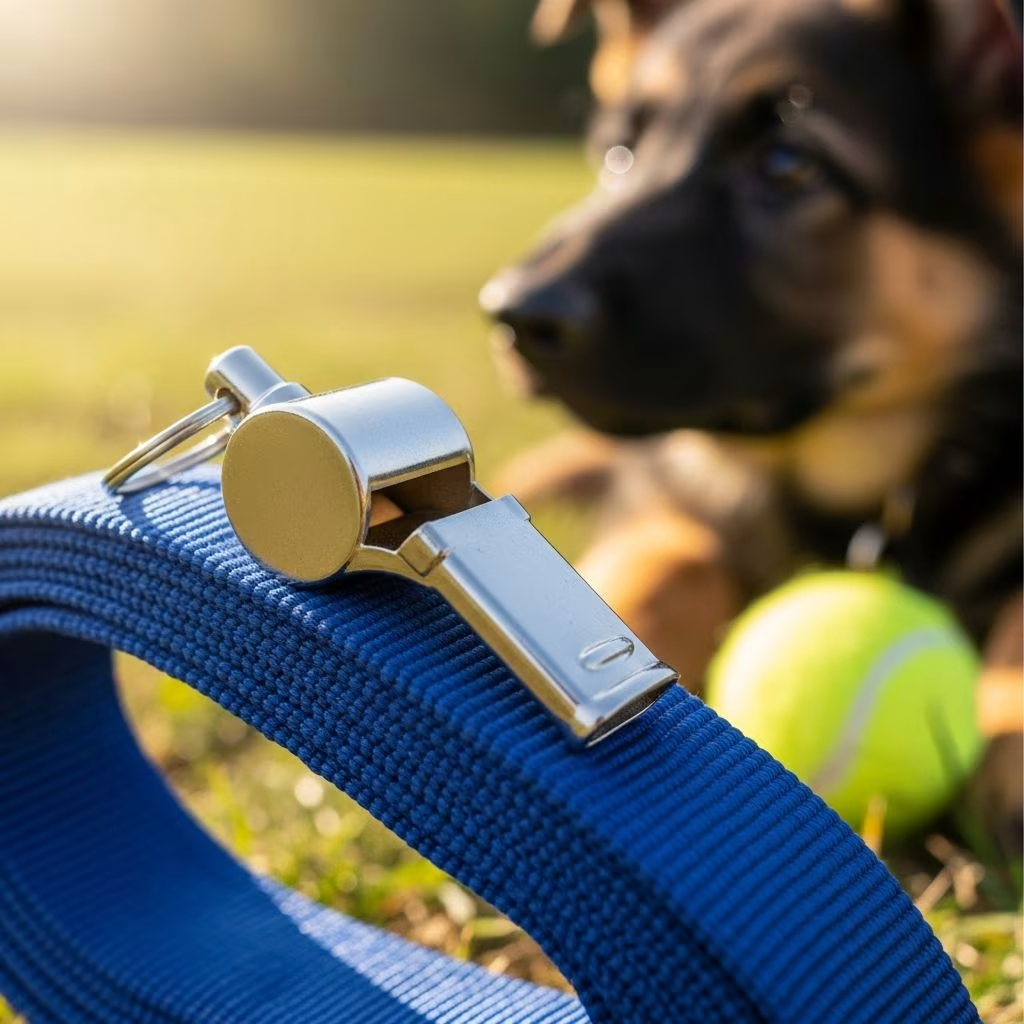
Dog whistles emit high-frequency sounds inaudible to most humans but detectable by dogs, making them powerful tools for training recall, controlling barking, and reinforcing commands at a distance.
The Science Behind Canine Hearing and Whistles
Dogs possess superior hearing compared to humans, capable of detecting sounds up to 65,000 Hz, while human hearing tops out around 20,000 Hz. This auditory advantage allows dog whistles, typically tuned between 23,000 and 54,000 Hz, to communicate signals without disturbing people nearby.
Higher pitches grab attention quickly by piercing through environmental noise, ideal for redirecting focus during distractions. Breeds vary in sensitivity; herding dogs like Border Collies often respond sharply due to selective breeding for sound cues in fieldwork.
- Frequency Range: Adjustable models let owners match their dog’s preferences.
- Breed Differences: Hunting breeds excel with sharp tones; smaller dogs may favor milder pitches.
- Age Factors: Puppies adapt faster, but older dogs with hearing decline might need lower frequencies.
Key Benefits of Incorporating Whistles in Training
Whistles outperform voice commands in reliability across distances and weather, maintaining consistent tone unlike varying human voices. They excel in noisy settings or when verbal cues have been “poisoned” by past negative associations.
| Benefit | Description | Best Use Case |
|---|---|---|
| Distance Control | Signals carry over 100 feet without fading | Outdoor recall, hunting |
| Weather Resistance | Unaffected by wind or rain | Field training |
| Family Consistency | Everyone uses the same sound | Multi-person households |
| Hearing-Impaired Dogs | High pitch penetrates mild losses | Senior pets |
Customizable patterns create a private “language,” pairing short peeps for “come” and long blasts for “stay,” fostering precise obedience.
Types of Dog Whistles Available Today
Selecting the right whistle depends on training goals and environment. Traditional metal versions produce audible tones for humans but cut through wind effectively.
- Metal Whistles: Durable for outdoors, multi-tone options for commands.
- Plastic/Traditional Silent: Pea-less designs reduce choking risk, consistent sound.
- Ultrasonic Electronic: Remote-controlled with adjustable frequencies and volumes for multiple dogs.
Electronic collars with whistle apps offer versatility but require batteries; prioritize models certified safe by veterinary standards to avoid discomfort.
Mastering Recall Training with a Whistle
Recall is a cornerstone of safety, and whistles shine here by serving as a neutral, attention-grabbing cue superior to voices in distraction-heavy scenarios.
- Condition the Sound: Blow gently during high-value moments like mealtimes to link it with positivity.
- Pair with Rewards: Whistle, then call and treat lavishly when they approach.
- Practice Progressively: Start indoors, advance to gardens, then fields with distractions.
- Phase Verbal Cues: Whistle precedes “come,” eventually standalone.
- Maintain Randomness: Vary rewards to prevent predictability.
For “stay-at-distance,” a specific trill signals freezing in place, invaluable for sports or hunting. Expert trainers report near-perfect recall after 2-4 weeks of daily 10-minute sessions.
Using Whistles to Manage Excessive Barking
While not a magic bark-stopper, whistles interrupt patterns by capturing focus, but only with proper conditioning. Dogs acclimate quickly without follow-up training.
Step-by-Step Bark Control:
- Blow a sharp burst to redirect attention.
- Immediately issue “quiet” and reward silence.
- Repeat consistently, avoiding overuse to prevent desensitization.
Combine with environmental management; effectiveness hinges on positive reinforcement, not punishment. Studies show 70-80% reduction in nuisance barking after 3 weeks when paired with treats.
Pros and Cons: Realistic Expectations
| Pros | Cons |
|---|---|
| Long-range reliability | Requires constant carrying |
| Consistent across users | Individual dog variability |
| Non-verbal cue recovery | Risk of fear/pain if misused |
| Discreet in public | Training time investment |
Whistles complement clickers or treats but aren’t standalone; clickers edge out for beginners due to lower adverse reaction risk.
Safety Guidelines and When to Avoid Whistles
Correct use ensures safety; excessive volume or pitch can cause anxiety or pain. Never use near other animals, infants, or hearing-sensitive individuals.
- Start low-volume, observe reactions.
- Avoid in confined spaces with multiple pets.
- Consult vets for anxious or hearing-impaired dogs.
Discontinue if fear signs appear (cowering, fleeing); opt for gentler methods.
Integrating Whistles into Broader Training Programs
Layer whistles atop obedience foundations: teach basics verbally first, then transition for distance. Multi-cue systems (whistle + hand signal) boost reliability by 50% in field tests.
For advanced users, encode commands: two short peeps for “sit,” trill for “down.” Track progress in a journal to refine patterns.
Frequently Asked Questions
Do all dogs respond to whistles equally?
No, responses vary by breed, age, and temperament. Hunting breeds often excel, but test individually.
Can whistles replace verbal commands?
They enhance, not replace; train as adjunct cues for reliability.
How long until results show?
1-4 weeks with daily practice; consistency is vital.
Are electronic whistles better?
They offer adjustability but traditional suffice for most; choose based on needs.
Will it hurt my dog’s ears?
Proper models don’t; monitor and adjust.
Final Tips for Whistle Success
Commit to short, fun sessions; patience yields expert-level control. Pair with professional classes for best outcomes, transforming chaotic walks into harmonious adventures.
References
- Do Dog Whistles Stop Barking? Understanding Their Effectiveness in Training — Houndsy. 2023. https://www.houndsy.com/blogs/modern-tails/do-dog-whistles-stop-barking-understanding-their-effectiveness-in-training
- Pros and Cons of Dog Whistle Training — Puptown Houston. 2023. https://puptownhouston.com/collegestation/pros-cons-dog-whistle-training/
- Dog Whistles for Training: How and When to Use Them — American Kennel Club (AKC). 2024-02-17. https://www.akc.org/expert-advice/training/dog-whistles-for-training/
- Prioritising Safety: Knowing When Not to Use a Dog Whistle — Acme Whistles. 2023. https://www.acmewhistles.co.uk/stories/prioritising-safety-knowing-when-not-to-use-a-dog-whistle
- Is it Worth Whistle Training Your Dog? — K9 Training Institute. 2024. https://k9ti.org/blog/is-it-worth-whistle-training-your-dog/
- How to train a dog with a whistle to get perfect recall every time — Country Life. 2023. https://www.countrylife.co.uk/out-and-about/dogs/how-to-train-a-dog-with-a-whistle-to-get-perfect-recall-every-time-by-expert-trainer-ben-randall-254524



