

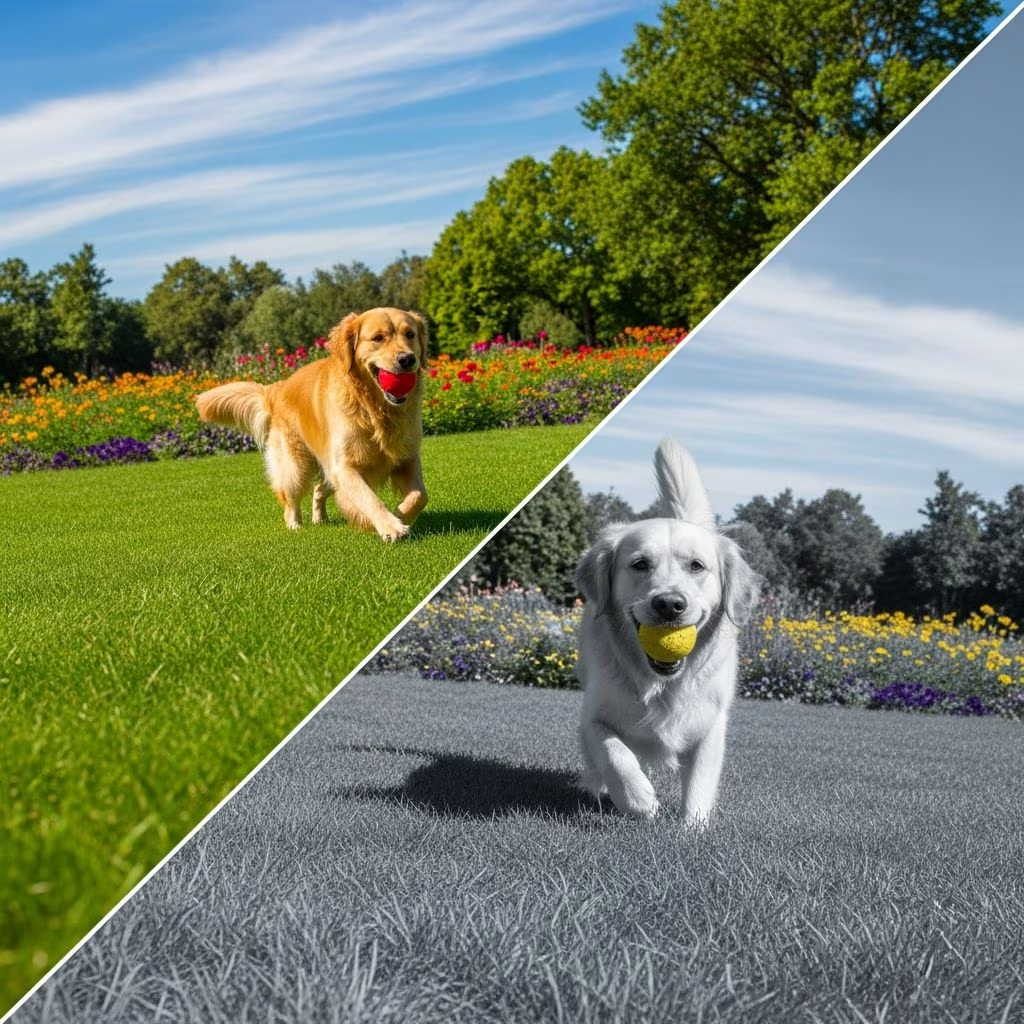
Dogs experience the world through a unique visual lens that differs significantly from human sight. While humans enjoy sharp, colorful vision, dogs prioritize motion detection, low-light performance, and wide peripheral fields suited to their predatory ancestry. This guide breaks down canine eyesight, addressing color perception, visual acuity, night vision, breed variations, health concerns, and behavioral cues.
What does a dog’s vision look like?
Dog vision fundamentally differs from human vision due to variations in retinal cells. Humans possess trichromatic vision with three types of cones enabling perception of red, green, blue, and their combinations. Dogs, however, are dichromatic, featuring only two cone types sensitive to blue and yellow wavelengths. This limitation causes dogs to confuse reds and greens, perceiving them as shades of yellow or gray.
Dr. Crystal Eng, a veterinary ophthalmologist, explains: “Vision in humans and animals is made up of a variety of rods and cones. In humans, we are trichromatic… while dogs are dichromatic.” Dogs compensate with superior rod cell density for enhanced low-light sensitivity and motion detection. Their retinas include a tapetum lucidum—a reflective layer absent in humans—that bounces light back through photoreceptors, amplifying night vision.
Visual simulations often depict dog sight as a muted, blue-yellow palette with reduced sharpness. Dogs excel at detecting movement across broad fields but struggle with fine details, aligning with their evolutionary role as hunters relying more on scent and sound.
Can dogs see color?
The myth that dogs see only in black, white, and gray persists despite evidence to the contrary. Dogs perceive colors but within a restricted spectrum. Their two cone types detect short (blue-violet) and medium (green-yellow) wavelengths, rendering reds indistinguishable from greens—both appear as muddy yellows or browns.
Research confirms dogs distinguish blue from yellow effectively but falter on red-green differences. This dichromatic setup provides adequate environmental cues without the full vibrancy humans enjoy. For pet parents, this means toys in blue or yellow hues are more visible to dogs than red ones, aiding play and training.
- Blue: Clearly visible and distinct.
- Yellow: Well-perceived, often vibrant.
- Red/Green: Confused as yellow/gray tones.
- White/Black: Detected like humans, aiding contrast.
How far can dogs see?
Dogs possess lower visual acuity than humans. Standard human vision measures 20/20, meaning clear detail at 20 feet. Dogs average 20/75 acuity, requiring closer proximity—20 feet versus a human’s 75 feet—to discern the same object.
This blurrier central vision suits dogs’ needs, as they detect prey via motion rather than precise shapes. Near vision proves particularly weak in long-nosed breeds (e.g., Collies, Hounds), with optimal focus starting 10-15 meters away.
Dog peripheral vision
Dogs’ forward-facing yet laterally positioned eyes grant a 240-250 degree visual field, surpassing humans’ 180-200 degrees. This wide panorama enhances threat detection but sacrifices binocular overlap, reducing depth perception to about 30-60 degrees versus humans’ 120 degrees.
Brachycephalic breeds (e.g., Pugs, Bulldogs) enjoy even broader fields without muzzle obstruction, while sighthounds like Greyhounds balance acuity with width.
Can dogs see in the dark?
Dogs outperform humans in low light thanks to multiple adaptations. Larger pupils dilate fully, admitting more light. Rod-rich retinas (~10x human density) excel at dim conditions, and the tapetum lucidum reflects photons for double exposure.
Dogs navigate twilight (dawn/dusk) effortlessly—prime hunting hours—seeing 3-4x better than humans in near-darkness. Complete pitch-black remains challenging without light, relying then on other senses. This explains dogs’ eerie glow in headlights from tapetal reflection.
How does dog vision differ from human vision?
Key contrasts include:
| Aspect | Dogs | Humans |
|---|---|---|
| Color Cones | 2 (Blue/Yellow) | 3 (RGB) |
| Visual Acuity | 20/75 average | 20/20 |
| Low-Light Vision | Superior (rods + tapetum) | Inferior |
| Peripheral Field | 240°+ | 180-200° |
| Motion Detection | Exceptional | Good |
| Depth Perception | Reduced | Strong |
Dogs prioritize survival-oriented vision: tracking, scanning horizons, low-light pursuits. Humans favor detail and color for complex tasks.
Does vision change across different dog breeds?
Eye anatomy varies by breed, influencing sight. Long-muzzled breeds (e.g., German Shepherds) feature visual streaks—horizontal rod bands—for panoramic horizon views, ideal for herding/guarding. Brachycephalics gain unobstructed fields but risk eye exposure issues.
Sighthounds (e.g., Salukis) boast higher acuity for distant prey. Overall, rod dominance persists across breeds, with positioning dictating field width and depth trade-offs.
Common eye conditions in dogs
Dogs face vision-threatening disorders:
- Cataracts: Lens clouding, leading blindness cause. Inherited in breeds like Labrador Retrievers, Poodles. Surgical removal restores sight.
- Glaucoma: Pressure buildup damages optic nerve. Primary in Cocker Spaniels, Basset Hounds; acute pain requires immediate vet care.
- Dry Eye (KCS): Tear deficiency causes inflammation. Treated with cyclosporine drops.
- Progressive Retinal Atrophy (PRA): Genetic retina degeneration to blindness.
- SARDS: Sudden retinal failure, cause unknown.
Diabetes accelerates cataracts. Early vet exams prevent irreversible loss.
How does age affect my dog’s eyesight?
Aging mirrors human changes: nuclear sclerosis clouds lenses painlessly, unlike cataracts. Reduced pupil response dims vision; antioxidants support retinal health. Senior dogs bump objects or hesitate on stairs—prompt vet checks rule out pathology.
Dog eye communication
Eyes convey emotions: direct gaze signals confidence/dominance; averted eyes show submission/fear. Whale eye (sclera whites visible sideways) indicates stress/anxiety. “Dogs use their vision… to understand what other dogs are communicating,” notes Dr. Eng. Tail wags, ear positions complement visual signals in pack dynamics.
Pet parents reading these cues strengthen bonds, averting conflicts.
Frequently Asked Questions (FAQs)
Can dogs see in complete darkness?
No, but far better than humans in low light via rods, pupils, tapetum. Total dark requires other senses.
Is dog eyesight better than human eyesight?
Not overall—poorer acuity but superior dim-light, peripheral, motion detection.
How can I tell if my dog has poor eyesight?
Signs: bumping furniture, hesitant navigation, dilated pupils, cloudy eyes, reluctance to jumps.
What colors are best for dog toys?
Blue, yellow—avoid red, which blends into green backgrounds.
Do all dogs have a tapetum lucidum?
Yes, enhancing night vision across breeds.
References
- What Do Dogs (Canis familiaris) See? A Review of Vision in Dogs and Implications for Cognition Research — Journal of Veterinary Behavior. 2019-05-01. https://www.sciencedirect.com/science/article/pii/S1558787818303493
- Eye Contact Is Crucial for Referential Communication in Pet Dogs — Current Biology. 2015-12-01. https://doi.org/10.1016/j.cub.2015.11.006
- Vision in Dogs — Journal of the American Veterinary Medical Association (via Kinship resources). 2022-01-15. https://www.kinship.com/dog-health/dog-vision
- Canine Retinal Structure and Function — Veterinary Ophthalmology. 2020-08-20. https://onlinelibrary.wiley.com/doi/full/10.1111/vop.12789
- Comparative Visual Acuity in Canines — American College of Veterinary Ophthalmologists. 2023-03-10. https://www.acvo.org



