

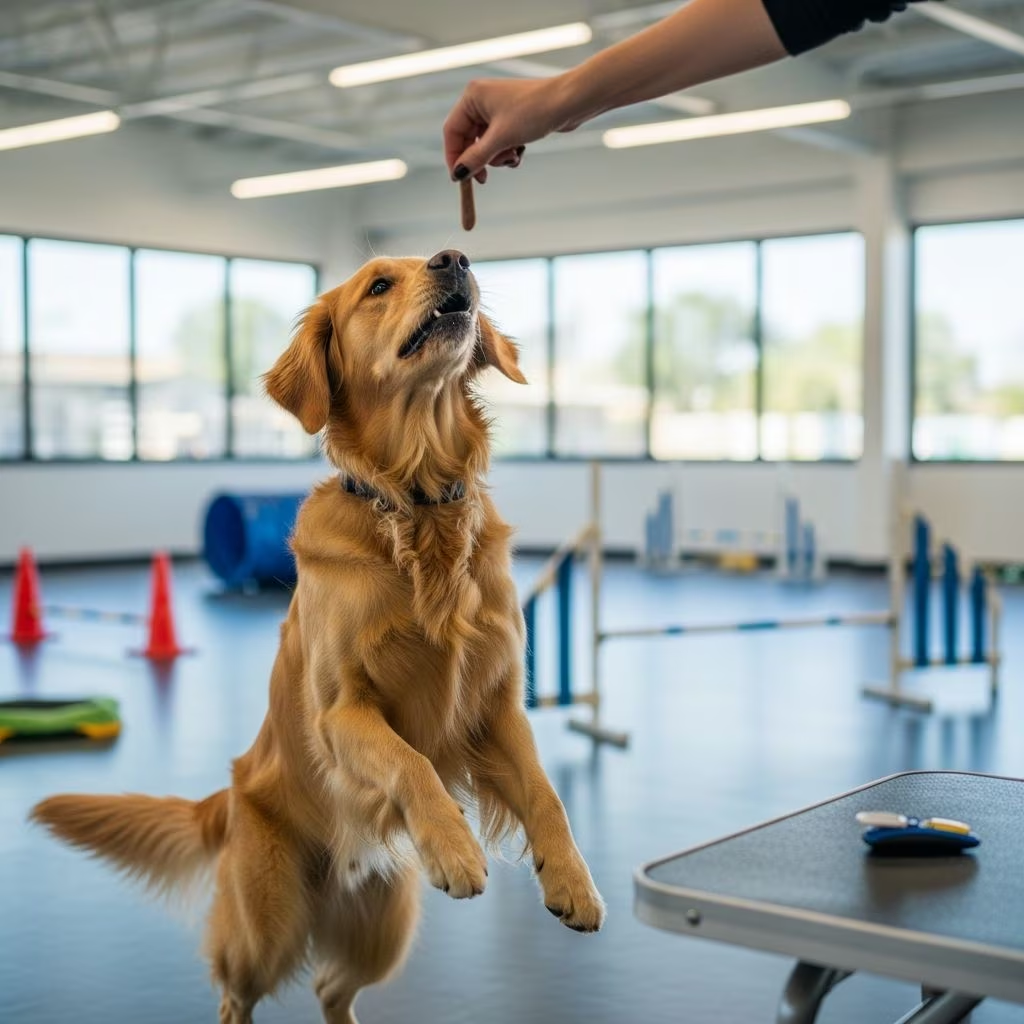
The practice of training dogs has undergone a profound transformation over centuries, evolving from coercive and fear-based methods rooted in military traditions to contemporary, welfare-focused strategies that prioritize mutual understanding and joy. This shift reflects broader advancements in behavioral science, particularly the principles of operant conditioning introduced by B.F. Skinner in 1937, which emphasize rewarding desired behaviors rather than punishing undesired ones. Today, dog owners benefit from techniques that foster trust, reduce stress, and produce reliable results without harm.
Ancient Foundations: Training in Early Civilizations
Dog training traces its origins to ancient times when humans domesticated canines for practical roles such as hunting, herding, and guarding. Records from around 420 BC, including writings by Athenian author Xenophon, describe early systematic approaches to canine instruction, focusing on consistency and fairness in handling working dogs. These methods laid the groundwork for human-dog partnerships but often relied on physical corrections to enforce compliance, mirroring the societal norms of authority and hierarchy prevalent in those eras.
In medieval periods, such as the 13th century, scholars like Albertus Magnus documented training guides that integrated observation of natural dog behaviors with task-specific drills. Dogs were essential for survival tasks, and training emphasized utility over companionship, with rudimentary tools like leashes and verbal cues emerging as standards. However, without scientific insight into learning processes, these early efforts frequently incorporated intimidation to suppress unwanted actions, setting a precedent for dominance-oriented philosophies that persisted for millennia.
The Dominance Era: Military Influence and Harsh Corrections
By the early 20th century, dog training was heavily shaped by military applications, particularly during and after World Wars I and II. Trainers adopted rigorous, punishment-heavy tactics—such as leash jerks, physical pinning, and even strikes—to instill obedience, viewing dogs through a lens of pack hierarchy where humans assumed an alpha role. This dominance theory posited that dogs required ‘breaking’ their will to ensure loyalty, a notion popularized in training manuals of the time.
In the mid-20th century, figures like William Koehler exemplified this approach. His 1962 book, The Koehler Method of Dog Training, advocated long lines, absence of verbal praise, and severe corrections including throw chains and electric shocks, criticizing food-based rewards as ineffective. Koehler’s methods gained widespread acceptance for producing disciplined working dogs but often at the cost of fear and resentment, leading to unpredictable long-term behavior. Negative reinforcement dominated, where relief from discomfort (e.g., pressure release after compliance) was the primary motivator, alongside positive punishment like collar corrections.
| Era | Key Methods | Tools/Techniques | Outcomes |
|---|---|---|---|
| Early 20th Century | Dominance-based | Leash jerks, pinning, hitting | Short-term compliance, high stress |
| 1960s | Koehler Method | Long lines, throw chains, shocks | Disciplined but fearful dogs |
The Scientific Revolution: Operant Conditioning Emerges
A pivotal change occurred in 1937 when psychologist B.F. Skinner formalized operant conditioning, explaining how behaviors are shaped by consequences: reinforcements increase likelihood, while punishments decrease it. This framework categorized training into four quadrants:
- Positive Reinforcement: Adding a desirable stimulus (e.g., treats for sitting) to encourage repetition.
- Negative Reinforcement: Removing an aversive stimulus (e.g., easing leash pressure when walking nicely) to promote behavior.
- Positive Punishment: Introducing an unpleasant stimulus (e.g., jerks) to deter actions—now largely discouraged.
- Negative Punishment: Withholding a desirable stimulus (e.g., ending play for jumping)—used sparingly in modern practice.
Post-WWII, Skinner’s students Keller and Marian Breland advanced these ideas through Animal Behaviour Enterprises, founded in 1947. They trained diverse animals using rewards, promoting humane alternatives worldwide and pioneering clicker training in the 1940s—a marker sound paired with rewards for precise timing. This marked the decline of force, emphasizing education over intimidation.
1980s Paradigm Shift: Positive Reinforcement Takes Center Stage
The 1980s heralded a renaissance in dog training, driven by renewed interest in operant conditioning. Marine biologist Karen Pryor popularized positive methods with her influential book Don’t Shoot the Dog, adapting principles from marine mammal training to canines. Simultaneously, veterinarian Ian Dunbar introduced puppy socialization classes and the Sirius Dog Training program, advocating early intervention with lure-reward techniques over corrections.
These innovators challenged dominance myths, backed by emerging research showing that punishment erodes trust and increases aggression risks. By the decade’s end, force-free training gained traction, with trainers like Milo Pearsall (1958) hinting at gentler shifts, though still mixed with leash snaps. The focus pivoted to building behaviors proactively, using food, toys, and praise as bridges to verbal cues.
Modern Innovations: Technology and Personalization
Entering the 21st century, dog training integrates digital tools and data-driven insights. Software platforms employ AI to track progress, analyze patterns, and customize plans, enhancing traditional methods. Clickers, apps for session timing, and remote cameras enable precise, consistent reinforcement, even for busy owners.
Contemporary best practices prioritize welfare: starting training in puppyhood, addressing breed-specific needs, and incorporating play. Studies affirm positive methods yield faster learning and better retention, with reduced cortisol levels in dogs. Hybrid approaches blend quadrants thoughtfully, favoring reinforcement (80-90% of interactions) while minimizing punishment.
Today’s Training Toolkit
- Clickers for instant feedback.
- High-value treats/toys for motivation.
- Apps for progress logging and virtual coaching.
- Long-line drills for safe recall practice.
Practical Applications: Training Tips for Everyday Owners
To apply this evolution, begin with foundational skills like sit, stay, and loose-leash walking using positive reinforcement. For sit: hold a treat above the nose, lure upward as hips drop, then mark (click/treat) immediately. Fade the lure over sessions for cue reliability.
Addressing common issues like jumping or pulling requires patience:
- Jumping: Turn away, reward four-paw grounding.
- Leash Pulling: Stop motion until slack returns (negative reinforcement).
- Recall: High-reward games in low-distraction areas, gradually increasing challenges.
Consistency across household members prevents confusion, and short, frequent sessions (5-10 minutes) align with dogs’ attention spans. Professional help from certified trainers (e.g., CPDT-KA) ensures evidence-based guidance.
Benefits of Modern Methods: Healthier, Happier Dogs
Switching to positive training not only accelerates learning but enhances welfare. Research links aversive methods to heightened anxiety and bite risks, whereas reward-based approaches boost confidence and bond strength. Owners report fewer behavioral relapses, with dogs generalizing skills across contexts effectively.
For working roles—therapy, service, agility—modern techniques excel, producing focused yet enthusiastic performers. The evolution underscores a key truth: effective training mirrors effective parenting—rooted in positivity, clarity, and respect.
Frequently Asked Questions (FAQs)
What is the most effective dog training method today?
Positive reinforcement, based on operant conditioning, is scientifically proven most effective for long-term results and welfare.
Can old dogs learn new tricks with modern methods?
Yes, neuroplasticity allows lifelong learning; patience and high motivation yield success at any age.
Why avoid punishment in training?
Punishment suppresses behavior temporarily but risks fear, aggression, and fallout like avoidance.
How long does it take to see results?
Basic cues: 1-2 weeks with daily practice; complex behaviors: 4-8 weeks, varying by dog and consistency.
Is professional training necessary?
Not always for basics, but experts accelerate progress and resolve stubborn issues safely.
This evolution from coercion to collaboration has redefined dog ownership, creating partnerships where dogs thrive as willing learners rather than subdued subordinates.
References
- Evolution of dog training methods — Animal Wellness Magazine. 2023. https://animalwellnessmagazine.com/evolution-of-dog-training-methods/
- The Evolution of Dog Training: From Traditional to Software-Based — Doxford.net. 2023. https://doxford.net/blog/evolution-of-dog-training
- Dog training — Wikipedia. 2024-03-01. https://en.wikipedia.org/wiki/Dog_training
- A Short History of Dog Training — Help Animals UK. 2023. https://www.helpanimals.co.uk/post/a-short-history-of-dog-training
- Dog Training | History | Research Starters — EBSCO. 2024. https://www.ebsco.com/research-starters/history/dog-training
- The Evolution of Modern-Day Dog Training & Obedience — NAIAOnline.org. 2023. https://www.naiaonline.org/articles/article/the-evolution-of-modern-day-dog-training
- A Personal History of Dog Training — IAABC Foundation Journal. 2023. https://journal.iaabcfoundation.org/a-history-of-dog-training/



