

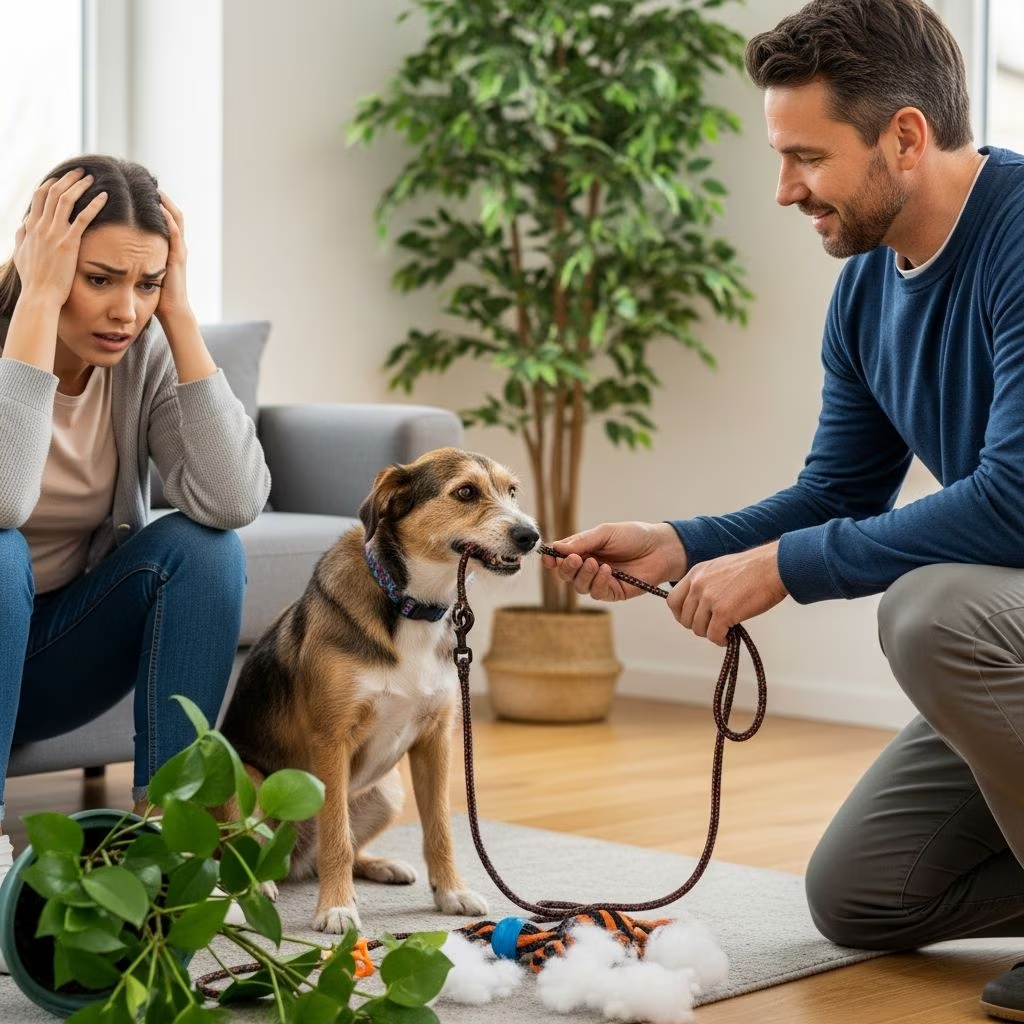
Training a dog involves more than simply teaching commands; it requires understanding canine psychology, maintaining patience, and employing evidence-based techniques that foster trust between you and your pet. Many dog owners encounter similar obstacles during the training process, from maintaining consistency to selecting appropriate rewards. This comprehensive guide explores the most prevalent training challenges and provides practical solutions based on expert recommendations.
The Foundation: Understanding Why Consistency Matters
One of the most significant hurdles dog owners face is maintaining consistent behavior expectations and responses. Dogs thrive on predictability, and when their handlers send mixed signals, the training process becomes unnecessarily prolonged and confusing. Consistency applies to both your reactions to behavior and the way you communicate commands.
When you react differently to the same behavior on different occasions, you inadvertently teach your dog that rules are flexible. For example, allowing your dog to jump on you while wearing casual clothes but discouraging it in work attire sends conflicting messages. Your dog cannot distinguish between these contexts and interprets your shifting reactions as unpredictability rather than contextual differences.
Professional trainers emphasize that consistency extends beyond your personal responses. Every person who interacts with your dog during training must understand and apply the same rules, commands, and reward systems. When family members enforce different standards, training progress stalls significantly.
Developing Clear Communication Protocols
Dogs need clear, unambiguous cues to learn effectively. Each behavior should have a single, unique command rather than multiple words that mean the same action. If you use “down” to mean both “lie down” and “get off the couch,” your dog receives contradictory instructions.
Communication goes beyond verbal commands. The tone of voice, body language, and hand signals all contribute to how your dog interprets instructions. Speaking calmly but confidently helps your dog understand that you expect compliance without anxiety or tension. Consider these communication elements:
- Use the same verbal cue each time
- Maintain consistent vocal tone and volume
- Employ identical hand signals and gestures
- Ensure all family members use the same signals
- Deliver commands with clear intention
Establishing a household training protocol where everyone agrees on terminology and signals prevents confusion and accelerates learning. This unified approach creates an environment where your dog can confidently predict what different commands mean and what behaviors produce positive outcomes.
Selecting Appropriate Rewards and Motivation
Dogs do not work for free, and understanding what genuinely motivates your individual pet is essential for successful training. While commercial dog treats serve as common reward tools, they do not work uniformly across all dogs or maintain effectiveness indefinitely.
Dogs lose interest in rewards when they become predictable or lose novelty. If you use the same treat for every training session, your dog’s attention and focus may gradually diminish as the reward loses its appeal. Successful trainers rotate between different treat flavors, textures, and nutritional compositions to maintain motivation.
Effective reward systems consider individual preferences. Some dogs respond enthusiastically to specific treats, while others prioritize toys, playtime, or verbal praise. Identifying what truly excites your dog enables you to create a reward hierarchy—using higher-value rewards for difficult behaviors and lower-value rewards for well-established commands.
Strategic reward implementation teaches dogs that good behavior directly leads to positive outcomes. Rather than rewarding randomly, link rewards immediately to the desired behavior so your dog makes the connection between action and consequence.
Creating an Optimal Training Environment
The setting where you conduct training significantly influences your dog’s ability to concentrate and learn. Environmental distractions compete for your dog’s attention and impede learning progress.
Begin all training in a quiet, calm, distraction-free space. This allows your dog to focus entirely on understanding the command and executing the behavior. Once your dog masters basics in a controlled environment, gradually introduce minor distractions like toys or other pets, progressively building toward more complex scenarios.
Training progression follows this sequence:
- Quiet, controlled indoor space
- Same space with minor environmental distractions
- Outdoor spaces like yards or driveways
- Semi-public environments with moderate activity
- Public spaces requiring full environmental generalization
This gradual exposure strengthens your dog’s ability to obey commands despite distractions, preparing them for real-world scenarios where they need to respond reliably regardless of their surroundings.
Recognizing and Responding to Canine Communication
Training represents a two-way conversation where you must actively listen to your dog’s signals. Dogs communicate through body language—ear position, tail movement, facial expressions, posture, and vocalizations all convey their mental and emotional state.
Learning to interpret these signals prevents you from pushing your dog beyond their current capacity. Signs of stress or disengagement include excessive blinking, yawning, looking away, and tension in facial muscles. When you observe these indicators, pause training and revisit it later rather than forcing continued practice.
Dogs also lose focus when tired, hungry, or overstimulated. Attempting to train a fatigued or distracted dog impedes learning and potentially creates negative associations with training itself. Professional trainers recommend training 1-2 times weekly with 1-2 sessions each, allowing adequate recovery time between sessions.
Practical Training Schedule and Duration
Research on optimal training frequency demonstrates that dogs trained 1-2 times per week with multiple short sessions show the greatest success rates. This schedule allows your dog to consolidate learning while remaining engaged and enthusiastic.
Most dogs require approximately 5-10 weeks to develop solid foundational obedience, though this varies based on individual learning pace, age, breed, and prior experience. Short, focused sessions prove more effective than extended training periods that exhaust your dog’s mental resources.
Think of training as an engaging movie—fast-paced, interesting, and easy to follow. Maintain your dog’s interest through varied exercises, appropriate pacing, and clear communication. Being fully present with your dog rather than distracted by external factors demonstrates respect for the training process and keeps your dog engaged.
Positive Reinforcement: The Modern Training Standard
Positive reinforcement-based training represents the contemporary gold standard for canine education. This approach rewards desired behaviors while avoiding punishment-based methods that can create fear, anxiety, and aggression.
Research demonstrates that positive reinforcement achieves comparable or superior results compared to punitive techniques. Beyond effectiveness, this method strengthens the human-animal bond, creates a trusting relationship, and prevents the psychological damage associated with fear-based training.
Trainers who rely on harsh techniques may appear to achieve rapid results, but these methods often produce underlying behavioral problems, stress, and anxiety that manifest over time. Positive reinforcement builds a foundation of trust where your dog willingly complies with commands because they anticipate positive outcomes.
Building a Foundation: Essential First Commands
Dogs benefit from learning basic commands in a logical progression that builds confidence and foundational skills. Experts typically recommend starting with “sit,” as this straightforward command establishes the concept of following cues and receiving rewards.
From sit, training typically progresses to:
- Down: Builds on sit and introduces laying postures
- Stay: Develops impulse control and duration
- Come: Establishes reliable recall in various situations
- Leave it: Creates safety by preventing ingestion of inappropriate items
- Drop it: Teaches your dog to release items on command
- Place: Designates specific resting areas
- Touch: Develops awareness of hand targeting and attention
Each command requires slightly different techniques tailored to the specific behavior. Teaching sit typically involves luring your dog upward with a treat, while recall requires greater distance, enthusiasm, and higher-value rewards. This individualized approach acknowledges that behaviors have unique challenges requiring adapted methodology.
When to Seek Professional Guidance
While many dog owners successfully train their pets independently, professional trainers offer valuable expertise for accelerating progress and addressing complex behavioral issues. Qualified trainers understand how to navigate common obstacles and provide objective perspectives on behavioral challenges.
When selecting a professional trainer, verify they employ positive reinforcement-based methods exclusively. Ask about their certifications, experience with your dog’s breed or age group, and their approach to specific behavioral concerns. Trainers who prioritize your dog’s emotional well-being create more effective and lasting behavioral change.
Professional training proves particularly valuable when addressing aggression, excessive anxiety, fear-based behaviors, or ingrained negative patterns that resist owner-led training attempts.
Practical Implementation Strategies
Successfully applying these training principles requires systematic implementation. Create a household training plan that includes:
| Training Element | Implementation Strategy |
|---|---|
| Consistency | Write down agreed-upon commands, signals, and rules. Review with all household members. Update as new behaviors are introduced. |
| Communication | Practice delivering commands with calm confidence. Record yourself to verify tone consistency. Demonstrate signals to family members. |
| Rewards | Create a reward menu with multiple treat options. Rotate rewards weekly. Identify your dog’s hierarchy of preferences. |
| Environment | Designate a quiet training space. Gradually increase environmental complexity weekly. Track progress at each difficulty level. |
| Schedule | Commit to 1-2 training sessions weekly. Keep sessions to 5-10 minutes. Schedule at times when your dog is alert and motivated. |
Advanced Training Considerations
Once your dog masters foundational commands, you can explore advanced training focused on specific skills, problem behaviors, or canine sports. However, these advanced pursuits rest upon the solid foundation of consistency, clear communication, and positive reinforcement established during basic training.
Dogs retain information more reliably when training incorporates novelty and gradually increased difficulty. Varying your training locations, introducing new distractions, and combining multiple commands into sequences keeps your dog mentally engaged and prevents boredom-related behavior regression.
Troubleshooting Common Setbacks
Training plateaus occur when dogs stop making progress on previously learned commands. This typically indicates insufficient practice consistency, changing reward effectiveness, or environmental factors affecting focus. Addressing plateaus involves revisiting environmental controls, evaluating reward motivation, and ensuring household consistency remains in place.
Behavioral regression—where previously learned behaviors deteriorate—usually stems from inconsistent enforcement or changing expectations. Reestablishing clear communication and consistent consequences typically resolves regression relatively quickly.
References
- 10 Expert Tips for Successful Dog Training — American Kennel Club. 2024. https://www.akc.org/expert-advice/training/expert-tips-for-dog-training/
- 20 Dog Training Tips from Experts — Pet Stop®. 2024. https://petstop.com/20-training-tips-top-dog-experts/
- Who’s a Good Dog? 5 Expert Dog Training Tips — American Animal Hospital Association. 2024. https://www.aaha.org/resources/whos-a-good-dog-5-expert-dog-training-tips/
- Dog Training 101: A Beginner’s Guide — Sniffspot. May 5, 2025. https://www.sniffspot.com/blog/dog-training/dog-training-101-how-to-train-your-dog
- Your Essential Guide to Basic Dog Obedience Training — Chewy. 2024. https://www.chewy.com/education/dog/training-and-behavior/sit-stay-and-beyond-weve-got-the-essential-guide-to-basic-dog-obedience-training



