

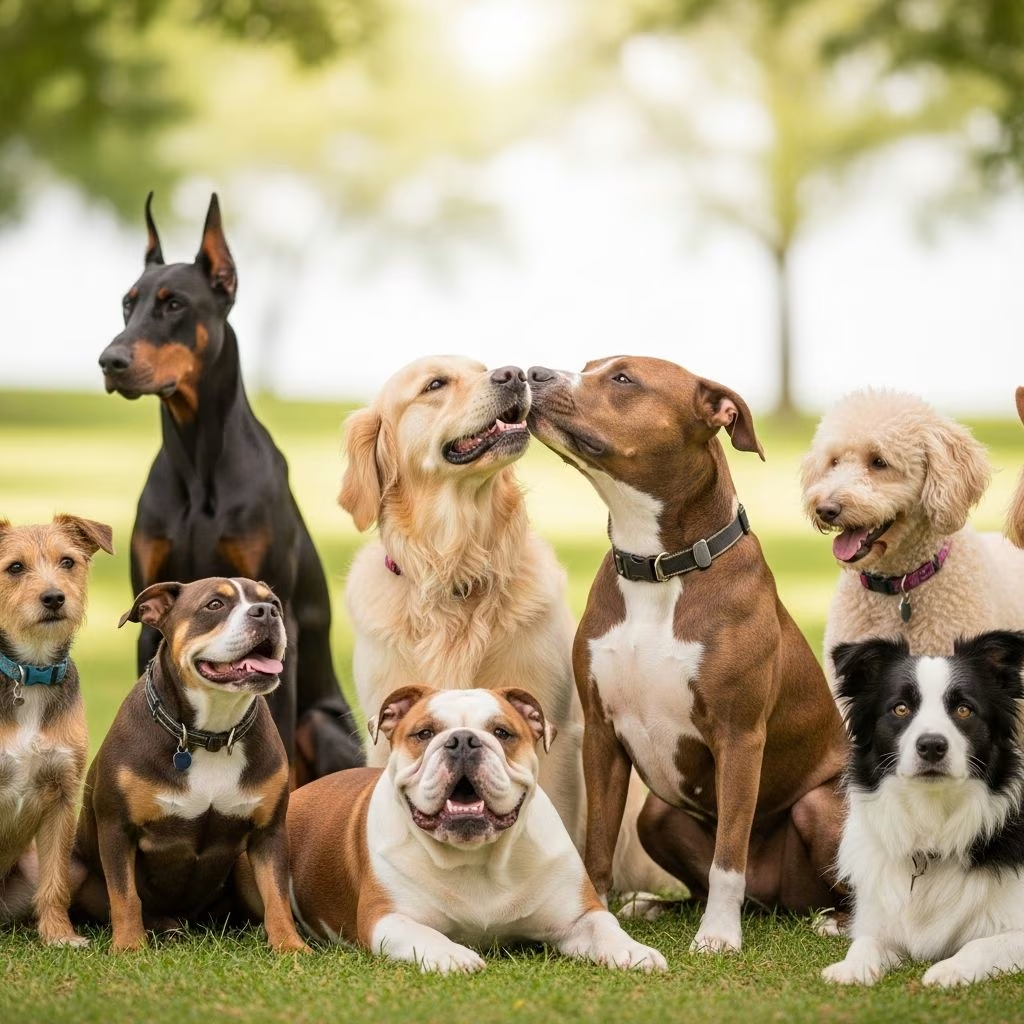
Dog breeds are often linked to specific personality traits, like the friendly Labrador or the loyal German Shepherd. However, recent genetic research indicates that breed ancestry explains only a small fraction of behavioral variation, around 9%, with individual experiences and genetics playing larger roles.
The Science Behind Canine Personalities
Modern understanding of dog behavior comes from large-scale genomic studies analyzing thousands of purebred and mixed-breed dogs. These investigations reveal that while breeds show strong differences in physical appearance—such as coat color, size, and ear shape—behavioral traits like sociability or trainability overlap significantly across groups.
For instance, a comprehensive study published in Science examined over 2,000 dogs and 200,000 owner surveys. It found that only 5.1% of breed-behavior comparisons were significantly differentiated, compared to 41.5% for physical traits. This means a Golden Retriever is only marginally more likely to be friendly than a Dachshund or mixed breed.
Genetic Influences on Behavior
Behavior arises from complex interactions between hundreds of genes, not fixed by breed standards. Genome-wide association studies identified 11 genomic regions strongly linked to traits like howling frequency and human sociability, plus 136 suggestive ones. Notably, these behavioral genes show less differentiation between breeds than those for aesthetics.
In mixed-breed dogs, ancestry effects are detectable but weak. Herding breeds like Border Collies correlate with higher biddability (responsiveness to commands), while sporting breeds show more toy-directed play. Yet, for traits like human sociability, even Labrador ancestry in mutts has no significant impact.
| Breed Group | Common Behavioral Tendencies | Genetic Correlation Strength |
|---|---|---|
| Herding | More biddable, toy-directed, aloof | Moderate (e.g., Border Collie ancestry) |
| Sporting | Toy-directed, active | Low to moderate |
| Working | Dog-social | Low |
| Toy | Independent | Low |
This table summarizes group-level patterns from ancestry analysis in mutts, highlighting that correlations are far from deterministic.
Brain Structure and Breed Evolution
Neuroscientific research complements genetics by linking brain differences to temperament. Premodern dogs, bred for survival tasks, have larger amygdalas for emotional processing and threat detection. Modern breeds feature expanded neocortices, aiding reasoning, motor control, and adaptability to human homes.
Evyn Hecht’s lab at Harvard identifies six brain networks influencing canine skills: drive/reward, olfaction, spatial navigation, social coordination, fight-or-flight, and vision. Selective breeding amplifies these more than ancient DNA, explaining why pet dogs excel in family environments regardless of breed.
Individual Variation Trumps Breed Stereotypes
Within-breed differences often exceed those between breeds. A UMass Chan study emphasized that no behavior is exclusive to any breed—even Labradors, least likely to howl, had 8% of owners reporting it occasionally. Greyhounds rarely bury toys (90% never), but exceptions exist.
Swedish research using behavior tests and owner questionnaires confirms substantial individual variation. Guarding breeds like Rhodesian Ridgebacks can be more social and playful than some Labradors, defying expectations.
- Sociability: Varies widely; not breed-locked.
- Playfulness: Individual energy levels dominate.
- Environmental Security: Fearfulness appears across breeds.
- Threatening Behavior: Protectiveness isn’t uniform.
Owner Bias and Survey Insights
Popular perceptions stem from stereotypes, amplified by media and marketing. DNA tests promise personality predictions, but studies show they’re unreliable—breed predicts behavior poorly even in purebreds.
Researchers mitigated bias by standardizing trait definitions: biddability (following directions), dog-human sociability (comfort with people/strangers), and toy interest. Results consistently show environment and early experiences shape dogs more than lineage.
Practical Advice for Choosing a Dog
Focus on individual assessment over breed labels. Meet the puppy or adult dog, observe interactions, and review temperament tests. Shelters often provide behavior evaluations more predictive than pedigree.
Training and socialization are key modifiers. Genetic predispositions exist but are subtle; consistent positive reinforcement builds desired traits in any dog.
FAQs on Dog Personalities and Breeds
Does breed determine my dog’s behavior?
No, breed explains just 9% of variation. Individual genetics, upbringing, and environment matter more.
Are some breeds naturally more aggressive?
No evidence supports breed-specific aggression as heritable. Fear or poor socialization drives most issues.
Can mixed breeds inherit breed traits?
Weakly—ancestry correlates modestly with some traits like biddability, but predictions are imprecise.
How do I predict my puppy’s personality?
Use behavior tests, parent observations, and early training. Avoid relying solely on breed.
What brain differences affect temperament?
Modern dogs have larger neocortices for adaptability; ancient types emphasize emotional vigilance.
Key Takeaways for Dog Owners
Embrace the uniqueness of each dog. While breeds offer hints, science urges looking beyond labels for joyful companionship. Physical traits are breed-stamped; personalities are personal.
References
- Ancestry-inclusive dog genomics challenges popular breed stereotypes. — Morrill, K.M. et al. Science. 2022-07-22. https://www.science.org/doi/10.1126/science.abk0639
- What shapes your dog’s personality. — Harvard Gazette. 2023-11. https://news.harvard.edu/gazette/story/2023/11/what-shapes-your-dogs-personality/
- Canine behavior only slightly influenced by breed. — UMass Chan Medical School. 2022-04. https://www.umassmed.edu/news/news-archives/2022/04/umass-chan-study-shows-canine-behavior-only-slightly-influenced-by-breed/
- The breed does not determine the dog – significant differences in mentality both between and within breeds. — Swedish University of Agricultural Sciences (SLU). 2025-10. https://www.slu.se/en/news/2025/10/The-breed-does-not-determine-the-dog-significant-differences-in-mentality-both-between-and-within-breeds/
- Study: Dog breed tied more to looks than behavior. — American Veterinary Medical Association (AVMA). Undated (recent). https://www.avma.org/news/study-dog-breed-tied-more-looks-behavior
- Dog genetics suggest that behavior is more than just breed. — Broad Institute. Undated (recent). https://www.broadinstitute.org/news/dog-genetics-suggest-behavior-more-just-breed



