

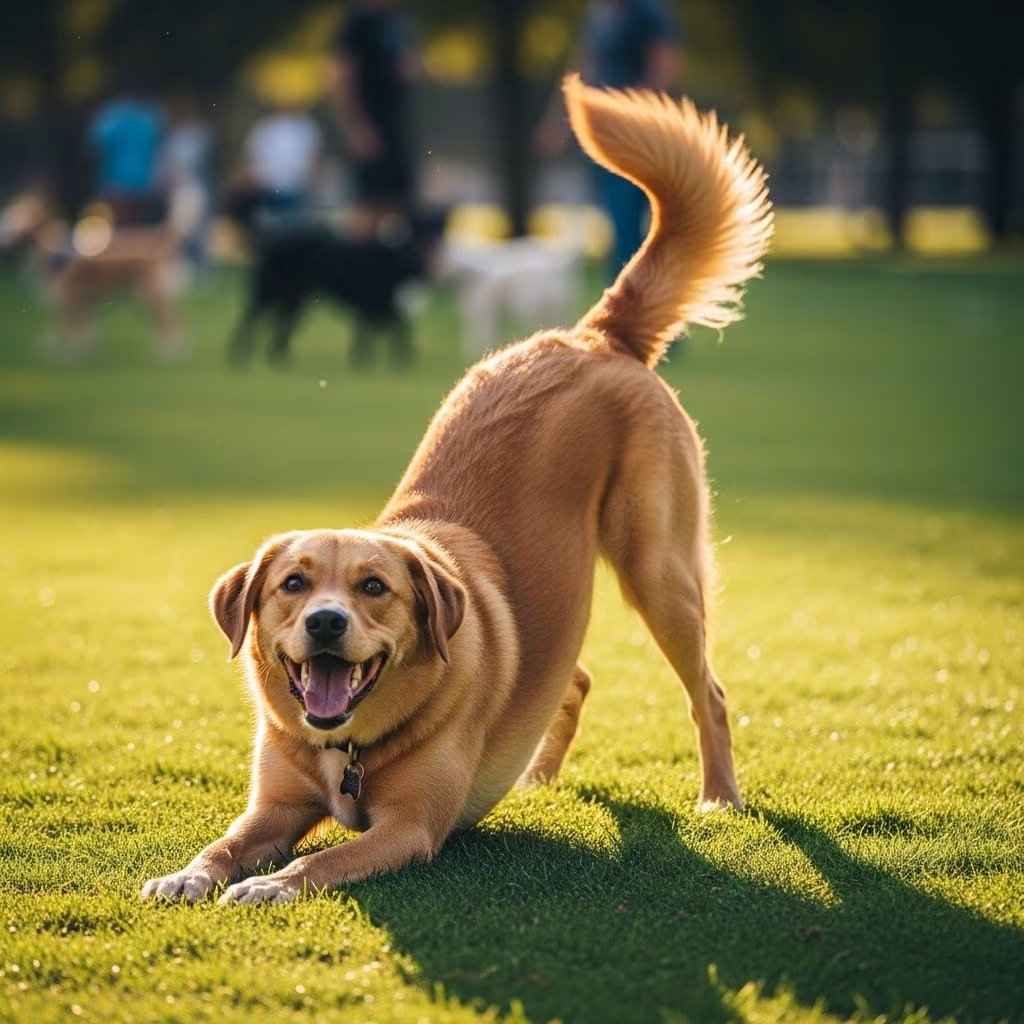
The **dog play bow** is one of the most recognizable and joyful signals in canine body language. With front legs stretched forward, elbows low, chest near the ground, and rear end elevated, this posture clearly communicates, “Let’s play!” It’s not just adorable—it’s evolutionarily refined to invite fun, restart paused play, and ensure interactions stay friendly rather than aggressive.
Understanding the play bow helps owners foster positive dog-to-dog and dog-to-human interactions, preventing misunderstandings that could escalate into conflict. This comprehensive guide covers its mechanics, science, breed variations, and red flags.
Translating Dog Play-Bows
A **dog play-bow** serves as a clear **play signal** to initiate or sustain play with other dogs, humans, or even toys. It reassures partners that behaviors mimicking aggression—like chasing, nipping, growling, tackling, or shaking—are purely playful, with no harmful intent.
This visual cue reduces misinterpretation risks. For instance, a chase followed by a play bow clarifies the fun motive, maintaining harmony during roughhousing. Research shows play bows often follow brief pauses, prompting renewed chase sequences or rearing up, rather than preceding ambiguous actions.
Play bows evolved through **ritualization**, transforming a natural stretch (like post-rest loosening) into a deliberate invitation. Dogs performing it associate the posture with play partners’ positive responses, reinforcing its use.
How Do You Know When Your Dog Is Play Bowing?
Spotting a play bow is straightforward due to its **stereotyped form**:
- Front end low: Elbows on or near the ground, chest lowered, forelegs extended forward.
- Rear end high: Hips elevated, tail often wagging vigorously.
- Expressive face: Relaxed mouth (play face), bright eyes, sometimes barking or yipping.
- Body language: Loose, bouncy posture; may wiggle or circle.
Duration varies: brief for quick invites, longer for emphasis. It’s directional—aimed at the play partner—and performed in clear view, confirming its visual nature. Unlike ambiguous postures, the play bow’s consistency across dogs makes it unmistakable.
The Science Behind the Dog Play Bow
Modern research challenges the old view that play bows solely clarify “I’m playing!” after rough actions. Studies reveal nuanced functions.
| Study Focus | Key Findings | Source |
|---|---|---|
| Adult Pet Dogs (Byosiere et al., 2016) | Play bows follow pauses, not offensive behaviors. Lead to chases or mutual rearing, reinitiating play. | PubMed |
| Wolf & Dog Puppies (Byosiere et al.) | Visual signal in both; dogs’ partners show offensive play post-bow. Strategic for chase invites. | Companion Animal Psychology |
| Canid Evolution (Bekoff) | Ritualized from locomotor stretches; honest signal of trust, punctuates play to apologize or continue. | Psychology Today |
Play bows exhibit **stabilizing selection**—uniform across species for locomotor and communicative reliability. In wolves, function is less clear but likely similar for play restart. They’re **honest signals**: partners trust ensuing “aggression” (e.g., biting) as fun 85% of the time.
Play Bow Variations by Breed & Age
Not all play bows are identical—**breed**, **size**, and **age** influence expression.
- Breed differences: brachycephalic breeds (e.g., Pugs, Bulldogs) may have shorter, stockier bows due to anatomy. Herding breeds (Border Collies) add directional stares; sight hounds (Greyhounds) elongate for speed prep.
- Age matters: Puppies bow more frequently to learn social rules; seniors less often, but enthusiastically.
- Size dynamics: Larger dogs self-handicap with exaggerated bows; small dogs amp energy with bounces.
Hand-reared wolf and dog puppies show similar bows, suggesting innate roots.
Why Do Dogs Play Bow to Humans?
Dogs frequently **play bow to people**, viewing us as play partners. This builds bonds, solicits interaction, and releases energy.
- Initiation: Bows invite fetch, tug, or chase.
- Trust indicator: Shows comfort and joy in your presence.
- Encouragement: Respond by mimicking (safe crouch) or throwing toys to engage.
Ignore repeated human-directed bows if overstimulated—redirect to toys to prevent frustration.
Play Bow vs Prayer Bow: Key Differences
Confuse **play bow** with **prayer bow** at your peril. The latter signals unmet needs.
| Aspect | Play Bow | Prayer Bow |
|---|---|---|
| Posture | Front low, rear high, bouncy | Front low, rear tucked/low, still |
| Context | Play sessions, excited | Mealtime, begging |
| Body Language | Wagging tail, play face | Still tail, pleading eyes |
| Duration | Brief, repeated | Prolonged, persistent |
Prayer bows stem from learned food solicitation; play bows are innate play signals.
Should You Worry About Dog Play Bows?
Occasional play bows signal health and happiness. But **excessive or isolated bowing** warrants attention.
- Red flags: Repetitive solo bowing, trembling, avoidance of play follow-up—may indicate pain (arthritis), anxiety, or neurological issues.
- Context check: Bows amid stiffness or limping? Vet visit essential.
- Decline in bowing: In social dogs, could signal depression or health decline.
Animal behaviorists note: “Not all bows are playful—repeated ones may hint at discomfort”. Monitor with play logs.
5 Tips to Encourage Healthy Play Bowing
Foster safe play to maximize play bow benefits.
- Supervised playdates: Match energy levels; intervene if signals ignored.
- Respond appropriately: Mimic bows, use toys—avoid rough encouragement.
- Train alternatives: Teach “sit” for calm solicitation.
- Enrich environment: Puzzle toys reduce frustration bows.
- Health checks: Annual vet exams rule out pain mimics.
Frequently Asked Questions (FAQs)
Q: Why does my dog play bow and then run away?
A: Classic **invitation to chase**—the bow positions them for runaway/chase play, a strategic re-start.
Q: Do all dogs play bow?
A: Most do, but frequency varies by breed, age, socialization. Under-socialized dogs may rarely bow.
Q: Is play bowing learned or innate?
A: Innate, ritualized evolutionarily; puppies and wolves bow similarly when hand-reared.
Q: What if my dog play bows excessively alone?
A: Possible anxiety or pain; consult vet/behaviorist. Provide outlets like interactive toys.
Q: Can I teach my dog to play bow on cue?
A: Yes, via positive reinforcement—capture natural bows, reward with treats/toys.
Q: Why don’t some dogs respond to play bows?
A: Fear, past trauma, or mismatched play styles. Gradual desensitization helps.
References
- The Function of Play Bows in Dog and Wolf Puppies — Companion Animal Psychology / Julie Hecht. 2017-02-28. https://www.companionanimalpsychology.com/2017/02/the-function-of-play-bows-in-dog-and.html
- Dogs at Play: How and Why Bowing Came to Mean “Let’s Play” — Psychology Today / Marc Bekoff. 2025-03-01. https://www.psychologytoday.com/us/blog/animal-emotions/202503/dogs-at-play-how-and-why-bowing-came-to-mean-lets-play
- Dog Play-Bows: Understanding Canine Play Signals — Kinship. Accessed 2026. https://www.kinship.com/dog-behavior/dog-play-bow
- Dog Bowing: What Does it Mean and When to Be Concerned — The Dog Alliance. Accessed 2026. https://thedogalliance.org/why-does-my-dog-bow/
- Investigating the function of play bows in adult pet dogs (Canis lupus familiaris), play partner, and context predicting the occurrence of play bows — PubMed / Byosiere et al. 2016-04-01. https://pubmed.ncbi.nlm.nih.gov/26923096/



