

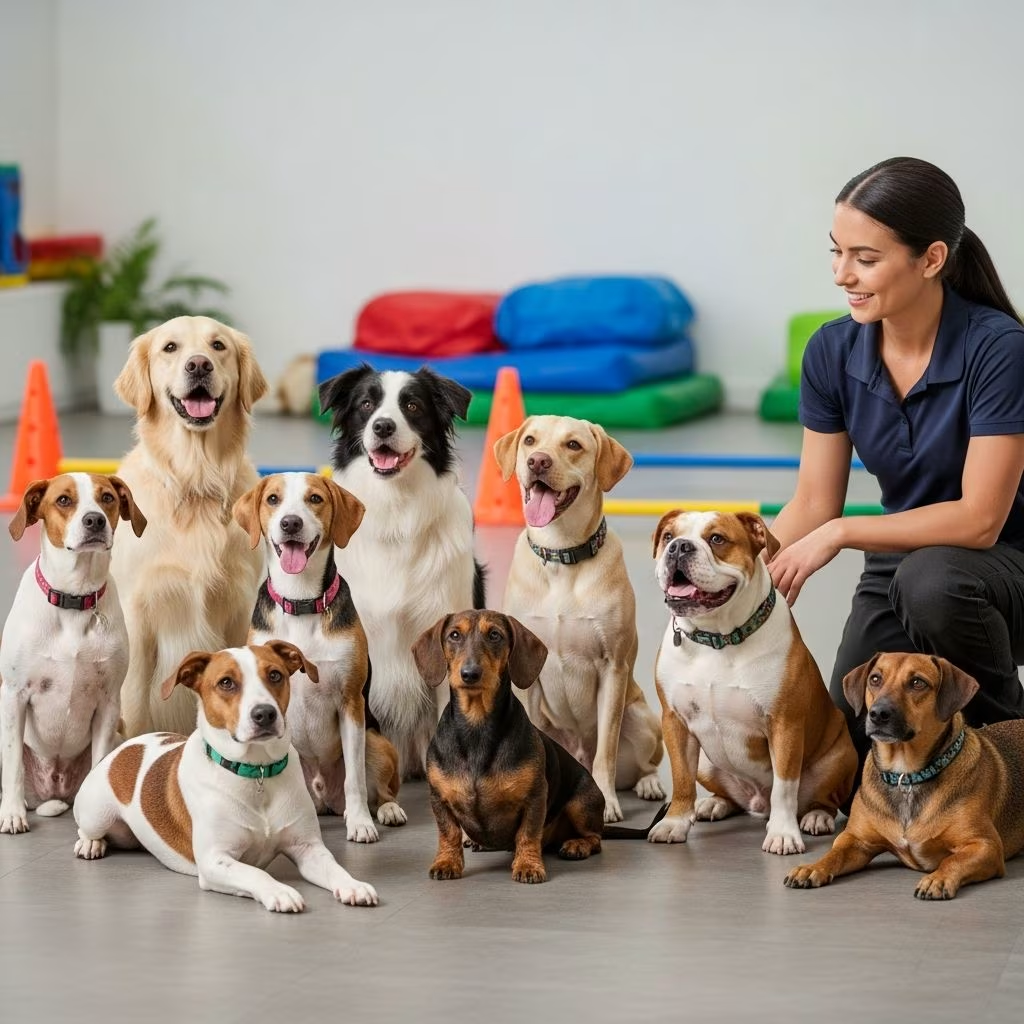
Not every dog responds identically to training methods due to their innate personalities, genetics, and life experiences. Recognizing this individuality prevents frustration and fosters effective, tailored training approaches.
Dogs Are Who They Are
Dogs exhibit profound individuality in their behavior, much like humans. Consider Helen’s dog Benny, an exceptionally well-behaved “ambassador” who rested his head gently on children with developmental disabilities, ignored tempting food at parties, never barked, and slept through thunderstorms. Benny was unusually calm and reliable.
In contrast, Helen’s later dog, Miro, struggled with impulse control, high arousal, and fearfulness despite dedicated training. Miro could not become a service dog, no matter the effort. This highlights that training improves behavior but cannot fundamentally alter a dog’s core temperament.
Many dog owners feel like failures when their dogs don’t meet expectations, wrongly assuming more training will transform them into perfect companions. However, dogs arrive with predispositions shaped by genetics and early experiences that training cannot erase.
Professional trainers acknowledge this variance. While some dogs excel off-leash in any environment or serve as demo dogs in classes, others require restrictions. Trainers often learn most from their challenging dogs, not the “straight-A students.”
Research supports this: a PNAS study shows oxytocin influences social bonding in dogs, but individual differences in endogenous oxytocin levels affect responsiveness, leading to varied social behaviors. Similarly, NIH research reveals sex-based differences in personality, cognition, and perception, further emphasizing innate variations.
Patience — and Understanding — Is Key
Training speed varies widely among dogs. One trainer recounted a dog that took weeks or months to learn skills taught to clients’ dogs in one or two sessions. This slow progress wasn’t due to poor training but the dog’s unique learning pace.
Your dog is special because of their unique personality and training response. Not all can handle large parties, off-leash woodland walks, or enthusiastic child hugs, even with training. Some battle mouthy behavior, excessive barking, or jumping greetings.
Training yields improvements—dogs who naturally take to it progress quickly, while others require more time. Patience is essential; criticizing slow progress overlooks the dog’s individuality.
Embodied learning research illustrates how humans must attune to dogs’ perspectives in training classes. Trainers adapt rewards (e.g., tripe, cheese, toys) based on individual preferences, combining breed knowledge with trial-and-error for effective motivation.
- Observe your dog’s energy levels: High-arousal dogs may need calming techniques before training.
- Tailor rewards: Food-motivated dogs respond to treats; play-driven ones prefer toys.
- Account for breed tendencies: German Shorthaired Pointers (GSPs) are independent hunters, harder to recall than heel-working breeds like Border Collies.
Accept Your Pup For Who They Are
Aim to expand your dog’s comfort zones through training, but never force changes to their core self. Variations from genetics, early life, or both persist despite behavioral modification.
Placing a dog in mismatched environments causes stress for both. Acceptance means loving them as they are—pre- and post-training.
Even within breeds, individuals differ: Not all Labradors fetch eagerly, Greyhounds sprint passionately, or Border Collies herd obsessively. Prepare via breed research, then appreciate your dog’s uniqueness.
Owner studies show many experiences match expectations, with positive surprises common, reinforcing that realistic views enhance satisfaction.
| Dog Trait | Training Impact | Example Adaptation |
|---|---|---|
| High Impulse | Slower progress on recall | Use long lines, high-value rewards |
| Fearful | Needs gradual exposure | Desensitization over force |
| Quick Learner | Fast skill acquisition | Advance to complex tasks |
| Independent | Resists close work | Incorporate freedom in sessions |
Practical Tips for Training Individual Dogs
To train effectively, assess your dog’s baseline:
- Genetics: Breeds predict tendencies (e.g., Terriers dig, Spaniels bird-hunt), but individuals vary.
- Early Experiences: Domestication and ontogeny shape social skills.
- Hormonal Factors: Oxytocin boosts bonding, modulated by personal levels.
Steps for success:
- Evaluate strengths/weaknesses without judgment.
- Use positive reinforcement suited to their motivators.
- Set realistic goals: Improve, don’t overhaul.
- Seek professional help for severe issues.
- Celebrate small wins to build confidence.
Multi-species research stresses mutual transformation: Humans learn to “trust and respond” to dogs, fostering joy in co-shaped motion.
Frequently Asked Questions (FAQs)
Why doesn’t my dog learn as fast as others?
Dogs have unique learning speeds due to genetics and personality. Patience and tailored methods help; it’s not a training failure.
Can training change my dog’s core personality?
Training improves behaviors but can’t erase innate traits like high arousal or fearfulness. Focus on management and enhancement.
How do breeds affect training?
Breeds predict tendencies (e.g., independence in hunters), but individual variation is key. Research breeds, then personalize.
What if my dog has impulse issues?
Use structured exercises, high rewards, and avoid overwhelming situations. Progress takes time.
Is my dog normal if not perfect?
Yes—perfection is rare. Embrace their uniqueness for a happier bond.
References
- Don’t Be Frustrated If Your Dog Is Tricky to Train — Kinship. 2023. https://www.kinship.com/dog-behavior/dog-individuality-training
- How to Train Against a Dog’s Nature — Kinship. 2023. https://www.kinship.com/dog-behavior/working-dog-training
- Oxytocin promotes social bonding in dogs — PNAS. 2014-05-06. https://www.pnas.org/doi/10.1073/pnas.1322868111
- Behavioral and Perceptual Differences between Sexes in Dogs — NIH/PMC. 2018. https://pmc.ncbi.nlm.nih.gov/articles/PMC6162565/
- ‘Imagine you are a Dog’: embodied learning in multi-species research — SAGE Journals. 2022. https://journals.sagepub.com/doi/10.1177/14744740221102907
- Owner expectations and surprises of dog ownership experiences — Frontiers in Veterinary Science. 2024. https://www.frontiersin.org/journals/veterinary-science/articles/10.3389/fvets.2024.1331793/full



