

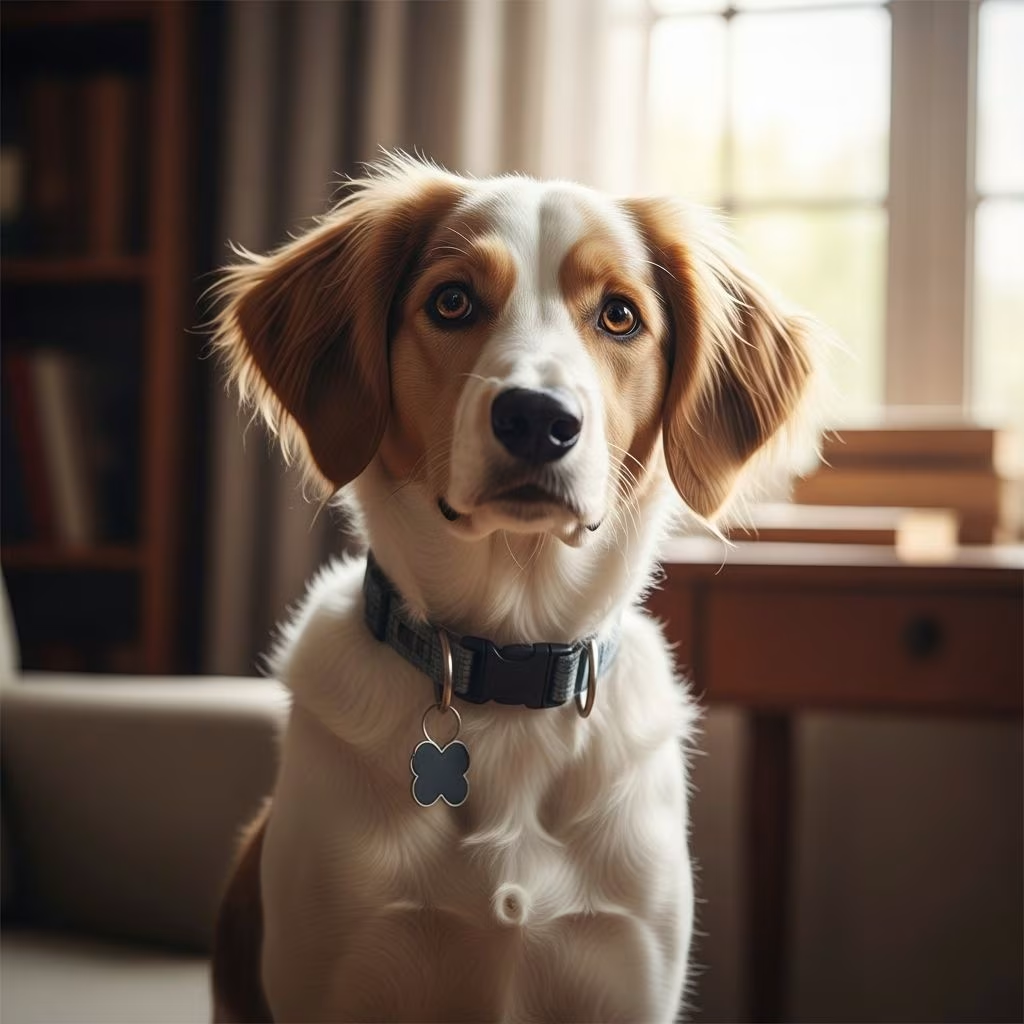
Some dogs possess extraordinary cognitive abilities that set them apart from their peers, earning them the label of “genius dogs.” Recent research published in Scientific Reports identifies three key traits—**curiosity**, **focus**, and **self-control**—that distinguish these gifted word learners (GWLs), dogs capable of learning and retrieving over 100 object names. These rare pups, often from working breeds like Border Collies, demonstrate innate intelligence beyond typical training, revolutionizing our understanding of canine cognition.
What Makes a Dog a Genius?
Genius dogs, or GWLs, excel in understanding human language for objects, a skill once thought unique to humans. In a citizen-science study involving 41 such dogs, researchers found they could fetch specific toys from groups of similar items based solely on verbal commands, even when separated by rooms. Unlike average dogs, GWLs show no reliance on visual cues alone; they process names semantically.
The study, led by Dr. Juliane Kaminski from the University of Portsmouth, spanned multiple countries, with owners conducting tests under strict protocols measuring curiosity, problem-solving, learning, memory, and human-directed communication. Control groups of non-GWL dogs highlighted the exceptional nature of these abilities.
The 3 Traits of Genius Dogs
Analysis revealed consistent patterns among GWLs. Here’s a breakdown:
- Curiosity: Genius dogs actively explore novel objects and situations, driving spontaneous learning. Owners reported pups picking up toy names during casual play without formal training.
- Focus: These dogs maintain prolonged attention on tasks, ignoring distractions to solve problems like retrieving named items amid decoys.
- Self-Control (Inhibitory Control): Crucially, GWLs suppress impulses, fetching requested items over preferred toys. Dr. Kaminski noted this as the foundational block for their genius, as poor control hinders object discrimination. Dr. Bräuer echoed this, citing her own dog’s ball obsession as a barrier.
| Trait | Description | Impact on Genius Ability |
|---|---|---|
| Curiosity | Drive to investigate new stimuli | Leads to effortless word learning via play |
| Focus | Sustained attention without distraction | Enables precise command execution |
| Self-Control | Impulse inhibition | Allows selection of non-preferred items |
How Researchers Identified Genius Dogs
The “Genius Dog Challenge” recruited candidates via online videos showing dogs fetching named toys from at least three options, with handlers absent. Of applicants, only 41 qualified as GWLs, predominantly Border Collies (52%), but including Labradors, Pomeranians, Corgis, and Australian Shepherds. Most lived in two-person households and engaged in activities like obedience or herding.
Cognitive batteries assessed multiple domains. GWLs outperformed controls significantly, particularly in inhibitory control tasks where they ignored favored toys for named ones. Example: Harvey, a UK Border Collie knowing 220+ objects, fetches on command amid toy clutter, keeping his mind engaged as a working breed.
Can Genius Dogs Learn by Eavesdropping?
A follow-up study in Science by Eötvös Loránd University’s Genius Dog Challenge team tested 10 GWLs (mostly Border Collies, plus others). Dogs learned new toy names in two scenarios:
- Direct interaction: Owners named toys while playing; success rate 80%.
- Eavesdropping: Owners discussed unseen toys with strangers; dogs succeeded 100%.
Even when toys were hidden post-viewing and named later, most GWLs fetched correctly, mimicking toddler-like passive learning. Shany Dror noted their cue sensitivity persists regardless of address direction. This ability is GWL-exclusive; average dogs cannot replicate it.
Can You Train a Genius Dog?
Surprisingly, no intentional training drives GWL abilities. 75% of owners didn’t teach toy names; dogs self-initiated during daily play (80% reported). Learning appeared effortless, with no GWL siblings among multi-dog homes or new puppies under identical methods. Researchers conclude owner skills aren’t primary; genius is innate and rare.
To nurture potential: Provide ample playtime, toys, and engagement. Working breeds thrive with jobs, preventing boredom. Future “Puppy IQ Tests” may predict service dog potential by assessing early traits.
Examples of Real Genius Dogs
- Harvey (Border Collie): Knows 220+ objects; daily fetch games prevent mischief.
- Other GWLs: Mixed breeds mastering 100+ names via play, spanning continents.
Limitations: Small sample sizes due to rarity; ongoing research probes innate vs. developed traits. Contact geniusdogchallenge.official@gmail.com if your dog shows promise.
Frequently Asked Questions (FAQs)
What are the 3 traits of a genius dog?
Curiosity, focus, and self-control distinguish gifted word learners capable of advanced object name comprehension.
Can any dog become a genius?
No, genius appears innate; training alone doesn’t produce GWLs, even in same households.
How do genius dogs learn new words?
Through play or eavesdropping; some master names after 4 exposures, even indirectly.
What breeds are most likely genius dogs?
Working breeds like Border Collies dominate (52%), but others like Labs and Aussies qualify.
How can I test if my dog is a genius?
Submit fetch videos to Genius Dog Challenge; assess curiosity, focus, and control at home.
References
- If Your Dog Possesses These 3 Traits, They Could Be a Genius, New Study Says — Kinship. 2023. https://www.kinship.com/news/smart-dogs-traits-new-study
- Is Your Dog a Genius? A New Study Says It’s Possible — Kinship. 2023. https://www.kinship.com/dog-behavior/genius-dogs
- ‘Genius’ Dogs Can Learn New Words Just by Eavesdropping, New Study — Kinship. 2023. https://www.kinship.com/news/genius-dogs-eavesdropping-learning-study
- Learning New Words Through Eavesdropping by Gifted Word Learner Dogs — Scientific Reports (via study reference). 2023-10-12. https://doi.org/10.1038/s41598-023-41182-5
- Superstar Cognitive Performance by a Border Collie — Eötvös Loránd University (Genius Dog Project). 2024. https://geniusdog.elte.hu/



