Dog Cruciate Ligament Injuries: Diagnosis, Surgery, Rehab
Comprehensive guide to understanding, diagnosing, and treating cranial cruciate ligament ruptures in dogs for better recovery outcomes.
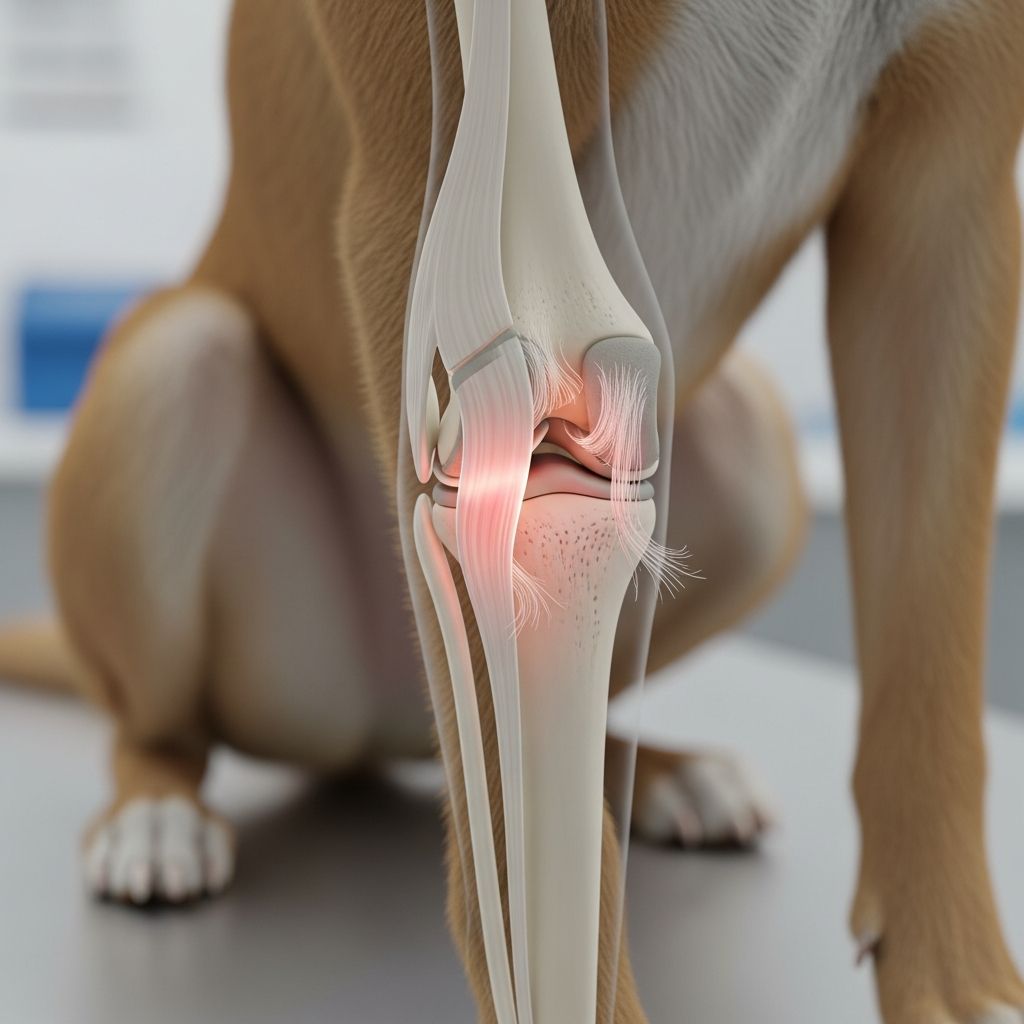
The cranial cruciate ligament (CCL) is a vital structure in a dog’s stifle joint, equivalent to the human anterior cruciate ligament (ACL). Injuries to this ligament are among the most frequent orthopedic issues in canines, leading to pain, lameness, and progressive joint degeneration if not addressed promptly.
The Anatomy of the Canine Stifle Joint
The stifle joint, located between the femur and tibia, relies on a network of ligaments for stability. The CCL originates from the caudomedial aspect of the lateral femoral condyle and inserts into the cranial intercondylar area of the tibia. It resists cranial displacement of the tibia relative to the femur, hyperextension, and internal rotation, while guiding the joint’s rolling-sliding motion.
Composed primarily of type I collagen fibrils with a crimped structure, the CCL exhibits regional variations in function based on joint angle and load. It is extrasynovial but intra-articular, covered by synovium that shields it from fluid exposure. Blood supply derives mainly from surrounding soft tissues, with poorer vascularization in the core of its middle third. Mechanoreceptors within the ligament contribute to proprioception and neuromuscular control.
Supporting structures include the caudal cruciate ligament, medial and lateral collateral ligaments, and menisci. The menisci enhance joint congruency, absorb shock, distribute load, and lubricate surfaces. The tibial plateau’s inherent slope in dogs exacerbates stress on the CCL during weight-bearing.
Why Do CCL Injuries Occur in Dogs?
Unlike acute traumatic ruptures common in humans, most canine CCL failures stem from chronic degeneration rather than single events. Repeated biomechanical stresses from the sloped tibial plateau cause tibial thrust forward under load, progressively weakening ligament fibers.
Factors contributing to degeneration include:
- Breed predisposition: Large breeds like Labrador Retrievers, Rottweilers, and Pit Bulls are overrepresented due to size and activity levels.
- Obesity: Excess weight amplifies joint stress.
- Conformational issues: Steep tibial plateau angles and shallow femoral trochleas increase susceptibility.
- Age and activity: Middle-aged working or athletic dogs face higher risks.
- Immune-mediated components: Some evidence suggests inflammatory processes degrade collagen over time.
Acute ruptures can occur from trauma like twisting falls, but they often represent the ‘final straw’ in a degenerated ligament.
Recognizing the Signs of CCL Damage
Symptoms vary by injury stage. Partial tears may cause intermittent limping, especially after exercise, with subtle stifle thickening. Complete ruptures trigger non-weight-bearing lameness, where the dog ‘toes’ or holds the leg up.
| Stage | Symptoms | Joint Changes |
|---|---|---|
| Early Degeneration | Mild intermittent lameness, subtle pain on flexion | Synovitis, early osteoarthritis |
| Partial Tear | Consistent limp, improved at rest | Meniscal wear, effusion |
| Complete Rupture | Severe lameness, three-legged stance | Instability, advanced arthritis |
Owners often notice crepitus (grinding sounds), muscle atrophy, and reluctance to jump or climb stairs. Pain arises from instability-induced meniscal damage and periarticular inflammation.
How Veterinarians Diagnose CCL Ruptures
Diagnosis combines history, physical exam, and imaging. Key orthopedic tests include:
- Cranial drawer test: Manual forward tibia push with femur stabilized; positive if tibia shifts cranially.
- Tibial thrust: Cranial displacement during stifle extension under weight-bearing simulation.
- Compression test: Tibial movement during simulated gait.
Radiographs reveal joint effusion, tibial sclerosis, and osteophytes. Advanced cases show meniscal mineralization. CT or MRI confirms ligament integrity and meniscal status, though sedation is required.
Non-Surgical Management Options
Conservative care suits small dogs (<15 kg) or poor surgical candidates. Strategies include:
- Strict rest (8-12 weeks crate confinement).
- Anti-inflammatories (NSAIDs like carprofen).
- Weight loss and controlled physiotherapy.
- Custom stifle braces for stabilization.
Success rates are lower in larger dogs, with 20-50% progressing to surgery due to persistent instability and arthritis.
Surgical Interventions: Stabilizing the Stifle
Surgery is gold standard for most cases, aiming to restore biomechanics without ligament replacement. Two primary categories:
Extracapsular Techniques
Lateral suture stabilization mimics CCL function using strong monofilament (e.g., fishing line). Scar tissue forms over 6-8 weeks to maintain stability. Ideal for small dogs; complications include suture failure (10-20%).
Osteotomy Procedures
These neutralize tibial thrust by altering plateau angle or geometry.
- TPLO (Tibial Plateau Leveling Osteotomy): Circular osteotomy levels the plateau to ~14 degrees, eliminating shear force. High success (90-95%), rapid return to function.
- TTA (Tibial Tuberosity Advancement): Advances tibial tuberosity to counter thrust via modified geometry. Effective for medium-large dogs.
| Procedure | Best For | Recovery Time | Success Rate |
|---|---|---|---|
| TPLO | Large breeds >20kg | 12 weeks | 95% |
| TTA | Medium-large 15-60kg | 10-12 weeks | 92% |
| Extracapsular | Small <15kg | 8-10 weeks | 80% |
Post-op, meniscal release or debridement prevents tears. Arthroscopy aids minimally invasive assessment.
Rehabilitation and Long-Term Care
Recovery protocols span 3-6 months:
- Weeks 1-2: Strict crate rest, passive range-of-motion.
- Weeks 3-8: Leashed walks, underwater treadmill.
- Weeks 9+: Agility building, joint supplements (glucosamine, omega-3s).
Ongoing management combats osteoarthritis: weight control, low-impact exercise, laser therapy, and stem cell injections in advanced cases.
Preventing CCL Injuries in At-Risk Dogs
Proactive steps include maintaining lean body weight, muscle conditioning via swimming/hydrotherapy, and early screening for conformational flaws. Neutering may influence risk in some breeds, warranting discussion with vets.
Frequently Asked Questions (FAQs)
Can my dog recover fully from a CCL tear?
With surgery and rehab, 90%+ regain near-normal function, though mild arthritis is common long-term.
How much does CCL surgery cost?
Ranges $3,000-$7,000 USD depending on procedure, location, and dog size.
Will both legs be affected?
50% of dogs rupture the opposite CCL within 1-2 years; monitor closely.
Is TPLO better than TTA?
Both excellent; surgeon expertise and dog anatomy guide choice.
Emerging Treatments and Research
Regenerative therapies like platelet-rich plasma (PRP) and mesenchymal stem cells show promise in slowing degeneration. Biomechanical modeling refines osteotomy precision. Ongoing studies explore genetic markers for predisposition.
References
- Morphologic and functional features of the canine cruciate ligaments — Arnoczky SP, et al. PubMed. 2006-12-01. https://pubmed.ncbi.nlm.nih.gov/17187639/
- Cranial Cruciate Ligament Disease in Dogs: What You Need to Know — Animal Medical Center. 2017-08-02. https://www.amcny.org/blog/2017/08/02/cranial-cruciate-ligament-disease-dogs/
- Anatomy of the Canine Knee — EasyAnatomy. N/A. https://easy-anatomy.com/anatomy-canine-knee/
- Canine Cranial Cruciate Ligament Rupture — Nashville Veterinary Specialists. N/A. https://www.nashvillevetspecialists.com/canine-cranial-cruciate-ligament-rupture
- Canine Cruciate Ligament Injury — Colorado State University Veterinary Teaching Hospital. N/A. https://vetmedbiosci.colostate.edu/vth/services/orthopedic-medicine/canine-cruciate-ligament-injury/
- Cruciate ligament disease or injury — Fitzpatrick Referrals. N/A. https://www.fitzpatrickreferrals.co.uk/orthopaedics/cranial-cruciate-ligament-injury/
Similar Articles








Read full bio of Sneha Tete