

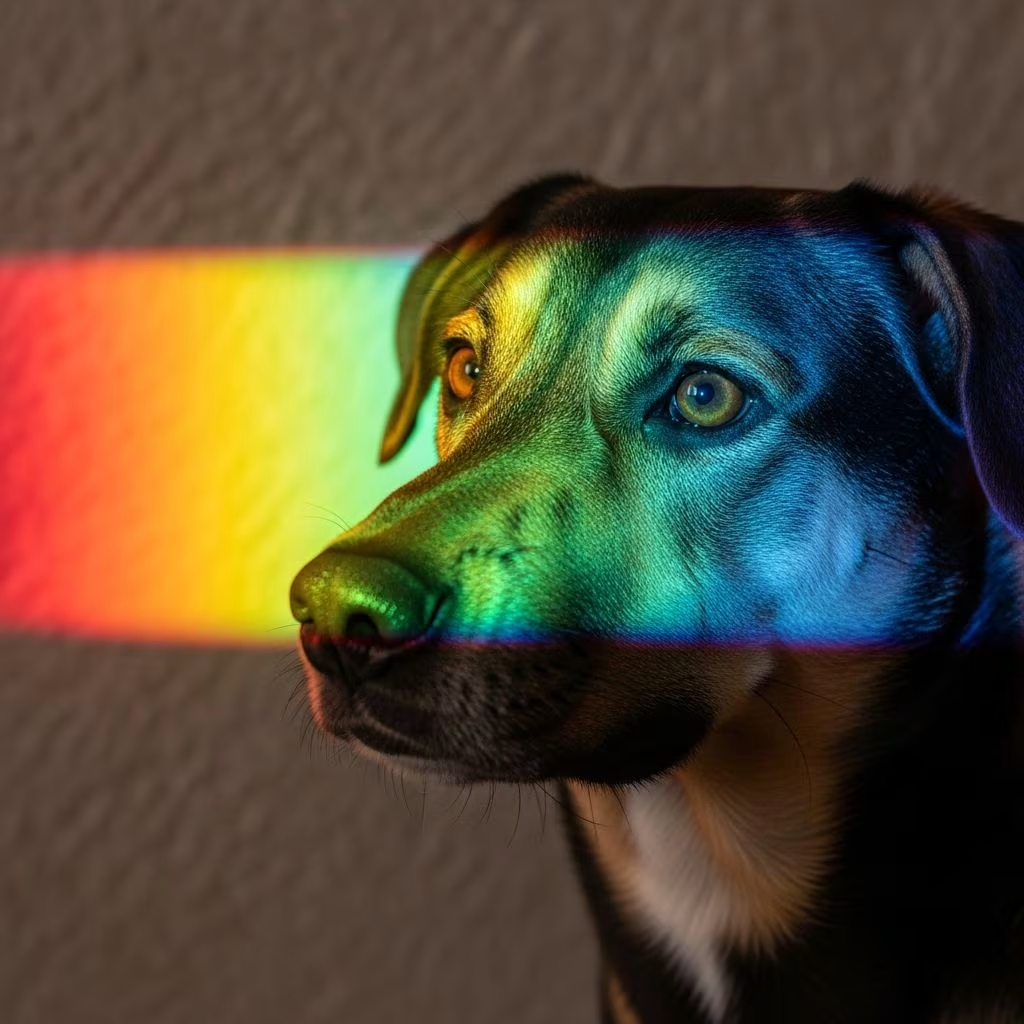
Dogs experience a distinct visual landscape compared to humans, primarily perceiving the world through shades of blue and yellow rather than the full spectrum humans enjoy. This dichromatic vision stems from having only two types of cone cells in their retinas, limiting their color discrimination but enhancing other sensory capabilities.
The Science Behind Canine Eyesight
Human eyes contain three types of cone photoreceptors sensitive to short (blue), medium (green), and long (red) wavelengths of light, enabling trichromatic vision. In contrast, dogs possess just two: one sensitive to short wavelengths around 429 nm (blue-violet) and another to longer wavelengths around 555 nm (yellowish-green). This setup mirrors human red-green color blindness, or deuteranopia, where reds and greens blend into similar hues.
Research confirms this structure through neurobiological and molecular analyses of canine retinas. Visual-evoked potential studies and immunohistochemical examinations reveal these two cone classes, supporting dichromatic color vision in dogs.
How Dogs Distinguish Colors in Practice
Early assumptions suggested dogs ignored color, relying solely on brightness due to limited cones. However, controlled experiments disprove this. In a study with eight untrained dogs, researchers presented papers in dark yellow, light yellow, dark blue, and light blue—colors and brightness levels tailored to canine sensitivity. Dogs learned to associate rewards with specific colors over brightness, choosing correctly over 70% of the time, with six achieving 90-100% accuracy.
This indicates color cues often outweigh brightness for dogs under natural lighting, challenging prior views that chromatic information was irrelevant.
Colors Dogs Perceive Most Vividly
- Blues: Dark and light blues appear distinct and vibrant to dogs.
- Yellows: Ranging from dark to light yellow, these stand out clearly.
- Greens and Reds: These merge into grays, browns, or muted yellows, making them hard to differentiate.
- Oranges and Purples: Often indistinguishable, blending into yellows or blues.
For instance, a green lawn might resemble dull yellow-brown hay, while a red toy could look like a shadowy grayish-brown object. Dogs excel at detecting blue against yellow backgrounds, aiding in tasks like spotting balls in grass.
Comparing Dog and Human Vision
| Aspect | Human Vision | Dog Vision |
|---|---|---|
| Cone Types | 3 (S, M, L wavelengths) | 2 (S: 429nm, L: 555nm) |
| Color Spectrum | Full: red, orange, yellow, green, blue, violet | Limited: blues, yellows, grays/browns |
| Red-Green Discrimination | Excellent | Poor (similar to deuteranopia) |
| Visual Acuity | Higher detail | 4-8x lower; motion-sensitive |
| Low-Light Vision | Moderate (rods + cones) | Superior (more rods) |
This table highlights key differences. Dogs’ lower cone density (about 20% in central retina) prioritizes motion detection and night vision over fine color detail.
Implications for Everyday Dog Life
Understanding canine color limits informs pet care. Toys in bright blue or yellow are easiest for dogs to see, while red or green ones may get lost in foliage. Training with color-coded cues leverages their strengths—pair blue markers with commands for quicker learning.
In natural settings, dogs prioritize color for object recognition under daylight. Even with metamerism challenges (colors shifting under different lights), their vision favors blue-yellow contrasts, aiding hunting or play.
Testing Canine Color Perception
Adapted human tests like Ishihara plates confirm dogs’ red-green deficits. Modified versions show behavioral responses akin to colorblind humans, using associative learning where dogs select colored stimuli over brightness-matched ones.
Other methods include increment-threshold functions, where dogs detect color increments better than expected, reinforcing color’s role.
Breed Variations and Limitations
Most studies use mixed breeds, suggesting general applicability, but variations exist. Some breeds may show subtle differences due to retinal packing or genetics, though dichromacy remains standard. Sample sizes are small, warranting further research across pure breeds.
Enhancing Your Dog’s Visual Experience
- Choose **blue or yellow toys** for visibility during fetch.
- Use **contrasting feeders**—blue bowls on yellow mats.
- Avoid **red laser pointers**; dogs see the dot as dark, frustrating play.
- Incorporate **color in training**: Blue flags for ‘sit’, yellow for ‘stay’.
- Leverage **UV sensitivity**—some objects fluoresce, appearing brighter.
These adjustments make environments more navigable, reducing frustration.
FAQs on Dog Color Vision
Are dogs completely colorblind?
No, dogs see colors but in a limited palette of blues and yellows, not fully colorblind like grayscale vision myths suggest.
Why can’t dogs see red?
Lacking red-sensitive cones, reds appear as dark grays or browns, blending with greens.
Do all dogs see colors the same?
Generally yes, as dichromatic vision is consistent across breeds, though acuity varies.
Can dogs see better at night?
Yes, more rods enhance low-light vision, though without color.
Should I buy colorful toys for my dog?
Opt for blue and yellow; others may not stand out.
Visual Adaptations Beyond Color
Dogs compensate with superior motion sensitivity, wider field of view (240° vs. humans’ 180°), and better scent integration. Their tapetum lucidum reflects light, boosting dim-vision. Color, while secondary, aids discrimination when brightness alone fails.
Recent studies (post-2023) reaffirm these traits, with no major shifts in understanding.
References
- New Study Shows That Dogs Use Color Vision After All — Smithsonian Magazine. 2013-08-14. https://www.smithsonianmag.com/science-nature/new-study-shows-that-dogs-use-color-vision-after-all-13168563/
- Are dogs red–green colour blind? — PMC – NIH (Proc Biol Sci). 2017-11-29. https://pmc.ncbi.nlm.nih.gov/articles/PMC5717654/
- Colour cues proved to be more informative for dogs than brightness — PMC – NIH (Proc Biol Sci). 2013-09-07. https://pmc.ncbi.nlm.nih.gov/articles/PMC3730601/
- Can Dogs See Color? — American Kennel Club. 2023-05-01. https://www.akc.org/expert-advice/health/can-dogs-see-color/
- Can dogs see color? The truth behind your pet’s eyesight — University of Washington Ophthalmology. N/A. https://ophthalmology.washington.edu/news/can-dogs-see-color-the-truth-behind-your-pets-eyesight
- What Colors Can Dogs See? Are Dogs Color Blind? — PetMD. 2023-09-12. https://www.petmd.com/dog/general-health/what-colors-can-dogs-see



