

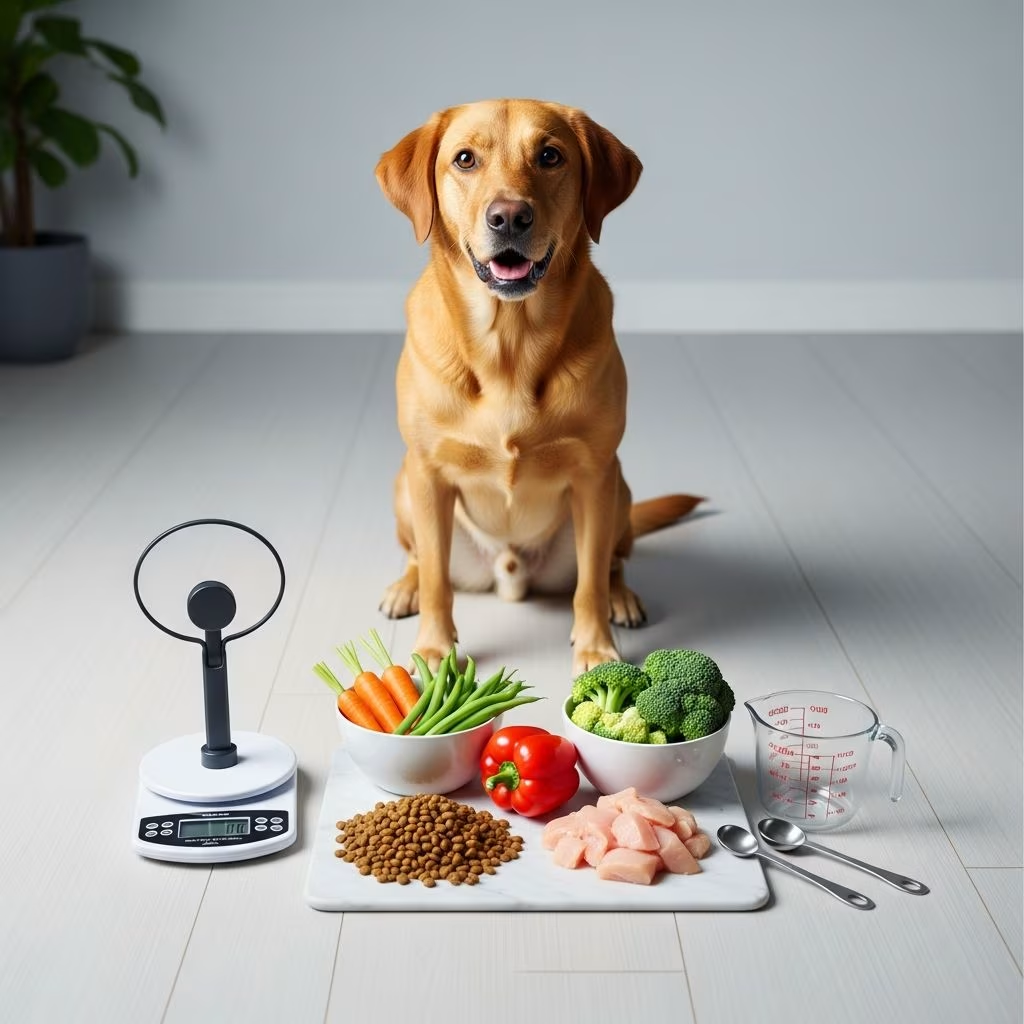
Determining the right number of calories for your dog is essential for maintaining ideal health, energy levels, and body weight. This involves calculating the Resting Energy Requirement (RER) and adjusting it based on individual factors like activity, age, and neuter status.
Understanding Energy Basics for Dogs
Dogs require energy to sustain basic life functions, such as breathing, heartbeat, and digestion. This baseline is known as the Resting Energy Requirement (RER), calculated using the formula: RER (kcal/day) = 70 × (body weight in kg)0.75 for dogs. Unlike simpler formulas like 30 × body weight in kg + 70, which are inaccurate for dogs under 2 kg or over 45 kg, the exponential formula provides precision across all sizes.
Once RER is established, multiply by a factor to get Daily Energy Requirement (DER) or Maintenance Energy Requirement (MER), accounting for lifestyle and physiology.
Step-by-Step Calorie Calculation
Follow these steps to compute your dog’s needs accurately.
- Weigh Your Dog: Use ideal body weight in kilograms. For overweight dogs, base on target weight.
- Compute RER: Apply 70 × (BWkg0.75).
- Apply Multipliers: Adjust for life stage and activity (see table below).
- Monitor and Adjust: Track body condition score (BCS) over 4-6 weeks.
Common Multipliers Table
| Life Stage/Activity | Multiplier × RER | Example Use Case |
|---|---|---|
| Neutered Adult (Average) | 1.6 | Indoor pet, moderate walks |
| Intact Adult | 1.8 | Unneutered, active lifestyle |
| Obese-Prone | 1.4 | History of weight gain |
| Weight Loss | 0.8-1.0 | Overweight, gradual reduction |
| Growth (Up to 4 Months) | 3.0 | Puppies in rapid growth |
| Growth (4+ Months) | 2.0 | Adolescent dogs |
| Light Work/Active | 2.0 | Working dogs, high exercise |
For neutered dogs, further reduce by 0.6-0.8 if needed due to metabolic changes post-surgery.
Factors Influencing Calorie Demands
Several variables beyond basics affect requirements. Adjust multipliers accordingly.
- Activity Level: Sedentary (1.2×RER), moderate (1.5×RER), highly active (2.0×RER). Working breeds or agility dogs need more.
- Body Condition Score (BCS): Ideal BCS (4-5/9) means no change; overweight reduces calories by 20-30%; underweight increases similarly. Palpate ribs and waistline.
- Life Stage: Puppies demand 2-3×RER for growth; seniors may need 1.1-1.4× due to lower metabolism.
- Reproductive Status: Pregnant/lactating females require up to 4-6×RER in late stages. Neutering lowers needs by reducing roaming and hormone-driven activity.
- Climate: Cold environments increase needs by 10-20% for thermoregulation; short-haired breeds affected more.
- Health Issues: Conditions like diabetes, hypothyroidism, or injuries alter intake. Medications may boost appetite.
- Metabolism: Individual variance; observe weight trends over time.
Practical Examples of Calculations
Consider a 20 kg neutered adult Labrador with moderate activity.
- RER = 70 × (200.75) ≈ 70 × 10.0 = 700 kcal/day.
- DER = 700 × 1.6 = 1,120 kcal/day.
For a 5 kg spayed Chihuahua, sedentary:
- RER = 70 × (50.75) ≈ 70 × 3.34 = 234 kcal/day.
- DER = 234 × 1.2 × 0.8 (neutered adjustment) ≈ 224 kcal/day.
A 10 kg puppy (4 months):
- RER = 70 × (100.75) ≈ 70 × 5.62 = 393 kcal/day.
- DER = 393 × 2.0 = 786 kcal/day.
Translating Calories to Food Amounts
Check food labels for kcal per cup/oz. Divide DER by that value.
Example: Dog needs 1,000 kcal/day; kibble is 400 kcal/cup → 2.5 cups/day. Limit treats to <10% total (e.g., 100 kcal).
For raw/home-prepared diets, sum ingredients’ calories using databases.
Assessing Body Condition Score
BCS is your feedback loop. Use a 9-point scale:
- 1-3: Underweight (ribs prominent, no fat).
- 4-5: Ideal (ribs palpable, waist visible).
- 6-9: Overweight (ribs hard to feel, no waist).
Reassess monthly; adjust intake by 10-20% increments.
Special Scenarios Requiring Adjustments
Pregnancy and Lactation
Increase gradually: 1.5×RER mid-gestation, up to 6× during peak lactation based on litter size.
Senior Dogs
Reduce to 1.1-1.4×RER; focus on joint-friendly, calorie-dense foods.
Working or Athletic Dogs
2-5×RER depending on intensity (e.g., sled dogs in cold).
Weight Management
Aim 1-2% weekly loss; use 0.8×RER + exercise.
Common Mistakes to Avoid
- Ignoring ideal vs. current weight in calculations.
- Not accounting for neuter status or treats.
- Using generic cup measurements without kcal checks.
- Failing to monitor BCS regularly.
Tools and Professional Input
Online calculators from vet sources aid estimates, but consult a veterinarian for tailored plans, especially with health issues.
Frequently Asked Questions
How often should I recalculate calories?
Every 3-6 months or after life changes like neutering, age milestones, or activity shifts.
Can I use human food calories for treats?
Yes, check packaging, but keep under 10% daily total.
What if my dog won’t eat the calculated amount?
Consult vet; may indicate illness or palatability issues.
Does breed matter?
Indirectly via size/activity; small breeds often less active, large more.
Raw vs. kibble calories?
Calculate identically by kcal content, not volume.
References
- Identifying Activity Level for Canine Calorie Calculations — Perfectly Rawsome. 2023. https://perfectlyrawsome.com/raw-feeding-knowledgebase/activity-level-canine-calorie-calculations/
- Metabolic Food Requirements for Your Pet — Wilson Veterinary Hospital. 2024. https://wilsonvet.net/metabolic-food-requirements-for-your-pet/
- Nutrition Math 101: Important Calculations — Today’s Veterinary Nurse. 2023. https://todaysveterinarynurse.com/nutrition/veterinary-nutrition-math/
- Estimated Energy Requirements Canine Feline — Hill’s Pet Nutrition (Vet). 2024. https://www.hillsvet.com/content/dam/cp-sites/hills/hills-vet/en_us/products/products-algorithms/other-misc/estimated_energy_requirements_canine_feline-secured.pdf
- Calorie Calculator — Pet Nutrition Alliance. 2025. https://petnutritionalliance.org/resources/calorie-calculator/



