

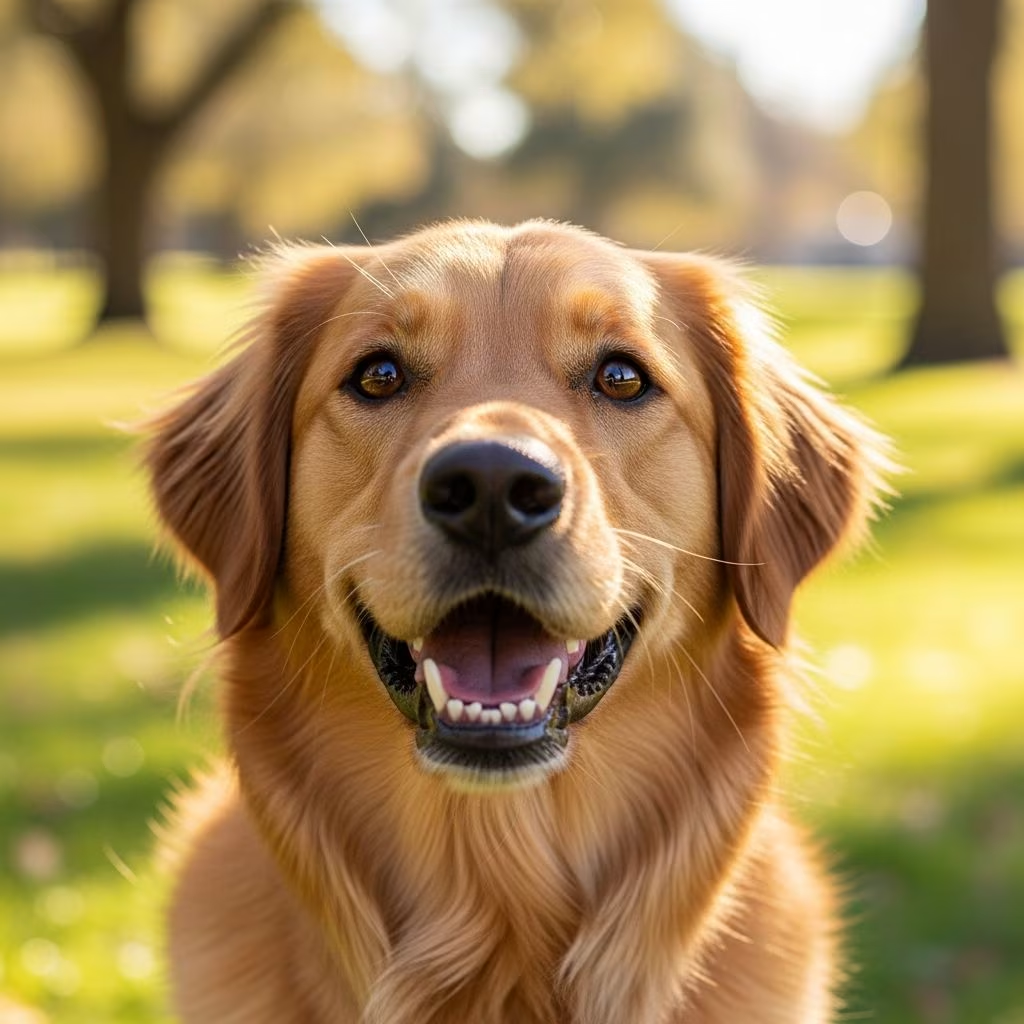
Dogs often display open mouths with tongues lolling out, prompting owners to interpret these as smiles expressing joy. Scientific studies indicate that while dogs do not smile in the exact human sense, their facial expressions serve similar social functions, particularly in interactions with people.
The Anatomy of a Canine Grin
Canine facial muscles differ from human ones, yet dogs possess unique adaptations like the levator anguli oculi medialis (LAOM) muscle, absent in wolves, which allows them to raise their inner eyebrows for expressive puppy-like looks. A typical “happy” dog expression includes a relaxed open mouth, visible teeth without tension, a loosely hanging tongue, soft eyes that may squint or blink, and overall loose body posture with a gentle tail wag. These signals collectively communicate contentment and safety rather than isolated facial joy.
Research shows dogs produce these expressions more frequently around humans than conspecifics, suggesting domestication has tuned their faces for human bonding. Positive human responses, such as smiles or treats, reinforce this behavior through operant conditioning.
Evolutionary Roots of Dog Expressions
Over thousands of years of cohabitation, dogs evolved facial musculature to mimic human emotions, enhancing survival through human favoritism. Studies confirm dogs respond to human smiles with their own expressions, akin to emotional contagion where one party’s happiness triggers another’s. For instance, experiments trained dogs to distinguish happy from angry human faces using only partial images, proving they process expressions holistically beyond simple cues like teeth visibility.
This mimicry activates brain regions like the amygdala, releasing hormones that link human presence to positive feelings, prompting facial relaxation. Unlike wolves, domestic dogs show heightened expressiveness, with the LAOM muscle eliciting caregiving responses from humans.
Decoding True Happiness from Stress Signals
Not every open-mouthed display means happiness. Behaviorists identify “submissive grins” or stress smiles where lips curl back tensely, often with pinned-back ears, lip licking, yawning, averted gaze, stiff body, or lowered posture. These indicate anxiety, fear, or appeasement rather than joy.
| Happy Smile Indicators | Stress Smile Indicators |
|---|---|
| Relaxed open mouth, lolling tongue | Tense lip curl, showing teeth rigidly |
| Soft, squinty eyes; blinking | Wide eyes; averted gaze |
| Loose body; gentle tail wag | Stiff posture; tucked tail; pinned ears |
| Play bows or forward lean | Yawning, lip licking, trembling |
Context matters: a dog “grinning” after mischief often shows submissive cues like lowered head and squinting eyes, not guilt but anticipation of correction. Whole-body language provides the fullest picture.
How Dogs Read Human Emotions
Dogs excel at interpreting human faces, discriminating smiles from frowns even in fragmented photos. This ability fosters reciprocity; a human smile can elicit a canine one via oxytocin release, deepening bonds. Owners’ dogs particularly recognize their smiling faces versus neutral or strangers’, underscoring personalized emotional attunement.
Breed Variations in Expressiveness
- Short-nosed breeds (e.g., Bulldogs, Pugs): Facial structure exaggerates grins but limits subtlety; observe body cues closely.
- Long-nosed breeds (e.g., Labs, Collies): Pronounced lip and eye movements make happiness clearer.
- Working breeds (e.g., Shepherds): Reserved expressions; smiles rarer but genuine when paired with play signals.
- All breeds share core signals, but flat-faced dogs may pant more, mimicking smiles.
Enhancing Communication with Your Dog
To encourage genuine happy expressions, use positive reinforcement: reward relaxed faces with praise or play. Avoid forcing interactions during stress signals; instead, create safe spaces. Training games teaching “sit for smile” leverage their human-reading skills. Regular observation hones your interpretation, preventing misreads that strain bonds.
Health factors influence expressions: dental pain or respiratory issues in brachycephalic breeds can alter mouths, mimicking stress. Vet checkups ensure physical causes aren’t misread as behavioral.
FAQs
Can all dogs smile the same way?
No, breed anatomy affects expression clarity, but universal body language cues confirm emotions across all.
Does my dog smile because it loves me?
Expressions signal comfort and affiliation, strengthened by bonding hormones during interactions.
What if my dog’s “smile” comes with whining?
Paired with tension, it indicates stress; separate from triggers and consult a behaviorist.
Do puppies smile more than adults?
Puppies use exaggerated expressions for nurturing; adults refine for social nuance.
Is a panting dog always happy?
Panting regulates temperature but with relaxed cues, it aligns with contentment; stiffness signals distress.
Practical Tips for Reading Your Dog
- Observe the full body: Tail, ears, posture trump face alone.
- Note context: Play vs. correction alters meaning.
- Respond positively to happy signs to reinforce.
- Track patterns: Journal expressions with situations for insights.
- Seek pro help for persistent stress signals.
Understanding these nuances transforms casual observation into empathetic communication, enriching the human-dog partnership.
References
- Do Dogs Smile? Vet Approved Guide to the Science Behind Canine Expressions (2025) — Dr. Duncan Houston BVSc, Ask A Vet. 2025. https://askavet.com/blogs/news/do-dogs-smile-vet-approved-guide-to-the-science-behind-canine-expressions-2025
- Do Dogs Smile? If So, Why? — PetMD. Accessed 2026. https://www.petmd.com/dog/behavior/do-dogs-smile-science-behind-looks-we-get-happy-dog
- Are you happy? Your dog can tell — Science | AAAS. 2016-09-01. https://www.science.org/content/article/are-you-happy-your-dog-can-tell
- Can Dogs Smile? — Zoetis Petcare. Accessed 2026. https://www.zoetispetcare.com/blog/article/can-dogs-smile
- Do Dogs Smile? — Mobility Service Dog – West Coast Project. 2024-03-10. https://mobilitydog.org/blog-about-mobility-service-dogs-and-their-ada-handlers/2024/3/10/do-dogs-smile
- Do Dogs Smile? — Psychology Today. 2025-02. https://www.psychologytoday.com/us/blog/canine-corner/202502/do-dogs-smile



