

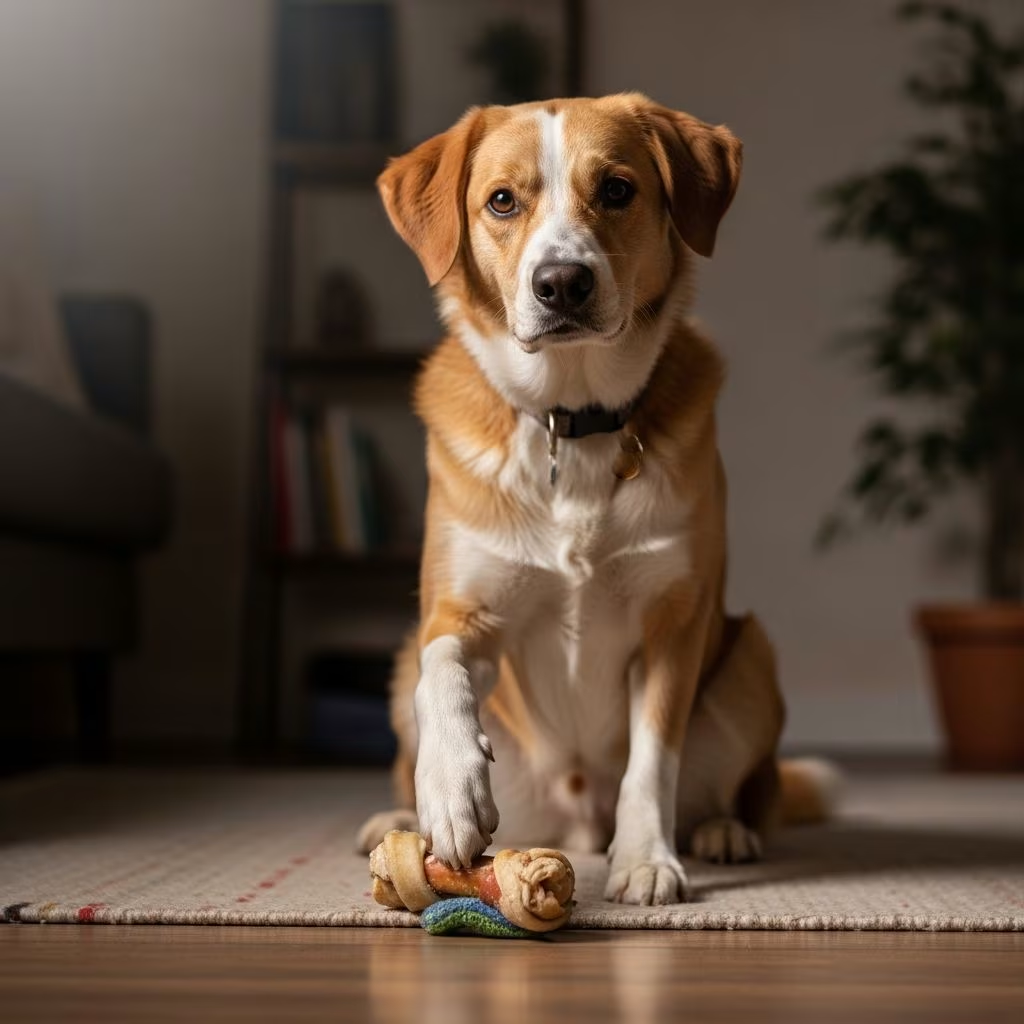
Dogs display paw preferences akin to human handedness, with many favoring one paw over the other in tasks like reaching or stabilizing objects. This laterality, or sidedness, varies by sex, age, and even owner influence, as supported by multiple studies on canine behavior.
Understanding Paw Preference in Canines
Paw preference refers to a dog’s consistent use of one forelimb over the other for specific actions, mirroring how humans favor a dominant hand. Research indicates that while not all dogs show a strong bias, a significant portion do, with patterns emerging across populations. For instance, surveys of thousands of dogs reveal that females tend toward right-paw dominance more than males.
This phenomenon arises early in life and strengthens with age. Younger dogs may switch paws more fluidly, but elderly ones solidify their preference, often leaning right-pawed. Scientists attribute this to neurological development similar to humans, where brain hemispheres specialize functions, leading to lateral biases.
How Paw Preference Manifests Daily
In everyday scenarios, paw dominance appears subtly. Dogs might consistently lift the same leg to urinate (males especially), offer a specific paw for shakes, or circle in one direction before lying down. Scratching an itch could involve the nearer paw, but repeated patterns signal true preference.
- Leg lifting: Male dogs often mark territory with their dominant-side leg.
- Paw shakes: Trained behaviors highlight the favored paw.
- Play retrieval: Reaching for toys or food uses the preferred limb.
Observing these habits provides insights into your dog’s natural tendencies without formal testing.
Scientific Methods to Test Paw Dominance
Researchers employ standardized tests to quantify paw preference reliably. These avoid training biases and focus on innate choices.
The Kong Test
Dogs hold a food-stuffed Kong toy with one paw while extracting treats. The paw used most frequently indicates dominance. This test is popular due to its simplicity and repeatability, though some debate if it measures holding or support paw.
Locomotion and Step Tests
Observe which paw steps forward first on stairs or ramps. Consistency across trials suggests a general preference stable in movement tasks.
Reach and Paw Tasks
In reach tasks, dogs retrieve items from under furniture, using their preferred paw. Paw tasks involve owners presenting hands for a shake response. These reveal influences like owner handedness.
| Test Type | Description | Reliability Notes |
|---|---|---|
| Kong Test | Stabilize toy for food | High repeatability; task-specific |
| Step Test | First paw on step | Stable across locomotion |
| Reach Task | Retrieve under object | Influenced by owner hand |
| Paw Task | Respond to hand cue | May involve training bias |
Perform tests over multiple sessions (e.g., 10 trials) for accuracy, scoring paws used to calculate a dominance index.
Sex and Age Influences on Paw Choice
Studies of nearly 18,000 dogs show females are right-paw dominant at 61%, males at 56%. Elderly dogs amplify this right bias, while puppies, especially males, show left preferences that shift rightward with maturity.
Females maintain right bias across life stages; males start left-pawed in puppyhood, transitioning later. This ontogenetic shift parallels human development, suggesting shared evolutionary roots.
- Females: Consistent right preference from youth.
- Males: Left in early life, right in adulthood.
- Seniors: Stronger overall right dominance.
Owner Handedness Shapes Dog Paw Bias
A key discovery: dogs mimic owner handedness. Right-handed owners’ dogs show right-paw bias in reach tasks; left-handers’ dogs lean left. This social learning aids domestication, as dogs imitate humans efficiently via observation.
In paw tasks, prior training (e.g., ‘give paw’) can override cues, but reach tasks clearly link to owner side. Researchers recommend considering this for service dog pairings.
Social learning reduces trial-and-error risks, enhancing survival in human environments.
Personality and Service Dog Success
Right-pawed dogs often succeed more as guide dogs, linked to calmer, less fearful temperaments. Left-pawed or ambidextrous dogs may exhibit higher reactivity.
However, emotionality links remain inconclusive; some studies find no paw-personality correlation, suggesting task-specificity over broad traits.
Practical Tips for Dog Owners
Identify your dog’s paw preference to tailor training and enrichment:
- Use dominant paw for complex tricks to build confidence.
- Balance exercise to prevent overuse injuries.
- Monitor changes, as shifts might signal health issues.
For service prospects, early right-paw bias predicts training success. Owners can test via simple home methods.
Debates and Research Gaps
Not all dogs paw strongly; ambilaterality exists. Test efficacy varies—Kong may favor support paw, tasks owner influence. Larger, longitudinal studies needed for causality.
Human-dog co-evolution amplifies imitation, but genetics play roles too. Future work may clarify brain lateralization in canines.
Frequently Asked Questions
Can all dogs develop paw preference?
Most do, but some remain ambidextrous. Preference strengthens with age and practice.
Does paw preference affect health?
Over-reliance might strain joints; balanced activity helps. Consult vets for limps.
How do I test my puppy’s paw?
Use non-trained tasks like Kong or steps; repeat over days for patterns.
Is left-pawedness a concern?
No, but may correlate with reactivity in service contexts. Normal variation.
Can training change dominance?
Training influences response but not innate preference. Use natural biases.
Key Takeaways on Canine Laterality
Paw preference is real, influenced by biology and environment. Females and seniors favor right paws; owners shape it via imitation. Tests like Kong reveal patterns, aiding training and understanding.
Observing your dog fosters deeper bonds, revealing quirks tied to their unique neurology.
References
- Do Dogs Have a Dominant Paw? — ElleVet Sciences. 2021. https://www.ellevetsciences.com/blog/do-dogs-have-a-dominant-paw/
- Does owner handedness influence paw preference in dogs? — PMC (Peer-reviewed). 2023-03. https://pmc.ncbi.nlm.nih.gov/articles/PMC9950156/
- Is There an Association between Paw Preference and Emotionality? — PMC (Peer-reviewed). 2022. https://pmc.ncbi.nlm.nih.gov/articles/PMC9103732/
- Your Dominant Hand May Determine Your Dog’s Paw Preference — Total Vet. 2023. https://total.vet/dog-paw-preference/



