

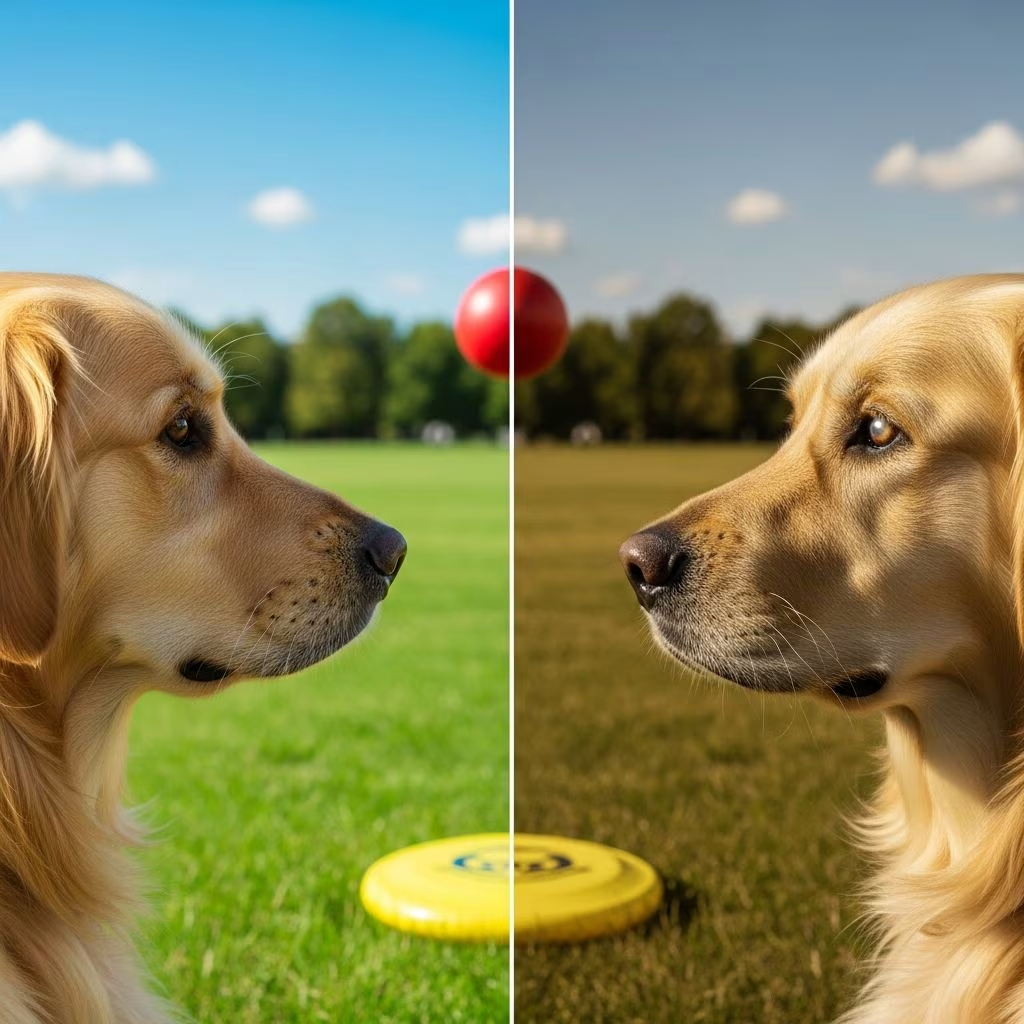
Dogs experience the world through a visual lens that differs markedly from human perception, primarily due to their dichromatic color vision system. Unlike humans with trichromatic vision capable of discerning a full spectrum of colors, dogs rely on two types of cone photoreceptors, enabling them to differentiate blues and yellows while viewing reds and greens as similar shades of grayish-yellow or brown.
The Science of Canine Vision
At the heart of a dog’s color perception lies the retina, which contains rods for low-light vision and cones for color detection. Human retinas feature three cone types sensitive to short (blue), medium (green), and long (red) wavelengths, allowing for rich color differentiation. Dogs, however, have only two cone classes: one peaking at approximately 429 nm (blue-violet) and another at 555 nm (yellow-green). This dichromacy means dogs cannot distinguish between reds and greens, perceiving them as overlapping hues.
Research confirms this through behavioral experiments where dogs were trained to select differently colored circles from sets of three. They consistently identified blues against yellows or grays but failed to differentiate reds from greens, even when brightness was controlled. Spectral sensitivity tests further support that dogs’ color world comprises blues, yellows, and grays, with a neutral point around 475-485 nm appearing as white or gray—equivalent to human greens or light blues.
Myths vs. Reality: Debunking Dog Color Blindness
- Common Myth: Dogs see only in black and white. Reality: This outdated belief stems from early assumptions but has been refuted by studies showing dichromatic capabilities.
- Partial Truth: Dogs lack the red-green cone distinction, akin to human red-green color blindness, but they excel at blues and yellows.
- Visual Trade-offs: More rods than cones enhance night vision and motion detection, compensating for limited color range.
Understanding these facts helps owners appreciate why a yellow tennis ball pops against green grass for a dog— the grass appears dull grayish-brown, making the ball vivid yellow.
How Dogs Perceive Specific Colors
Dogs interpret colors through their limited cones:
| Human Color | Dog Perception | Reason |
|---|---|---|
| Blue | Vivid blue | Strong response from short-wavelength cone |
| Yellow | Bright yellow | Peaks with medium-wavelength cone sensitivity |
| Green | Grayish-yellow or brown | Confused with yellow due to overlapping signals |
| Red | Dull grayish-brown | No dedicated cone; appears like dark yellow |
| Purple | Blue-gray | Blue dominance with muted tones |
| Orange | Yellowish-gray | Blends into yellow spectrum |
This table illustrates why toys in blue or yellow are more engaging for dogs, as they stand out sharply in their visual field.
Implications for Toys, Training, and Toys
Choosing the right colors enhances a dog’s interaction with their environment. Blue and yellow toys are ideal because they appear vibrant, aiding in play and training. Red or green items may blend into backgrounds, reducing visibility.
- Use blue leashes for better outdoor visibility against grass.
- Opt for yellow fetch balls that contrast with fields.
- Avoid red corrections in training, as they may not register distinctly.
Food bowls in contrasting colors can encourage eating, while bedroom decor in blues promotes relaxation, aligning with their natural sensitivities.
Breed Variations in Eyesight
While all dogs share dichromatic vision, breed-specific eye structures influence overall sight. Brachycephalic breeds like Pugs have prominent eyes offering wider fields but shallower sockets, potentially affecting depth perception. Sighthounds like Greyhounds possess large eyes for enhanced motion tracking, though color perception remains uniform across breeds.
No significant color vision differences exist between breeds; variations primarily impact peripheral vision or acuity.
Vision Strengths Beyond Color
Dogs compensate for color limitations with superior attributes:
- Low-light vision: More rods detect motion in dim conditions.
- Motion sensitivity: Quick eye movements track fast objects.
- UV detection: Possible sensitivity to ultraviolet light, invisible to humans.
- Depth perception: Binocular overlap aids distance judgment, independent of color.
These strengths make dogs exceptional hunters and companions, relying less on color than humans.
Practical Tips for Dog Owners
Leverage canine vision knowledge daily:
- Select toys in blue/yellow for engagement.
- Use contrasting colors for commands or signals.
- Ensure pathways are brightly lit for night safety.
- Monitor eye health with vet checkups, as cataracts can worsen vision.
- Test preferences: Observe toy choices to confirm individual responses.
These adjustments create a more navigable world for your pet.
Frequently Asked Questions (FAQs)
Can dogs see all colors like humans?
No, dogs have dichromatic vision, seeing primarily blues, yellows, and grays, unable to differentiate reds from greens.
Why do dogs chase yellow tennis balls?
Yellow appears bright against perceived grayish grass, creating high contrast.
Do all dog breeds see colors the same way?
Yes, color perception is consistent; differences lie in eye shape affecting field of view.
Is dog vision worse than human vision?
In color range, yes; but superior in low light and motion detection.
Can dogs see TV or screens?
Limitedly, due to flicker rates and color mismatches, but motion draws attention.
Health Considerations for Canine Eyes
Vision issues like progressive retinal atrophy or cataracts can degrade even dichromatic sight. Regular exams detect problems early. Aging dogs may develop nuclear sclerosis, clouding lenses but preserving function longer than in humans.
Nutrition supports eye health: Antioxidants like lutein in blueberries (perceived as blue) benefit retinal cells. Avoid over-reliance on color for training; use shapes and scents too.
Comparing Dog and Human Vision
| Aspect | Humans (Trichromatic) | Dogs (Dichromatic) |
|---|---|---|
| Cone Types | 3 (Red, Green, Blue) | 2 (Blue, Yellow) |
| Color Range | Full spectrum | Blues, yellows, grays |
| Strengths | Detail, color variety | Night vision, motion |
| Weaknesses | Poor low light | Red-green confusion |
This comparison underscores evolutionary adaptations: dogs as crepuscular hunters prioritize detection over hue.
Future Research Directions
Ongoing studies explore genetic variations in cone pigments and UV vision potential. Advanced imaging refines models of dog-perceived worlds, aiding product design.
References
- Color Vision in the Dog — PubMed/NIH. 1989-07-01. https://pubmed.ncbi.nlm.nih.gov/2487095/
- Is Fido Color Blind? Understanding Your Dog’s Eyesight — Paw Prints Easley. 2025. https://www.pawprintseasley.com/understanding-your-dogs-eyesight/
- Can Dogs See Color? And How Do We Know? — CattleDog Publishing. N/A. https://cattledogpublishing.com/blog/can-dogs-see-color-and-how-do-we-know/
- Discover what color looks like for your cat or dog — Blue Buffalo. N/A. https://www.bluebuffalo.com/articles/pets/how-do-pets-see-color/
- Can Dogs See Color? — American Kennel Club. N/A. https://www.akc.org/expert-advice/health/can-dogs-see-color/
- Colour Vision in the Dog: A Brief Summary — Royal Kennel Club. N/A. https://www.royalkennelclub.com/media/3932/annex-a-colour-vision-in-the-dog.pdf



