

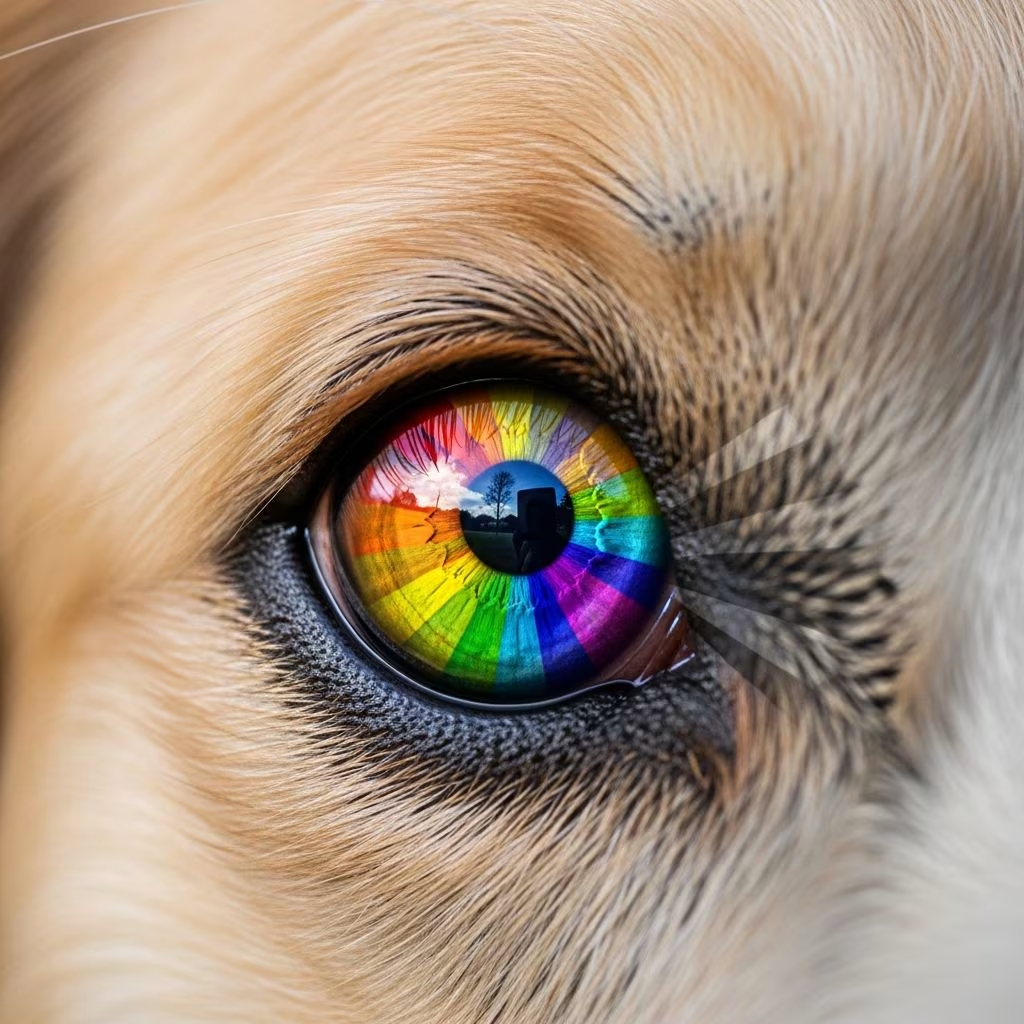
Dogs experience a vibrant yet distinct visual world, relying on two types of color-sensing cones that emphasize blues and yellows over the full human spectrum. This dichromatic vision challenges the outdated belief that dogs see only in black and white, revealing a more nuanced perception shaped by evolution and biology.
The Science of Canine Vision
At the heart of a dog’s eyesight lies the retina, which contains rods for detecting motion and low light, and cones for color differentiation. Humans possess three cone types sensitive to red, green, and blue wavelengths, enabling a broad color palette. Dogs, like most mammals, have just two cone types: one attuned to shorter blue wavelengths and another to longer yellow ones. This setup results in dichromatic vision, where reds and greens blend into muddy grays or browns.
Research from the University of Washington highlights that without red-sensing cones, dogs’ color perception mirrors human red-green color blindness. Jay Neitz, a leading ophthalmology expert, explains this limitation stems from genetic adaptations favoring scent and motion over vivid hues. In practical terms, a bright red toy might appear as dark gray to a dog, while a lime green ball fades into yellowish tones.
How Dogs Perceive the Color Spectrum
Dogs interpret the rainbow differently: what we see as red becomes dull brown, orange shifts to dark yellow, yellow remains vivid, green turns grayish-yellow, blue stays prominent, and violet appears as deeper blue. This selective palette means dogs excel at spotting blue objects against green grass but struggle with red fruits or green vegetables.
| Human Color | Dog’s Perception | Example Object |
|---|---|---|
| Red | Dark gray/brown | Red ball |
| Orange | Dark yellow | Orange toy |
| Yellow | Light yellow | Lemon |
| Green | Grayish yellow | Grass |
| Blue | Light blue | Sky |
| Violet | Dark blue | Purple flower |
This table illustrates key distinctions, drawn from cone sensitivity studies. Dogs’ superior night vision, thanks to more rods, compensates for color limits, aiding hunts in dim conditions.
Debunking the Black-and-White Myth
The notion of dogs as fully colorblind arose from early 20th-century tests that failed to control for brightness, leading researchers to assume dogs ignored hue. Modern experiments prove otherwise. A 2013 study in Proceedings of the Royal Society B trained eight dogs to select food-linked papers: dark yellow vs. light blue or light yellow vs. dark blue. Despite equal discriminability by brightness, dogs chose based on color over 70% of the time, with six achieving 90-100% accuracy.
These findings indicate color serves as a primary cue under natural lighting, overturning assumptions that brightness dominates. Smithsonian reports confirm dogs actively use their limited palette for object recognition, enriching our view of their world.
Brightness vs. Color: What Dogs Prioritize
- Training Phase Insights: Dogs learned to associate specific hues with rewards, ignoring luminance differences.
- Real-World Application: In parks, a blue frisbee stands out more than a red one, even if equally bright.
- Limitations: Low light activates rods only, eliminating color temporarily.
Unlike prior research, this study allowed brightness cues yet dogs favored chromatic signals, suggesting evolutionary preference for reliable object identification. PetMD notes dogs distinguish blue-yellow variations adeptly, akin to human protanopia.
Implications for Dog Owners and Trainers
Understanding this vision transforms daily interactions. Opt for blue or yellow toys and leashes for visibility—red ones may blend into soil. Training benefits too: color-coded commands (blue for sit, yellow for stay) enhance learning, as dogs memorize hues effectively.
Breeds vary slightly; herding dogs with acute motion detection might leverage color less, but the core dichromatic model holds across mixes. VCA Hospitals advises against assuming grayscale sight, as it underestimates sensory capabilities.
Visual Acuity and Other Strengths
Dogs’ eyesight includes trade-offs: visual acuity is 20/75 vs. human 20/20, with a narrower focal range but wider peripheral view (240° vs. 180°). Enhanced motion sensitivity detects subtle twitches, ideal for spotting prey.
- Night vision: 4x better due to tapetum lucidum reflector.
- Motion detection: Excels at fast-moving objects.
- UV sensitivity: Possible detection of urine marks invisible to us.
Common Misconceptions Clarified
Myth 1: Dogs see no color. Fact: They see a blue-yellow world.
Myth 2: Brightness trumps all. Fact: Color often leads.
Myth 3: All dogs see identically. Fact: Minor breed differences exist.
Health Factors Affecting Vision
Age, cataracts, or progressive retinal atrophy can impair color sight. Regular vet checks preserve quality of life. Nutritional support with antioxidants aids retinal health.
Frequently Asked Questions (FAQs)
Are dogs truly colorblind?
No, they have dichromatic vision focused on blue and yellow, not monochrome.
What is the best color for dog toys?
Blues and yellows for maximum visibility and appeal.
Can dogs see in the dark better than humans?
Yes, due to more rods and the tapetum lucidum.
Do all dog breeds see colors the same way?
Generally yes, though working breeds may prioritize motion.
Should I avoid red items for my dog?
Red appears dark gray, so use contrasting colors instead.
Enhancing Your Dog’s Visual Experience
Incorporate high-contrast environments: yellow bedding against blue walls. Puzzle toys in detectable hues stimulate mentally. Outdoor play with blue balls leverages natural strengths.
Scientific progress continues; future studies may explore UV or polarization sensitivity, further illuminating canine perception.
References
- New Study Shows That Dogs Use Color Vision After All — Smithsonian Magazine. 2013-08-14. https://www.smithsonianmag.com/science-nature/new-study-shows-that-dogs-use-color-vision-after-all-13168563/
- Colour cues proved to be more informative for dogs than brightness — Proceedings of the Royal Society B (PMC). 2013-09-07. https://pmc.ncbi.nlm.nih.gov/articles/PMC3730601/
- What Colors Can Dogs See? Are Dogs Color Blind? — PetMD. Accessed 2026. https://www.petmd.com/dog/general-health/what-colors-can-dogs-see
- Do Dogs See Color? — VCA Animal Hospitals. Accessed 2026. https://vcahospitals.com/know-your-pet/do-dogs-see-color
- Can dogs see color? The truth behind your pet’s eyesight — University of Washington Ophthalmology. Accessed 2026. https://ophthalmology.washington.edu/news/can-dogs-see-color-the-truth-behind-your-pets-eyesight
- Dogs don’t see life through rose-colored glasses — Phys.org. 2023-09. https://phys.org/news/2023-09-dogs-dont-life-rose-colored-glasses.html



