

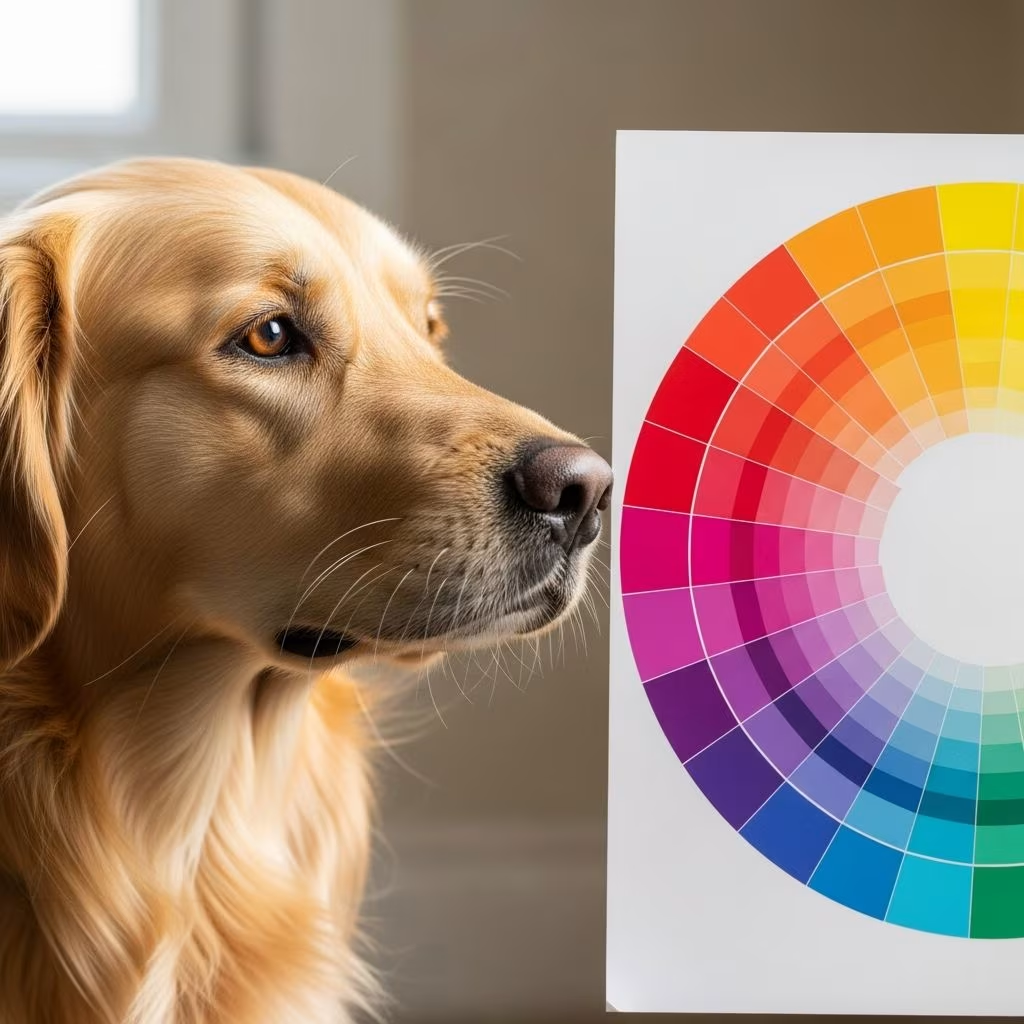
Dogs possess dichromatic vision, meaning they see colors but in a limited range compared to humans, primarily distinguishing blues and yellows while perceiving reds and greens as shades of gray or brown.
The Science Behind Canine Color Perception
Human eyes contain three types of cone cells sensitive to red, green, and blue wavelengths, enabling trichromatic vision that captures the full spectrum of colors. In contrast, dogs have only two cone types: one sensitive to short-wavelength blue light (around 429 nm) and another to medium-to-long wavelengths (around 555 nm), akin to yellow. This setup results in a worldview dominated by blues and yellows, with reds and greens appearing muted or indistinguishable.
Neurobiological studies confirm this retinal structure, showing dogs’ cones align with dichromatic capabilities similar to human red-green color blindness, or deuteranopia. Behavioral experiments reinforce that dogs actively use color cues in decision-making, not just brightness.
Myths and Realities of Dog Vision
- Common Myth: Dogs see only black and white. Reality: They detect colors, though limited.
- Common Myth: Color plays no role in a dog’s life. Reality: Dogs prefer and learn via color differences, especially blue vs. yellow.
- Common Myth: All dogs have identical vision. Reality: Color perception is consistent across breeds, but acuity varies with facial structure.
Early assumptions of grayscale vision stemmed from outdated tests ignoring cone sensitivities. Modern research debunks this, proving dogs discriminate hues effectively under natural light.
How Dogs Perceive Specific Colors
Dogs interpret the color spectrum differently:
| Human Color | Dog Perception | Notes |
|---|---|---|
| Red | Dark gray/brown | Blends with green; low distinction. |
| Orange | Grayish brown | Limited saturation. |
| Yellow | Light yellow/grayish yellow | Vivid and well-detected. |
| Green | Yellowish gray | Confused with red. |
| Blue | Light/dark blue | Clearly distinguished. |
| Violet | Dark blue | Strong perception. |
This table illustrates why blue toys stand out to dogs while red ones may go unnoticed.
Key Experiments Proving Dogs Use Color
A pivotal 2013 study tested eight mixed-breed dogs with papers in dark yellow, light yellow, dark blue, and light blue—hues and brightness levels tailored to canine sensitivity. During training, dogs associated one color with food rewards. In tests, they chose correctly by color over 70% of the time, six dogs at 90-100%, prioritizing hue over brightness. This challenges trainers’ avoidance of color cues.
Another study adapted the Ishihara test for dogs, confirming red-green blindness via behavioral responses matching human deuteranopes. Dogs failed to distinguish red-green plates but succeeded with blue-yellow ones, validating dichromacy.
Associative learning trials with purebred dogs further showed wavelength matching, supporting dichromatic models.
Comparing Dog and Human Vision
| Aspect | Humans (Trichromatic) | Dogs (Dichromatic) |
|---|---|---|
| Cone Types | 3 (Red, Green, Blue) | 2 (Blue, Yellow) |
| Color Range | Full spectrum | Blue-Yellow axis |
| Red-Green Distinction | Excellent | Poor (gray shades) |
| Visual Acuity | Higher detail | 4-8x lower |
| Brightness Discrimination | Superior | 2x worse |
Dogs compensate with superior low-light vision and motion detection, thanks to more rods.
Implications for Dog Owners and Trainers
Understanding canine color vision enhances daily interactions:
- Toys and Training Aids: Opt for blue or yellow items; avoid red, which fades into backgrounds.
- Home Environment: Blue-yellow accents guide navigation better than red-green.
- Agility and Sports: Use contrasting blue obstacles for visibility.
- Health Checks: Vision issues mimic color limits; consult vets for eye exams.
Trainers should incorporate color strategically, as dogs learn hue associations reliably.
Breed Variations in Overall Eyesight
While color vision is uniform, other traits differ:
- Brachycephalic breeds (e.g., Pugs) have shallower sockets, impacting peripheral vision.
- Hunting breeds excel in motion tracking.
- Most achieve emmetropia (perfect focus), but conformation affects field of view.
No breed-specific color advantages noted in studies.
FAQs on Canine Color Vision
Are all dogs color blind?
No, dogs see color dichromatically, not monochromatically like true color blindness.
Can dogs see blue?
Yes, blues appear vivid; one of their strongest hues.
Why do red toys seem ignored?
Red looks like dark gray, blending with surroundings.
Do puppies see color at birth?
Vision develops; full color by 8-12 weeks, like humans.
Does diet affect dog vision?
Nutrient deficiencies (e.g., vitamin A) impair rods/cones; balanced food prevents this.
Enhancing Your Dog’s Visual World
Leverage their strengths: provide high-contrast toys, ample daylight for cone activation, and regular vet checks for cataracts or retinal issues common in aging dogs. Research continues evolving our grasp, but current evidence empowers better care.
References
- New Study Shows That Dogs Use Color Vision After All — Smithsonian Magazine. 2013-04-23. https://www.smithsonianmag.com/science-nature/new-study-shows-that-dogs-use-color-vision-after-all-13168563/
- Are dogs red–green colour blind? — PMC – NIH (Proceedings of the Royal Society B). 2017-11-08. https://pmc.ncbi.nlm.nih.gov/articles/PMC5717654/
- Can Dogs See Color? Here’s What Veterinarians Say — Chewy Education (Veterinary Ophthalmologist Insights). 2023. https://www.chewy.com/education/dog/health-and-wellness/can-dogs-see-color
- 20 Amazing Facts About Dog’s Vision — Plush Paws Products. Accessed 2026. https://plushpawsproducts.com/blogs/news/through-a-dogs-eyes-20-amazing-facts-about-dogs-vision
- Do Dogs See Color? | VCA Animal Hospitals — VCA. Accessed 2026. https://vcahospitals.com/know-your-pet/do-dogs-see-color



