

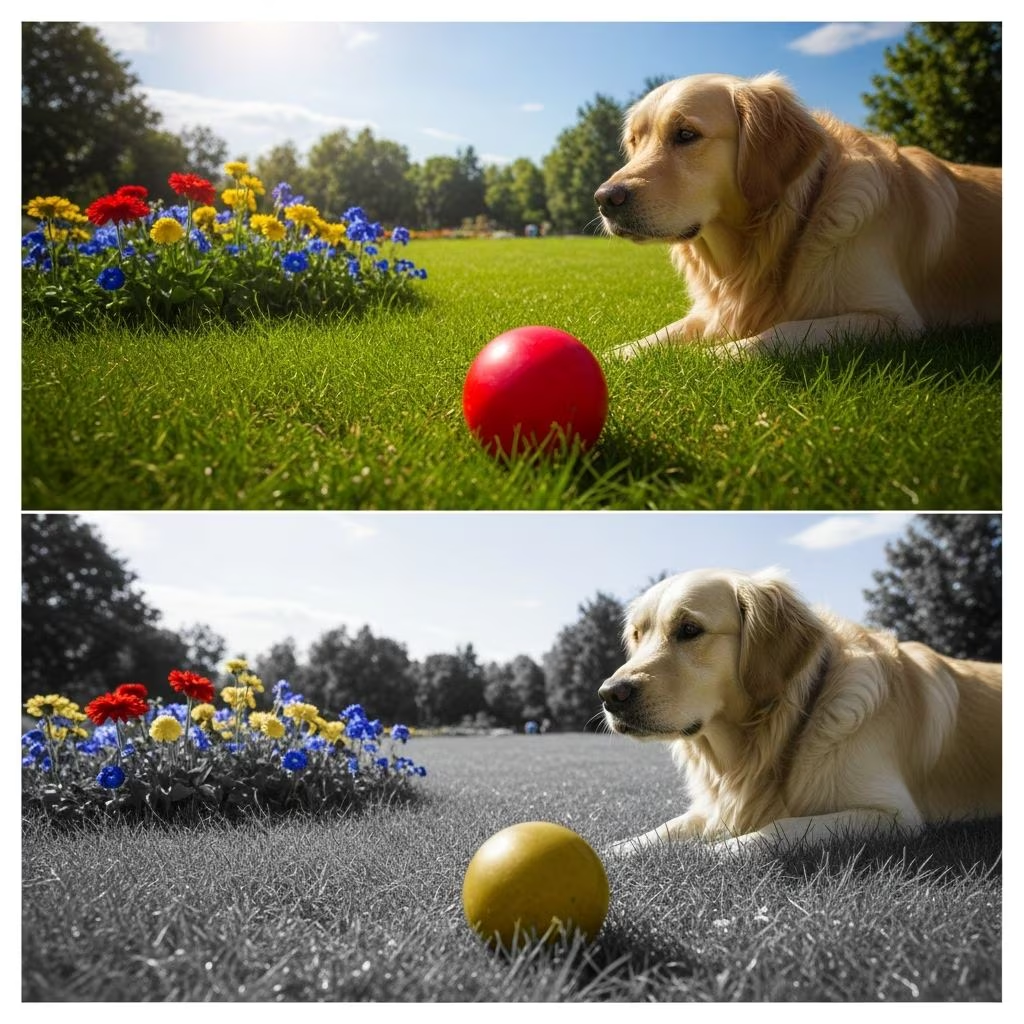
Dogs possess dichromatic color vision, relying on two types of cone cells sensitive to blue-violet and yellow-green wavelengths, which makes their world less vibrant than humans’ trichromatic view but still colorful.
The Science Behind Canine Vision
Understanding how dogs see color starts with their retinal structure. Unlike humans, who have three cone types detecting red, green, and blue light, dogs have only two: one peaking at 429 nm (blue) and another at 555 nm (yellow-green). This setup results in dichromatic vision, where reds and greens appear muted or indistinguishable, resembling human red-green color blindness or deuteranopia.
Research confirms this through neurobiological analysis and molecular studies of cone pigments. Visual-evoked potentials and immunohistochemistry reveal these two discrete cone classes, enabling dogs to differentiate certain hues but not the full spectrum. Behavioral experiments further validate this, showing dogs respond to color differences beyond mere brightness.
Myths vs. Facts: Debunking Dog Color Blindness
The old myth that dogs see only in black and white stems from early, conflicting studies, but modern evidence proves otherwise. Dogs are not colorblind; they perceive a palette shifted toward blues and yellows, with reds often appearing as dark yellows or grays.
- Common Myth: Dogs see monochrome like old TVs.
- Fact: Dichromatic vision allows hue discrimination, especially in blue-violet and yellow-green ranges.
- Human Comparison: Dogs’ view mirrors red-green blind individuals, confirmed by modified Ishihara tests where dogs oriented toward specific color patterns like colorblind humans.
Visual acuity in dogs is lower—four to eight times worse than humans—due to fewer ganglion cell connections and optic nerve fibers, prioritizing motion and low-light detection over sharp detail.
How Dogs Perceive Specific Colors
Dogs excel at distinguishing blue-violet shades and yellow-greens but conflate reds with darker tones. A 2025 cognitive study using eye-tracking on walks captured over 11,000 gazes, revealing dogs fixate on colorful objects like vehicles or plants, indicating active color use.
| Color | Human Perception | Dog Perception |
|---|---|---|
| Blue | Vivid blue | Strong blue-violet |
| Yellow | Bright yellow | Clear yellow-green |
| Green | Rich green | Muted yellow or gray |
| Red | Bright red | Dark yellow/gray |
| Purple | Purple | Blue-gray |
This table summarizes spectral sensitivities: Dogs’ cones divide their spectrum into blue-violet (well-seen) and yellow-green groups.
Testing Color Vision in Dogs
Scientists employ associative learning with food rewards and unlearned orienting responses to assess canine color vision. In one study, dogs chose color over brightness cues, proving hue importance. A novel method adapted the Ishihara test: Dogs reacted to a moving ‘cat’ figure in colors mimicking plate 22’s ‘2’ (visible to dichromats) but ignored plate 6’s ‘6’ (invisible), directly confirming red-green blindness-like vision.
Other tests train dogs to select colored panels for treats, matching wavelengths and supporting dichromatic models. Eye-tracking during walks shows individualized attention to colors, with some dogs fixating on buses or pavement.
Why Color Matters for Dogs Daily
Though less reliant on color than humans, dogs use it for foraging, navigation, and social cues under natural light. Brightness discrimination is weaker than humans’ (twice as poor), but color aids object detection. In roles like guide dogs or search-and-rescue, understanding limits helps optimize training with blue/yellow cues.
Pet owners benefit too: Toys in blue or yellow stand out more, enhancing play. Low cone count (3% of retinal cells vs. humans’ 5%) emphasizes rods for night vision.
Comparing Dog and Human Eyesight
Humans’ trichromatic system (L, M, S cones) yields millions of colors; dogs’ dichromacy limits to thousands. Dogs’ superior motion sensitivity and night vision (more rods) compensate, but daytime acuity lags.
- Dogs: 10% color cells, focus on movement.
- Humans: Sharper detail, richer colors.
Practical Tips for Enhancing Your Dog’s Visual World
Choose toys and collars in blues, yellows for visibility. Avoid red-based items, as they blend into backgrounds. During training, use contrasting colors against environments.
For health, watch for vision changes signaling issues like cataracts. Regular vet checks ensure optimal sight.
Frequently Asked Questions (FAQs)
Are dogs truly colorblind?
No, they have dichromatic vision, seeing blues and yellows distinctly but not reds/greens.
What does the world look like to a dog?
A desaturated version: Blues pop, reds dull to grays, with emphasis on motion over detail.
Can all dogs see color the same way?
Most breeds share dichromatic vision, though individuals vary in focus.
How was dog color vision scientifically proven?
Through retinal studies, pigment analysis, and behavioral tests like modified Ishihara plates.
Should I buy color-specific toys for my dog?
Yes, prioritize blue and yellow for better engagement.
Implications for Training and Welfare
In animal-assisted therapy or guide work, leveraging dogs’ strengths—blue/yellow discrimination and motion tracking—improves efficacy. Research underscores dogs as models for human retinal disorders, advancing ophthalmology.
Daily, this knowledge fosters empathy: A red ball might vanish against grass for your dog, explaining chase frustrations. Tailor environments accordingly for happier pets.
References
- Are dogs red–green colour blind? — PMC – NIH. 2017-11-08. https://pmc.ncbi.nlm.nih.gov/articles/PMC5717654/
- How Do Dogs See The World? They Do See Color, But They Focus More on Us — Discover Magazine. 2025. https://www.discovermagazine.com/how-do-dogs-see-the-world-they-do-see-color-but-they-focus-more-on-us-48134
- How do dogs see the world? — BBC Science Focus Magazine. Recent. https://www.sciencefocus.com/nature/how-do-dogs-see-the-world
- Do Dogs Have A Color Preference? — SARSEF Virtual Fair. 2025-02-17. https://virtualfair.sarsef.org/wp-content/uploads/2025/02/5-ANI02-virtual_presentation-2025-02-17T214448.000Z.pdf
- Can dogs see color? The truth behind your pet’s eyesight — University of Washington Ophthalmology. Recent. https://ophthalmology.washington.edu/news/can-dogs-see-color-the-truth-behind-your-pets-eyesight
- What Colors Can Dogs See? Are Dogs Color Blind? — PetMD. Recent. https://www.petmd.com/dog/general-health/what-colors-can-dogs-see
- Do Dogs See Color? — VCA Animal Hospitals. Recent. https://vcahospitals.com/know-your-pet/do-dogs-see-color



