

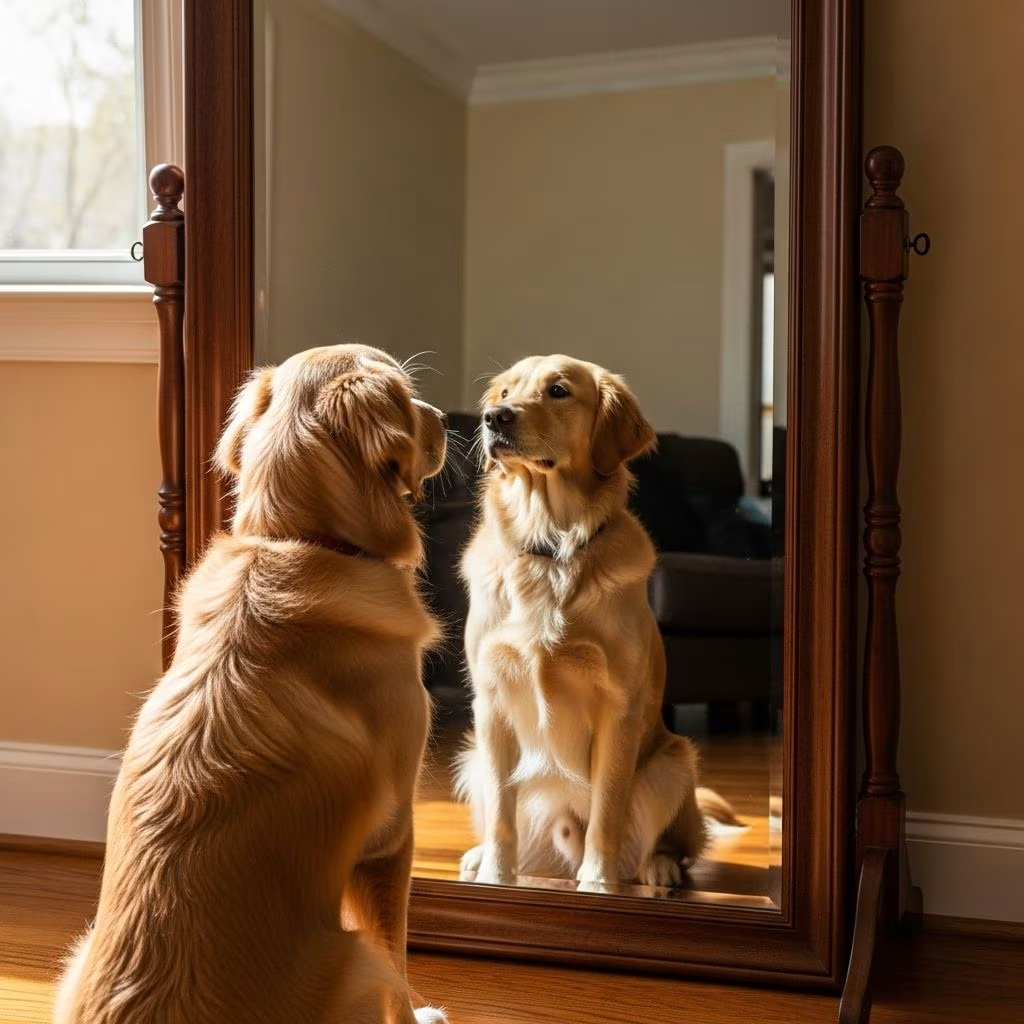
Dogs exhibit a form of self-awareness centered on their physical presence and scent rather than visual self-recognition. Research demonstrates that while they typically fail traditional mirror tests, they succeed in tasks assessing body as an obstacle and olfactory identification, suggesting a nuanced understanding of their own form and identity.
The Limitations of Visual Self-Recognition in Dogs
The mirror mark test serves as the standard benchmark for visual self-recognition in animals. In this experiment, a mark is placed on an animal’s body, and access to a mirror is provided to observe if the animal investigates the mark via its reflection. Species such as great apes, dolphins, elephants, and magpies pass this test, indicating they distinguish their image from others.
Dogs, however, consistently fail the mirror test. When confronted with their reflection, they often react as if encountering another dog—barking, playing, or showing aggression—rather than recognizing themselves. This outcome stems partly from dogs’ reliance on olfaction over vision as their primary sense. Vision plays a secondary role in their perceptual world, making mirror-based assessments less relevant.
Body Awareness: A More Relevant Measure for Canines
Recent studies have shifted focus to body awareness, adapting methods from elephant and infant research. In a key experiment published in Scientific Reports, researchers at Eötvös Loránd University tested 32 dogs of various breeds and sizes using the “body as an obstacle” task.
Dogs sat on a small mat while an experimenter placed a toy at its edge, attached by a string to the mat’s opposite side. To retrieve and deliver the toy to their owner, dogs needed to step off the mat, recognizing that their body anchored the toy in place. In control conditions:
- Unattached toy: Dogs handed over the loose toy without leaving the mat (only 5 out of 49 trials involved departure).
- Foot discomfort: Experimenter tugged the mat under stationary dogs, mimicking test sensations; few left (5 out of 49).
- Attached toy without need to move: Similar low departure rates.
In the test condition, dogs left the mat significantly more often and sooner, especially improving across trials (e.g., trial 2 odds ratio exp(β)=2.19, p<0.001; trial 4 tendency p=0.08). They differentiated self-caused mat movement from external pulls, indicating mental representation of their body's impact on the environment.
| Condition | Dogs Leaving Mat (First Trial) | Statistical Significance |
|---|---|---|
| Test (Toy Attached) | High frequency, quicker departures | p<0.001 vs. controls |
| Unattached Toy | Low (5/49) | Baseline |
| Foot Discomfort | Low (5/49) | No mat-type difference |
| Attached (Pulled by Experimenter) | Lower than test | z=2.835, p=0.005 |
This task reveals dogs’ practical self-awareness: they understand their paws’ spatial occupation and adjust behavior accordingly, akin to novice agility dogs learning obstacle navigation.
Olfactory Self-Recognition: Dogs’ True Mirror?
Given olfaction’s primacy, studies explore scent-based self-recognition. Dogs distinguish their own urine scent from others, suggesting odor as a self-identifier. This parallels mirror success in visually dominant species but leverages canines’ sensory strengths.
While not definitive proof of full self-concept, it indicates dogs maintain a self-representation via smell, potentially equivalent to visual self-recognition in humans.
Other Indicators of Canine Self-Awareness
Beyond body and scent, dogs display cognitive traits linked to self-awareness:
- Episodic memory: Recalling specific past events.
- Imitation: Copying observed actions.
- Empathy: Responding to human emotions.
- Social learning: Adapting via observation.
- Theory of mind hints: Inferring others’ intentions.
Neural studies show hypothalamus activation when witnessing caregiver distress, underscoring emotional attunement tied to social bonds. These abilities, evolved in human environments, support lower-level self-representation focused on action consequences.
Why Traditional Tests Miss the Mark for Dogs
Mirror tests prioritize vision, ecologically irrelevant for dogs. Body-obstacle and scent tasks better align with their perceptual ecology as social predators in anthropogenic niches. Failures in visual tests do not negate self-awareness; they highlight species-specific expressions.
Learning effects in experiments—dogs adapting faster in later trials—further evidence cognitive flexibility.
Implications for Dog Cognition and Training
Understanding canine self-awareness enhances training and welfare. Recognizing body space aids agility or therapy work; scent self-ID informs behavior around smells. Owners can leverage this by using verbal cues paired with physical adjustments, fostering problem-solving.
Future research might integrate multi-sensory tests, combining olfaction, touch, and sound for comprehensive self-representation assessment.
Frequently Asked Questions (FAQs)
Why don’t dogs pass the mirror test?
Dogs prioritize smell over sight, treating mirrors as unfamiliar dogs rather than self-reflections. Adapted tests show awareness via other senses.
Do all dogs show body awareness?
In studies, most did, improving with trials across breeds/sizes, indicating a general canine trait.
Is a dog’s sense of self like humans’?
No, it’s more body- and action-focused, lacking abstract visual self-concept but rich in practical, sensory forms.
Can puppies develop self-awareness?
Like human infants, it emerges developmentally; early tests show learning curves similar to adults.
How does this affect daily dog care?
Encourage problem-solving toys exploiting body awareness for mental stimulation and bonding.
These findings reshape views on dog minds, affirming sophisticated cognition tailored to their world.
References
- Dogs May Be More Self-Aware Than Experts Thought — Smithsonian Magazine. 2021-07-21. https://www.smithsonianmag.com/smart-news/canines-may-have-more-self-awareness-how-their-paws-take-space-180977081/
- Are Dogs Self Aware? New Research Suggests Yes — American Kennel Club (AKC). 2021-07-22. https://www.akc.org/expert-advice/news/a-new-way-to-look-at-dog-self-awareness/
- Dogs (Canis familiaris) recognize their own body as a physical obstacle — PMC / NIH (Scientific Reports). 2021-02-04. https://pmc.ncbi.nlm.nih.gov/articles/PMC7893002/
- Neural Responses of Pet Dogs Witnessing Their Caregiver’s Distress — PMC / NIH. 2021-08-18. https://pmc.ncbi.nlm.nih.gov/articles/PMC8382916/
- Do dogs have a sense of self? — Science News Explores. 2017-11-04. https://www.snexplores.org/article/do-dogs-have-sense-self



