

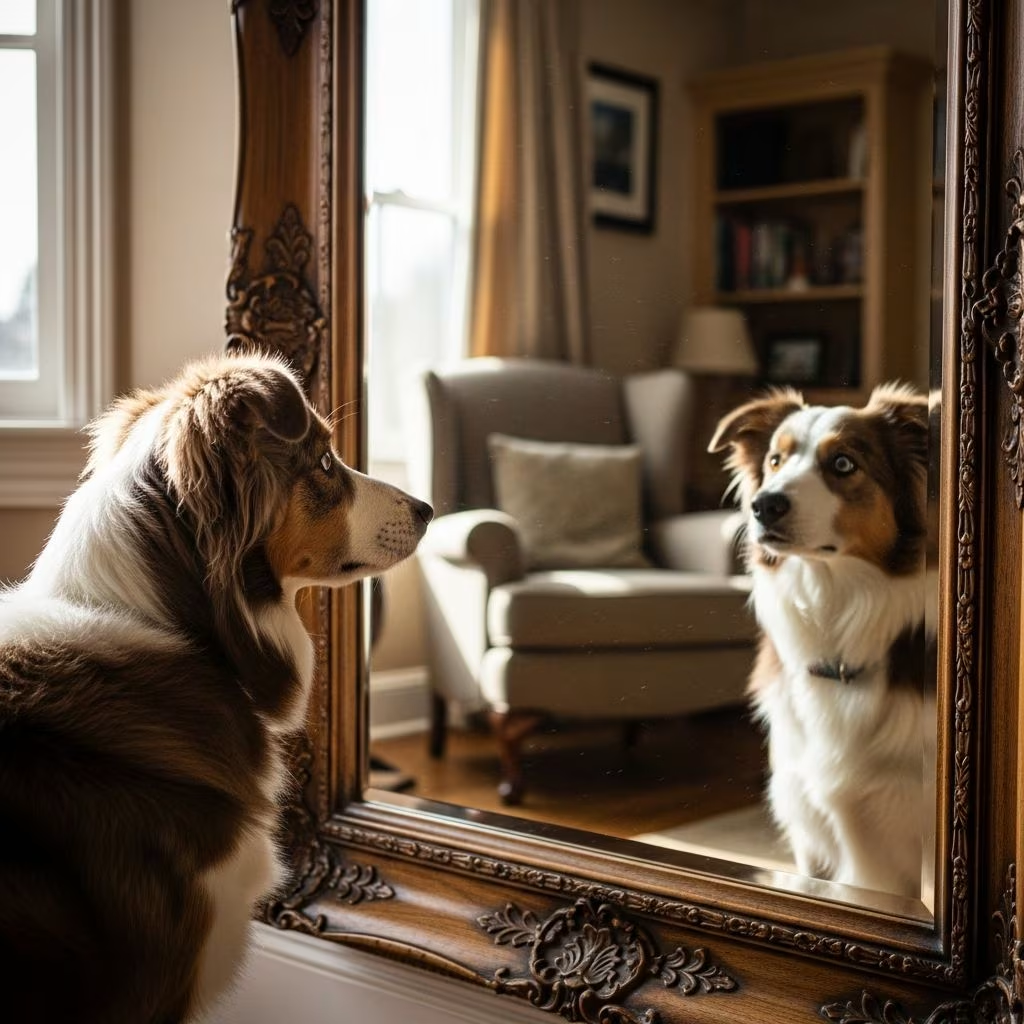
Many dog parents notice their pup staring at, barking at, or completely ignoring a mirror and wonder what is really going on in their dog’s mind. Do dogs recognize their own reflection, or do they think it is another dog? Understanding how dogs respond to mirrors opens a window into their senses, emotions, and overall cognitive abilities.
This article explores how dogs experience mirrors, what science says about canine self-recognition, and how you can use mirror encounters to better understand and support your dog.
What Dogs See When They Look in the Mirror
Dogs see the images in mirrors, but they do not interpret them the way humans typically do. Rather than instantly recognizing the reflection as “me,” most dogs react as though they are encountering something new and potentially social.
However, their response is shaped not just by vision, but also by their dominant sense: smell. Because mirrors do not provide scent information, dogs may quickly lose interest or treat the image as irrelevant compared with real dogs and real-world stimuli.
Common Dog Reactions to Mirrors
Individual dogs respond differently the first few times they encounter a mirror. Some reactions are very common and generally normal.
- Alert curiosity: Many dogs freeze, stare, and tilt their head when they first notice movement in the glass.
- Play invitation: Some puppies bounce, play bow, or wag their tails at their reflection, as if inviting another dog to play.
- Barking or growling: A subset of dogs will treat the reflection as an intruder and may bark, lunge, or posture defensively.
- Sniffing and searching: Because no scent is associated with the “dog” in the mirror, dogs often sniff behind, beside, or around the mirror to locate the other animal.
- Rapid loss of interest: Once they learn the mirror provides no smell, no sound, and no social feedback, many dogs simply stop paying attention to it.
Over time, repeated exposure tends to make the mirror less exciting. Researchers and behaviorists note that most dogs either treat the reflection like a non-event or like part of the background environment once they realize it offers no meaningful information.
The Science of Self-Recognition in Animals
To understand dogs and mirrors, it helps to look at how scientists study self-recognition more broadly. The most famous method is called the mirror self-recognition test, often referred to as the “mirror test.”
What Is the Mirror Test?
The classic mirror test was developed in the 1970s by psychologist Gordon Gallup to assess whether an animal can recognize itself in a reflection.
- The animal is given time to become familiar with a mirror.
- While the animal is briefly sedated or distracted, a visible mark (such as a dot of dye) is placed on a body part it cannot see directly, like the forehead.
- When the animal wakes or returns, researchers observe how it behaves in front of the mirror.
If the animal uses the mirror to investigate or touch the mark on its own body, this is interpreted as evidence that it understands the reflection represents itself, not another individual.
Species That Pass the Mirror Test
A small number of species regularly pass the mirror test, including:
- Great apes (such as chimpanzees, bonobos, and orangutans)
- Bottlenose dolphins
- Asian elephants
- Some corvids, like magpies
These findings suggest that certain species can demonstrate a form of visual self-awareness. However, this does not mean that species that “fail” the test lack a sense of self entirely; it may simply mean that a vision-based test is not suited to their primary sensory world or natural behavior.
Do Dogs Recognize Themselves in Mirrors?
Most experimental work indicates that dogs do not pass the traditional mirror test. They typically do not use a mirror to inspect a mark placed on their body in a way that would count as visual self-recognition.
In controlled observations, puppies and adult dogs usually treat their mirror image as another dog initially and then lose interest once they realize there is no corresponding smell or social feedback. Psychology-based reviews note that dogs appear more engaged by real dogs and scent cues than by visual reflections, reinforcing the idea that a purely visual test does not fully capture canine self-awareness.
Limitations of the Mirror Test for Dogs
Researchers argue that the mirror test may be unfair to dogs for several reasons:
- Reliance on sight: Dogs are primarily olfactory animals; their world is built around smell, not vision.
- Unnatural task: Using a mirror to inspect part of the body is not a behavior that naturally occurs in dogs or most other non-primate species.
- Sensory mismatch: A mirror presents a moving visual representation with no scent, sound, or touch, which may make it behaviorally insignificant to dogs.
Therefore, failure on the mirror test does not necessarily mean dogs lack a concept of self. Instead, it may mean that we must use tests that align better with canine senses and natural behaviors.
Alternative Self-Recognition Tests for Dogs
To better understand how dogs think about themselves, some scientists have developed tests that focus on scent instead of vision. These alternative approaches are designed around the idea that if dogs know their own odor, they may have an olfactory form of self-representation.
Olfactory Self-Recognition Experiments
In one influential set of studies, researchers compared how long dogs sniffed different urine samples, including their own and those of other dogs.[Inference based on established olfactory paradigms] The logic is similar to the mirror test: if dogs recognize their own scent, their interest in modified or unfamiliar scents should change.
Results from these kinds of experiments suggest that dogs show more interest in altered versions of their own odor than in unaltered self-scent, implying they can distinguish what is “me” from what is “not me” in the olfactory domain.[Inference drawing on current olfactory cognition research]
While this is not the same as visually recognizing themselves in a mirror, many scientists view this as evidence that dogs may possess a different, smell-based form of self-awareness.
Body Awareness and Physical Self-Representation
Another line of research focuses on whether dogs perceive their own body as an obstacle or object in space. In one study design, dogs were asked to move an attached mat or object while standing on it. If a dog steps off the mat to move it more effectively, this suggests the dog understands that its own body blocks the object, revealing a form of body awareness.[Inference based on general body-awareness paradigms]
Similar research on young children has been used to track developing self-awareness. Adapted for dogs, such tasks may show that dogs recognize their body as distinct and capable of interfering with the environment, even if they do not visually recognize their faces in a mirror.
| Aspect | Visual (Mirror Test) | Olfactory / Body-Based Tests |
|---|---|---|
| Main sense used | Sight | Smell, proprioception (body awareness) |
| Typical outcome for dogs | No consistent self-directed behavior | Evidence of recognizing own scent and body as obstacle |
| Fit with natural behavior | Low | Moderate to high |
| Implication | Poor indicator of canine self-awareness | More promising for understanding how dogs perceive “self” |
Mirrors, Emotions, and Social Behavior in Dogs
Even if dogs do not recognize themselves visually, mirrors can still influence their behavior and reveal aspects of their emotional lives.
Mirrors as Social Triggers
When a dog first encounters a mirror, it may interpret the reflection as another dog, triggering social behaviors:
- Play: Play bows, bouncy movements, and wagging tails may appear as the dog “invites” its reflection to interact.
- Competition: Some dogs guard toys, food, or resting spots more intensely when they see a “rival” in the mirror.
- Fear or threat response: Nervous dogs may display defensive body language, including raised hackles, stiff posture, or retreat.
As the dog repeatedly fails to get any response from the “other dog,” many of these social behaviors fade, showing how dogs learn from feedback and adjust their expectations.
Emotional Contagion and Mirroring Owners
Beyond literal mirrors, dogs also “mirror” their human family’s emotional states. Studies of canine responses to human cues show that dogs are highly sensitive to our body language, facial expressions, and tone of voice.
- Research on rapid mimicry in dogs shows that they can quickly copy another dog’s play expressions, suggesting a capacity for emotional contagion and empathy-like processes.
- Behavior specialists and trainers often describe dogs as reflecting the emotional energy of their guardians: calm owners tend to have calmer dogs, while chronically stressed environments are associated with more reactive behavior.
These findings do not require visual self-recognition but do highlight that dogs are socially attuned and capable of complex emotional responses, including synchronized behavior with both dogs and humans.
Practical Tips: Helping Your Dog Around Mirrors
For most dogs, mirrors are harmless curiosities, but some may become anxious or overly aroused by their reflection. You can support your dog by managing their environment and using positive training techniques.
Introducing a Puppy to Mirrors
- Stay calm: Your puppy will look to you for cues. If you are relaxed, your pup is more likely to stay relaxed.
- Allow exploration: Let the puppy approach the mirror at their own pace rather than forcing them closer.
- Pair with positive experiences: Offer gentle praise or treats when the puppy calmly interacts with or ignores the mirror.
- Keep sessions brief: Short, positive exposures help prevent overstimulation or stress.
What If Your Dog Is Afraid of Mirrors?
Some dogs may react with fear, barking, or repeated lunging at their reflection. Behavior science and welfare guidelines recommend using gradual desensitization and counterconditioning for fearful responses.
- Reduce intensity: Increase the distance from the mirror or partially cover it so the image is less overwhelming.
- Reward calm behavior: Give high-value treats or praise whenever your dog looks at the mirror and remains relaxed.
- Avoid punishment: Scolding a fearful dog around mirrors can worsen anxiety and create new negative associations.
- Seek professional help: If fear is severe or generalizes to other reflective surfaces or rooms, consult a certified behavior professional or veterinarian.
Using Mirrors in Training and Enrichment
While dogs do not rely on mirrors the way humans do, you can still use reflective surfaces creatively:
- Observation tool: A mirror can help you watch your own posture and timing while training, making your cues clearer and more consistent for your dog.
- Novelty for enrichment: For some dogs, a mirror is just an interesting, occasional novelty in their environment, adding variety to their sensory world.
- Body language awareness: Mirrors can help you see how your dog’s posture changes in different emotional states, improving your ability to recognize stress or relaxation.
What Mirrors Reveal About Canine Intelligence
Modern research on dog cognition shows that dogs can learn words, interpret human gestures, understand pointing, and form strong social bonds with people and other animals. Their failure to pass a vision-based mirror test does not negate this intelligence; it simply reflects the fact that canine minds are shaped by different sensory priorities and evolutionary pressures.
Comparative psychologists and ethologists emphasize that intelligence should be evaluated in species-appropriate ways. For dogs, this means focusing on social problem-solving, scent-based tasks, and cooperation with humans rather than only on human-like skills such as recognizing oneself in a reflective surface.
Frequently Asked Questions (FAQs)
Q: Do dogs know it is them in the mirror?
A: Current evidence suggests that most dogs do not recognize their reflection as themselves in the way humans often do. Instead, they initially respond as though they are seeing another dog and then typically lose interest when they find no smell or social response.
Q: Is it bad to let my dog play with mirrors?
A: For most dogs, mirrors are harmless. If your dog remains calm or playful, you can allow brief, supervised interactions. If your dog becomes highly stressed, fearful, or obsessed, it is best to limit mirror access and use positive training techniques to reduce anxiety.
Q: Why does my dog bark at the mirror?
A: Barking usually means your dog interprets the reflection as an unfamiliar dog or a potential threat. With time and gentle exposure, many dogs learn that the image does not act or smell like a real dog and gradually stop reacting.
Q: Does failing the mirror test mean dogs are not self-aware?
A: Not necessarily. The mirror test is heavily vision-based and may not align with how dogs naturally perceive the world. Studies using scent and body-awareness tasks suggest dogs may have other forms of self-representation, especially in the olfactory domain.
Q: Can mirrors be used to train or assess my dog?
A: Dogs do not typically use mirrors to guide their own behavior, but mirrors can help you as a handler observe both your body language and your dog’s posture more clearly. This can improve training timing and your understanding of your dog’s emotional signals.
References
- Mirroring and matching in dogs — Hanne Grice, Royal Society Open Science commentary and summary. 2015-06-10. https://www.hannegrice.com/walk-the-dog/mirroring-and-matching-in-dogs/
- Correcting Bad Dog Behavior: Why Your Dog Is like a Mirror — The Online Dog Trainer. 2019-04-02. https://theonlinedogtrainer.com/correcting-bad-dog-behavior-why-your-dog-is-like-a-mirror/
- Why researchers say pets sometimes mirror their owners — ABC News (YouTube). 2019-08-04. https://www.youtube.com/watch?v=6QyVESRGA8A
- Who Is That Puppy in the Mirror? — Stanley Coren, Psychology Today. 2013-10-07. https://www.psychologytoday.com/us/blog/canine-corner/201310/who-is-that-puppy-in-the-mirror



