

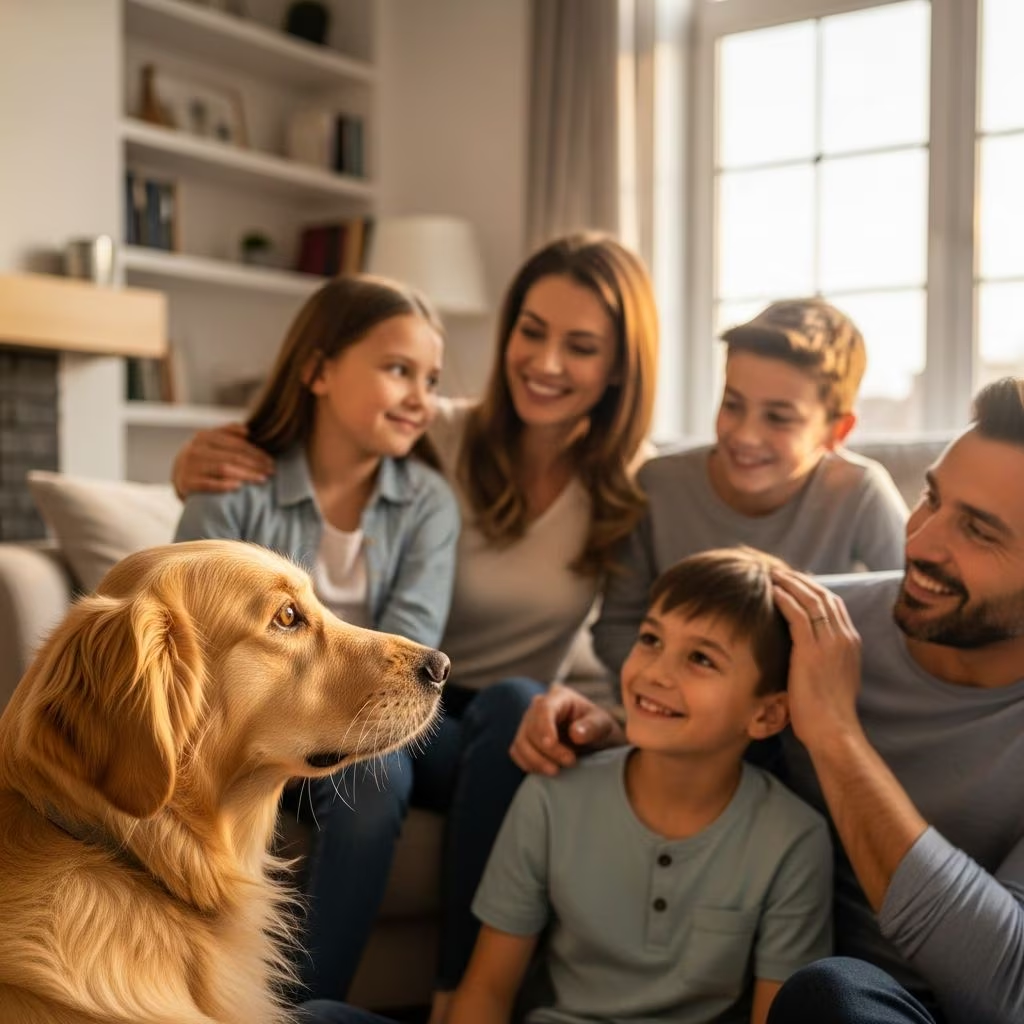
Do Dogs Understand the Concept of Family?
Many people see their dogs as full-fledged family members, from sharing the couch to appearing on holiday cards. But the question remains: do dogs actually understand the idea of “family,” or do they relate to us in a different way entirely?
Current research suggests that dogs do not think in terms of legal or cultural family structures the way humans do. Instead, they rely on social bonds, attachment, and familiarity to determine who belongs in their inner circle. These bonds are shaped by daily interaction, caregiving, and emotional experiences rather than abstract concepts.
Ethologists and cognitive scientists often describe dogs as forming flexible social groups rather than strict nuclear families. In free-ranging or street dogs, for example, care for puppies is usually provided by the mother and sometimes by other nearby dogs, while males rarely offer paternal care. This indicates that, for dogs, stable social companionship matters more than long-term genetic lineage.
- Dogs recognize “their people” based on routine, care, and emotional safety.
- They form attachments that resemble infant–caregiver bonds in humans.
- Family for dogs is less about blood and more about who consistently meets their needs.
So while your dog probably does not label you as “parent” in a human sense, they are highly capable of forming deep, enduring bonds with you that function very much like family.
Do Dogs Understand Genetic Relationships?
Even if dogs do not draw family trees, there is evidence that they can identify close relatives—especially their mothers and, to a lesser extent, their siblings—mainly through scent-based recognition.
Several controlled experiments have explored what is called kin recognition in dogs:
- Puppies and their mothers: In classic studies, puppies were given a choice between their mother and an unrelated female of the same breed. They consistently preferred their biological mother, even when only her scent on a blanket was present.
- Long-term memory of mothers: When researchers reunited adult dogs with their mothers after about two years of separation, both the mothers and offspring showed signs of recognition and preference, suggesting long-lasting maternal memory.
- Siblings: Young puppies can recognize littermates, but this recognition often fades unless the dogs continue to live together. Adult dogs typically do not distinguish siblings they have not seen for years, unless they have maintained close contact.
Recognition of fathers appears weaker and more variable. In some studies, female puppies showed more interest in their father’s scent than unrelated males, while male puppies often favored non-kin females—likely reflecting natural mating strategies in free-ranging dogs.
Beyond their fellow dogs, research suggests that dogs can use scent and other cues to distinguish between humans who are related versus unrelated and who live in the same household. Their powerful sense of smell allows them to form complex scent maps of the social world around them.
| Relationship | How Dogs Recognize | How Long Recognition Lasts |
|---|---|---|
| Mother–puppy | Primarily scent, plus early-life contact | Up to at least 2 years after separation in some studies |
| Siblings (littermates) | Scent and familiarity during early weeks | Persisting mainly if they continue living together |
| Fathers | Mostly scent; evidence less consistent | Recognition weaker and dependent on sex and experience |
| Human household members | Daily interaction, scent, voice, and routines | Ongoing, updated through repeated experience |
Importantly, while dogs are capable of recognizing kin, there is no strong evidence that they reflect on family relations in an abstract way—such as wondering what their siblings are doing now or seeking contact with distant relatives. Their focus appears to remain on current, meaningful relationships and the environment they actively experience.
Do Dogs Think of Themselves as Part of the Family?
When you come home, your dog’s greeting is often dramatically different from how they respond to a stranger. That contrast reveals something crucial: dogs clearly differentiate between “their group” and outsiders.
Several lines of research show that dogs can form attachment bonds to humans strikingly similar to the way human infants bond to caregivers:
- In structured tests modeled on human attachment research, dogs show behaviors consistent with secure attachment to their guardians, including using them as a “safe base” to explore unfamiliar settings and seeking comfort when stressed.
- Dogs often show signs of separation-related distress when separated from their caregivers, especially if attachment is strong and coping skills are underdeveloped.
- Studies indicate that many dog guardians perceive and treat their dogs in a child-like role, reinforcing caregiving dynamics similar to parent–child relationships.
This does not mean dogs think, “These are my parents and siblings” in human terms, but it does indicate they categorize certain humans as trusted, central figures in their social world. In sociological research on dog–human households, dogs are routinely described and treated as family members, and the dogs’ behavior aligns with this role—seeking proximity, protection, and social engagement with their primary caregivers.
From the dog’s point of view, family looks like:
- The people and animals who are predictably present in daily life.
- Those who provide food, safety, play, and comfort.
- Individuals whose cues and routines the dog has learned to understand.
In short, your dog is very likely to perceive you as a core member of their social group—functionally, their family—even if the concept is built from experience rather than genetics.
How Dogs Form Bonds With Their Humans
Dogs do not automatically trust or attach to humans; their feelings develop over time through thousands of small interactions. Several factors shape how close and secure the relationship becomes.
Experience and Predictability
Dogs learn what to expect from people based on repeated experiences. When interactions are kind, consistent, and understandable, dogs tend to feel safe and connected. Unpredictable or harsh treatment can have the opposite effect, producing anxiety or withdrawal.
Key ingredients of a secure bond include:
- Predictable routines: Regular feeding, walks, play, and rest at similar times each day.
- Clear communication: Using consistent cues for behaviors and reading your dog’s body language.
- Emotional stability: Calm, patient responses rather than sudden anger or rough handling.
Biology and the “Love Hormone” Oxytocin
One especially striking finding is the role of oxytocin, sometimes called the “love hormone.” Studies show that when dogs and their guardians gaze into each other’s eyes or engage in gentle physical contact, oxytocin levels rise in both species—similar to patterns seen between human parents and infants.
This hormonal feedback loop appears to reinforce social bonding, increasing feelings of trust and attachment on both sides and helping to explain why dog–human relationships can feel so emotionally rich.
Nature vs. Nurture in Canine Personality
Genetics and early life experiences both influence how readily a dog forms attachments and how they behave in a family setting.
- Inherited traits: Some breeds and individual dogs are naturally more sociable, people-oriented, or sensitive.
- Early socialization: Positive exposure to humans, other animals, and varied environments during the first weeks and months supports confident, friendly behavior later in life.
- Life history: Rescue dogs or those with traumatic backgrounds may take longer to trust but can still form very strong bonds given patience and appropriate support.
Research also suggests that the caregiver’s personality and emotional state can influence the dog. Guardians who are anxious or inconsistent may have dogs who show more fearful or anxious behaviors, while calm, supportive guardians often have more relaxed pets.
How Your Parenting Style Affects Your Dog’s Behavior
How you train and interact with your dog has a significant impact on both their behavior and the quality of your bond. Studies comparing training methods have found notable differences in outcomes depending on whether guardians primarily use positive reinforcement or rely on punishment-based techniques.
Positive Reinforcement and Secure Attachment
Positive reinforcement—rewarding desired behaviors with treats, praise, toys, or other things the dog values—has been associated with:
- More consistent signs of secure attachment to guardians.
- Increased willingness to interact with both their humans and strangers during play or tests.
- Better learning outcomes and reduced stress-related behaviors.
Because positive reinforcement focuses on what the dog is doing right and strengthens cooperation, it helps build trust and a sense of safety. This supports a family-like dynamic in which the dog looks to their guardian for guidance and feels confident exploring the world.
Harsh Methods and Social Withdrawal
In contrast, heavy use of positive punishment (adding something unpleasant, like yelling or leash jerks) and negative reinforcement or punishment (removing something the dog wants, such as attention, in an aversive way) is linked to:
- Less frequent interaction with guardians and unfamiliar people during social tests.
- More signs of fear, avoidance, or anxiety.
- Weaker or more insecure attachment styles.
These methods can cause dogs to associate their humans with unpredictable discomfort rather than security, undermining the very bond most people want to create.
Supporting Healthy Independence
A strong bond does not mean your dog should be unable to cope when you leave the room. In fact, healthy attachment combines closeness with resilience. Guardians can encourage this balance by:
- Providing mental and physical exercise before alone time.
- Leaving safe, engaging items (like puzzle toys or chew items) when they go out.
- Practicing short, low-key departures and returns to prevent overexcitement or anxiety.
These strategies help dogs feel secure in the knowledge that their guardian will return, much like a child who trusts that a parent will come back after school or work.
Modern Dog–Human Families
In contemporary households, dogs often occupy a role that blends companion, child-like family member, and friend. Research in psychology and sociology highlights that many people describe their relationship with their dog using familial language, and dogs are often integrated into family routines, celebrations, and emotional life.
At the same time, dogs remain a different species, with distinct needs and ways of understanding the world. Respecting those differences—while offering care, structure, and affection—allows the relationship to be both emotionally satisfying for humans and behaviorally healthy for dogs.
Frequently Asked Questions (FAQs)
Q: Does my dog know I am their “parent”?
Your dog likely does not think in terms of “parent” the way humans do, but they can form a secure attachment to you much like an infant to a caregiver, seeing you as a central and trusted figure in their social world.
Q: Can my dog recognize their mother or siblings years later?
Studies suggest dogs can remember their mothers for at least a couple of years using scent, while recognition of siblings tends to fade unless they continue to live together.
Q: Do dogs miss their biological families?
Dogs can experience separation stress and may initially miss familiar individuals, but over time they typically bond most strongly with the humans and animals they live with and interact with daily. There is no clear evidence that they dwell on distant relatives in an abstract way.
Q: Does using punishment in training affect how my dog feels about me?
Frequent use of harsh or aversive training methods is associated with more fearful behavior and less interaction with guardians, while positive reinforcement is linked to stronger, more secure attachment and better cooperation.
Q: Can technology like video calls help my dog feel close to me when I’m away?
Some dogs may respond to your voice or image on screens, but their strongest sense of connection comes from in-person cues—especially scent, touch, and natural interaction. Video calls are not a substitute for real-life bonding, though they may comfort some dogs in limited ways.
References
- Topál, J., Miklósi, Á., Csányi, V., & Dóka, A. “Attachment behavior in dogs (Canis familiaris): A new application of Ainsworth’s (1969) strange situation test.” — Journal of Comparative Psychology. 1998-03-01. https://doi.org/10.1037/0735-7036.112.3.219
- Pal, S. K. “Recognition of mother and siblings in dogs.” — Applied Animal Behaviour Science. 1994-06-01. https://doi.org/10.1016/0168-1591(94)90558-4
- Horn, L., Huber, L., & Range, F. “The importance of the secure base effect for domestic dogs – Evidence from a manipulative problem-solving task.” — PLoS ONE. 2013-05-29. https://doi.org/10.1371/journal.pone.0065254
- Vieira de Castro, A. C., Barrett, J., de Sousa, L., & Olsson, I. A. S. “Carrots or sticks? The relationship between training methods and dog-owner bond.” — Applied Animal Behaviour Science. 2020-07-01. https://doi.org/10.1016/j.applanim.2020.104997
- Zilcha-Mano, S., Mikulincer, M., & Shaver, P. R. “Pet in the family: An attachment perspective on pet ownership and psychological well-being.” — Journal of Research in Personality. 2011-12-01. https://doi.org/10.1016/j.jrp.2011.08.005
- Charles, N. “Post-human families? Dog–human relations in the domestic sphere.” — Sociological Research Online. 2014-08-31. https://doi.org/10.5153/sro.3975
- Nagasawa, M., Mitsui, S., En, S., et al. “Oxytocin-gaze positive loop and the coevolution of human–dog bonds.” — Science. 2015-04-17. https://doi.org/10.1126/science.1261022



