

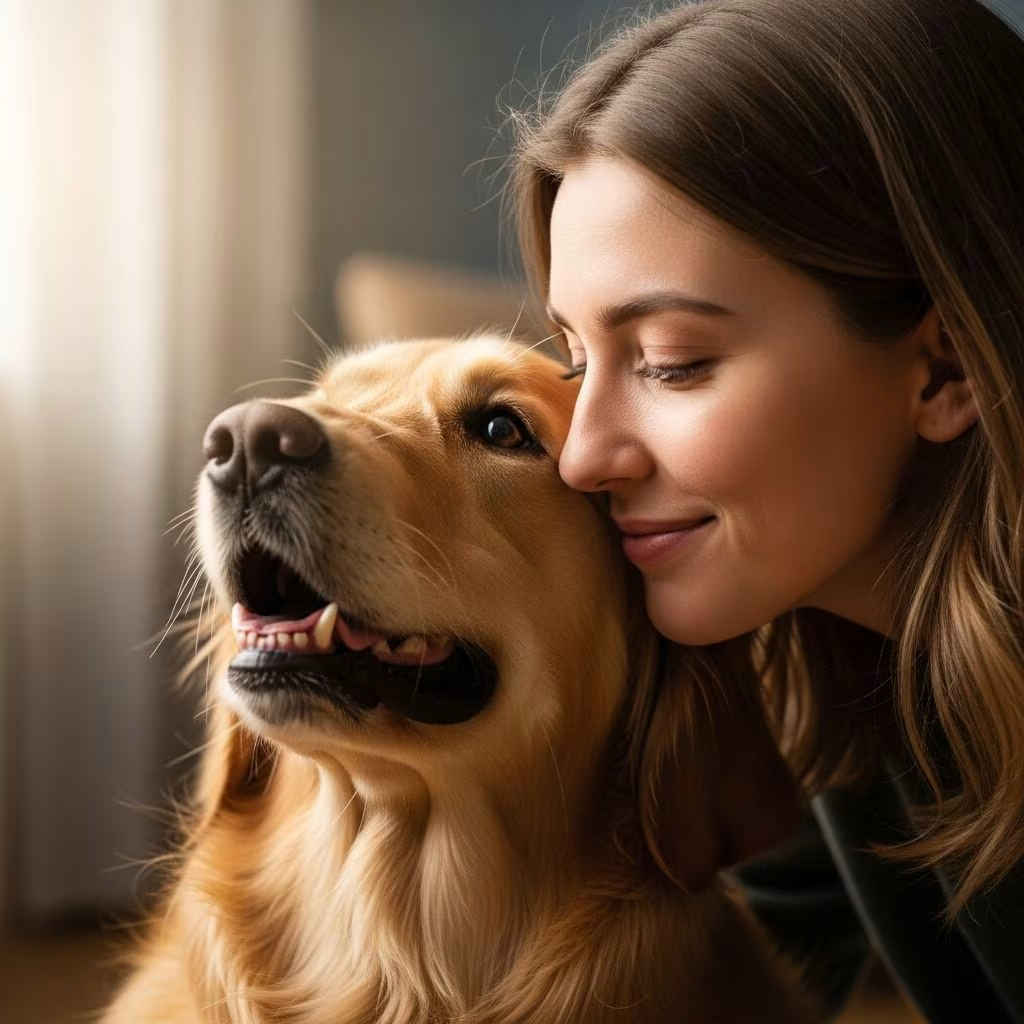
Many pet parents feel sure their dog knows exactly who they are. The excited tail wags at the door, the way your pup follows you from room to room, and the extra attention you get compared to strangers all suggest recognition that goes far beyond basic training. But what does science say about whether dogs truly recognize their owners—and how do they do it?
Researchers studying canine cognition have found that dogs rely on a combination of **smell**, **sight**, **sound**, and **social memory** to identify familiar humans, including their primary caregivers. These recognition abilities are closely tied to their emotional bond with you and shaped by early life experiences, daily routines, and ongoing interaction.
How Dogs Recognize the People They Love
Dogs did not evolve to live with humans by accident. Over thousands of years, they developed a unique sensitivity to our cues, becoming experts at reading our voices, faces, and body language. Studies using brain imaging and behavioral tests show that dogs process human-related signals in specialized ways, suggesting they treat their closest humans as socially meaningful individuals rather than just sources of food or walks.
In daily life, your dog is constantly gathering information about you through multiple channels:
- Olfactory cues (your personal scent)
- Visual cues (your body shape, gait, face, and movement patterns)
- Auditory cues (your voice, words, and intonation)
- Contextual cues (routines, locations, and timing of your interactions)
Together, these signals form a detailed profile of “you” in your dog’s mind—one that most dogs can recognize with remarkable consistency across time and circumstances.
The Power of a Dog’s Sense of Smell
Among all the ways dogs identify people, **smell is the strongest and most reliable**. Dogs have up to hundreds of millions of scent receptors in their noses and a large portion of the brain devoted to processing odor information, far exceeding human capacity.
Research on recognition between canine family members shows that dogs can remember and prefer familiar scents, including those of their mothers, offspring, and sometimes siblings, even after long separation. While these studies examined dog-to-dog recognition, the same underlying mechanisms likely support recognition of specific humans as well.
How scent helps dogs recognize owners
- Personal odor signature: Every human has a unique blend of skin secretions, microbiome, diet-related odors, and environmental smells that create a consistent scent profile.
- Long-lasting scent memory: Experimental work on canine olfaction and kin recognition indicates that dogs can remember particular scents for months or years, especially when associated with important social relationships.
- Emotional significance: Scents linked to attachment figures can trigger approach behavior, relaxed body language, and positive anticipation, suggesting both recognition and emotional response.
This is why many dogs will gravitate toward their guardian’s clothes or bedding when left alone—they are seeking comfort from a familiar scent that clearly signals “my person.”
| Recognition Cue | How Dogs Use It | Reliability for Identifying Owners |
|---|---|---|
| Smell | Detects unique human odor signatures, even at low concentrations | Very high, especially across time and different contexts |
| Vision | Reads body shape, gait, and posture at distance; face at closer range | High, but more affected by lighting, distance, and changes in appearance |
| Sound | Recognizes voice patterns, intonation, and key words or names | High when combined with other cues; moderate alone |
| Context | Associates you with routines, locations, and predictable events | Moderate, supports but does not replace direct sensory recognition |
Visual and Auditory Recognition of Owners
Although smell may be the most powerful tool dogs use to recognize you, it is far from the only one. Dogs are also capable of recognizing familiar humans by **sight** and **sound**, including subtle cues that we may not notice ourselves.
Recognizing owners by sight
Behavioral studies show that dogs can discriminate between familiar and unfamiliar humans using visual information alone, especially when they can see the whole body and movement rather than just static faces.
- Dogs are particularly good at reading **body posture and gait**, which helps them identify a person even at a distance.
- When shown images of their guardian’s face compared with strangers, many dogs show more attention or preference toward the familiar face, indicating visual recognition.
- Dogs also use **eye contact** as a key social cue; sustained, soft eye contact is more likely with trusted individuals.
Recognizing owners by voice and words
Dogs do not just recognize how you look; they also learn how you sound. Research in canine auditory processing has found that dogs can detect relevant words or names embedded in streams of speech, even when intonation is relatively neutral. Brain imaging work further suggests that dogs process word meaning and tone in partly distinct brain regions, then integrate the two for interpretation.
- Dogs can recognize a guardian’s **voice** as distinct from others, especially in familiar contexts.
- They can learn the **meaning of specific words**, including object names like “ball” or “leash,” and activate mental representations of those items when hearing the word.
- They rely heavily on **intonation** and consistency of cues, which help them link your voice to predictable outcomes.
Put together, this means your dog is not responding to random noise; they are listening for patterns, familiar sounds, and emotionally relevant signals that indicate “this is my person talking to me.”
Do Dogs Recognize Their Owners Emotionally?
Recognition is not just about knowing who someone is; it is also about what that person means. Evidence from attachment research suggests that many dogs form bonds with their guardians that resemble the secure attachments seen between human children and caregivers.
- Dogs often use their primary caregiver as a **secure base**, exploring more confidently when that person is present and seeking them out when stressed.
- They may show **preference behaviors**, such as choosing their guardian over strangers for comfort or social contact in test situations.
- Heart rate and stress-marker studies indicate that interaction with a familiar human can **lower physiological stress** in dogs, pointing to an emotionally meaningful bond.
In addition, dogs are highly sensitive to human emotional states—a phenomenon sometimes described as **social referencing**. They look to their humans for cues about how to respond to ambiguous situations, and their behavior can shift based on the emotional tone they perceive.
Recognition of Owners vs. Other Familiar Humans
Many dogs share their home with multiple people: partners, children, roommates, or extended family. In these environments, dogs often distinguish clearly between their **primary caregiver** and other familiar humans.
- Dogs may show the **strongest response** (excitement, greeting intensity, proximity seeking) toward the person who feeds, walks, trains, or plays with them most consistently.
- They might still recognize and feel comfortable with less-involved family members, but their behaviors (following, checking in, cuddling, attention-seeking) are often concentrated on their main attachment figure.
- Some dogs divide attachment relatively evenly across multiple caregivers, especially if responsibilities and interactions are shared.
From the dog’s perspective, recognition is not only about identity but also **history and predictability**—who has been reliable, kind, and responsive over time.
Do Dogs Remember Owners After Long Separations?
A common concern among people reuniting with a dog after travel, deployment, rehoming, or shelter adoption is whether the dog will remember them. While individual variation exists, research on canine social memory and kin recognition suggests that many dogs can remember important humans and dogs after months or years apart, especially when the relationship was strong.
- Dogs retain **scent memories** and can recognize familiar odors after long gaps.
- They also maintain broader **associative memories**—linking people with events, places, and emotions.
- The intensity of reunion behavior often reflects both recognition and renewed attachment, though shy or anxious dogs may show more subtle signs.
Factors that influence how well and how long a dog remembers a specific person include the depth of the bond, the age at which they were last together, the length of the relationship, and the dog’s general temperament.
Why Some Dogs Seem to Prefer One Person
Even in loving households, many dogs develop a clear preference for a particular individual. This does not mean they do not recognize or like everyone else; rather, one person often becomes the primary focus of their attachment.
Key influences include:
- Early socialization: Puppies in critical developmental windows often form stronger bonds with those who interact with them most during that time.
- Consistency and routine: The person who reliably provides meals, walks, play, and training tends to become the most important social partner.
- Communication style: Dogs often feel more at ease with humans whose body language, tone of voice, and handling are predictable and gentle.
- Shared activities: Dogs that regularly engage in enjoyable activities (like agility, hikes, games, or training sessions) with one person may show stronger orientation to that individual.
In this sense, recognition is not static; it is strengthened over time by repeated positive experiences with the same person.
How to Strengthen Your Dog’s Recognition and Bond
Because your dog already has impressive tools for recognizing you, the goal is less about teaching them who you are and more about **deepening the quality of your relationship**. Evidence from canine behavior and attachment research points to several practical strategies.
Build predictable, positive routines
- Feed, walk, and play at relatively consistent times when possible.
- Use the same words and cues for key events, such as “walk,” “dinner,” or “bedtime.”
- Pair your presence and voice with calm, rewarding experiences.
Communicate clearly
- Use a **cheerful, steady tone** and avoid rapidly shifting between commands or emotions.
- Support verbal cues with **body language**—pointing, gestures, and posture your dog can easily read.
- Reward desired responses promptly so your dog can link your words and actions to predictable outcomes.
Engage their senses
- Allow your dog to sniff you and your belongings; this reinforces scent-based recognition and comfort.
- Incorporate **nose work games** or scent-based play to leverage their strongest sense.
- Use familiar objects and environments when teaching new skills to anchor learning to your presence.
Support emotional security
- Respond to signs of fear or uncertainty with calm reassurance rather than punishment.
- Provide a safe place (like a bed or crate) where your dog can relax near you.
- Use positive reinforcement–based training to build trust and confidence.
Frequently Asked Questions (FAQs)
Q: Can dogs recognize their owners just by smell?
A: Yes. While most recognition is multi-sensory, research on canine kin recognition and olfactory memory shows that dogs can identify familiar individuals—including humans—using scent alone, and they may remember these scents for long periods.
Q: Do dogs know the difference between their owner and other family members?
A: Most dogs can distinguish between multiple familiar humans using scent, sight, and voice. They often show a preference for their primary caregiver through behaviors like following, greeting intensity, and choice of whom to seek out for comfort.
Q: Will my dog remember me after months or years apart?
A: Many dogs do remember important humans after long separations, especially when the previous relationship was close. Their recognition is supported by strong scent memory and associative learning linking you with past experiences.
Q: Does my dog understand that I am their “parent”?
A: Dogs probably do not think in human family terms, but research on attachment suggests they treat primary caregivers as secure bases and sources of safety, much like young children do with trusted adults.
Q: Can dogs recognize their previous owners after being rehomed?
A: If the prior relationship was significant and not too distant in time, many dogs can recognize former guardians through scent and other cues. However, once they form strong new attachments, their daily behavior usually reflects their current home and caregivers.
References
- Can dogs recognize their relatives? — Wisdom Panel. 2021-08-03. https://www.wisdompanel.com/en-us/blog/can-dogs-recognize-their-relatives
- Dogs eavesdrop on humans, new study finds — Kinship. 2023-09-19. https://www.kinship.com/news/dogs-eavesdrop-study
- People and their dogs really do have similar personalities — Kinship. 2023-03-14. https://www.kinship.com/pet-behavior/dogs-mirror-humans
- Your dog actually knows the words for familiar objects, study finds — Kinship. 2023-11-08. https://www.kinship.com/dog-behavior/dogs-recognize-object-words-news
- Social referencing in dogs — Merola, S., Prato-Previde, E., Marshall-Pescini, S. Animal Cognition. 2012-11-01. https://doi.org/10.1007/s10071-012-0538-3



