

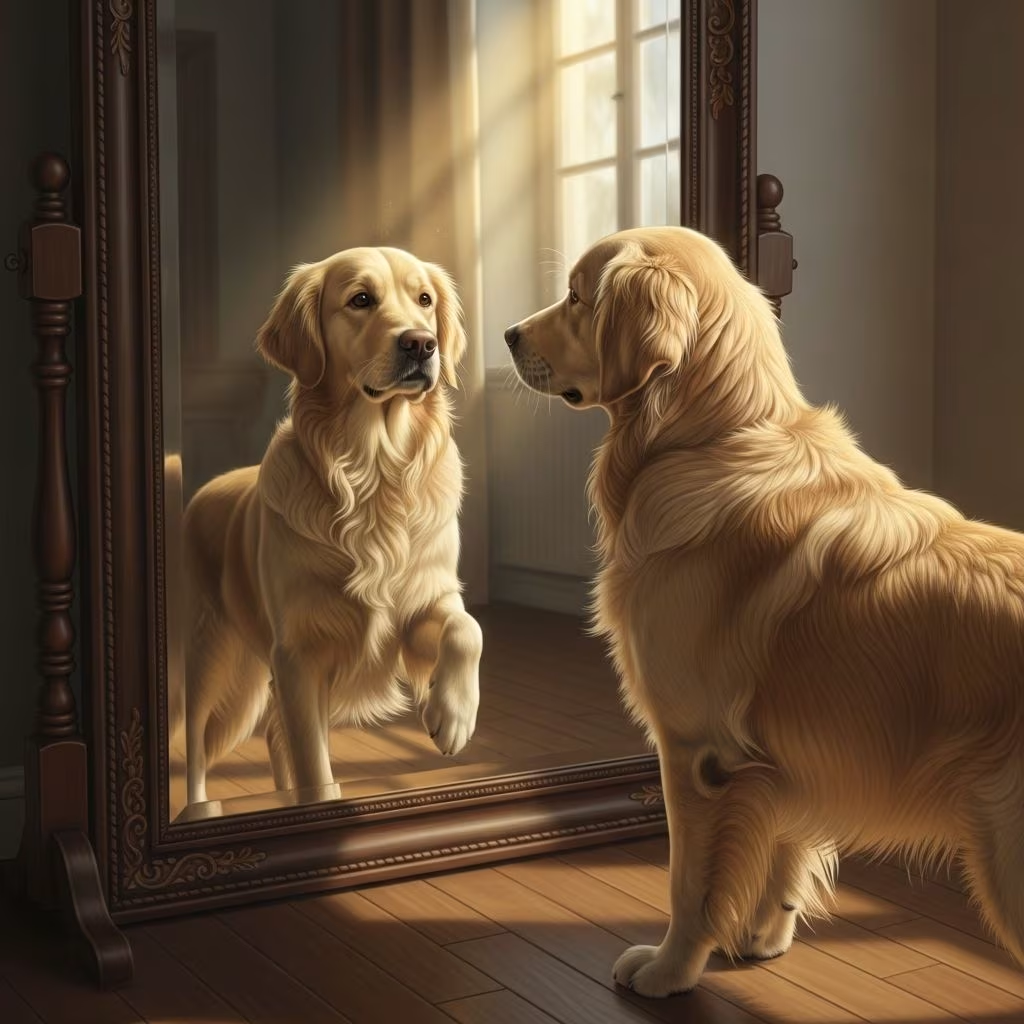
Dogs exhibit forms of self-awareness through olfactory recognition and body perception tasks, as demonstrated in recent scientific studies, challenging the limitations of visual mirror tests.
Understanding Self-Awareness in Animals
Self-awareness refers to an animal’s ability to recognize itself as a distinct individual separate from its environment and others. In cognitive science, this is often measured by self-recognition tasks that test whether subjects can identify their own body, scent, or image. Traditional benchmarks like the mirror self-recognition (MSR) test have been pivotal, but they may not suit all species due to sensory differences.
For dogs, whose primary sense is smell rather than sight, visual tests like mirrors often fail to capture their cognitive capabilities. Puppies, for instance, frequently react to their reflection as another dog, attempting play or aggression, which leads researchers to question if dogs lack self-awareness or if the test is mismatched to their sensory world.
The Limitations of the Mirror Test for Canines
The mirror test, developed for visual species like primates, involves marking an animal and observing if it uses the mirror to investigate the mark on its body. Great apes, dolphins, elephants, and even magpies pass this test, indicating visual self-recognition. Dogs, however, consistently fail, barking at or ignoring their reflections, suggesting no visual self-concept.
This failure doesn’t equate to absent self-awareness. Dogs prioritize olfaction, with a sense of smell 10,000 to 100,000 times more acute than humans’. Visual dominance in tests biases results against olfactory-oriented animals. Researchers argue for sensory-appropriate methods to fairly assess canine cognition.
Breakthrough: The Sniff Test of Self-Recognition
A pioneering olfactory approach, the Sniff Test of Self-Recognition (STSR), evaluates dogs’ ability to distinguish their own scent. Proposed by Prof. Roberto Cazzolla Gatti in 2016 and validated in subsequent studies, this test presents dogs with urine samples: their own, another dog’s, and their own altered with an unfamiliar odor like aniseed oil.
In experiments with 36 domestic dogs, subjects spent more time investigating their modified scent compared to unaltered own scent or others’, implying recognition of ‘self’ odor and detection of novelty. Dr. Alexandra Horowitz’s 2017 study in Behavioural Processes confirmed this, showing dogs discriminate olfactory ‘self’ images, supporting self-cognition hypotheses.
- Dogs sniffed own unaltered urine briefly, as familiar.
- Prolonged investigation of own urine mixed with novel scent.
- Less interest in other dogs’ urine, indicating distinction.
This olfactory self-recognition suggests dogs maintain a mental representation of their scent profile, akin to visual self-recognition in other species.
Body Awareness: Recognizing the Body as an Obstacle
Beyond smell, body awareness tests probe if dogs perceive their physique as an obstacle in problem-solving. In a 2021 study from Eötvös Loránd University, published in Scientific Reports, researchers tested 32 family dogs (mean age 5.6 years, various breeds) using the ‘body as an obstacle’ task.
Dogs sat on a mat with a toy attached by a string. To retrieve and deliver the toy to handlers, they had to leave the mat—effectively using their body as the barrier. Control conditions included loose toys on the mat to rule out simple fetching.
| Condition | Description | Dog Response |
|---|---|---|
| Test | Toy attached to mat under dog | Most dogs stood/moved off mat (83% success), then fetched toy. |
| Control 1 | Loose toy on mat | Dogs fetched without leaving mat. |
| Control 2 | Invisible string attachment | No systematic leaving behavior. |
| Control 3 | Toy beside mat | Direct fetch, minimal mat interaction. |
Dogs demonstrated understanding that their body blocked access, adjusting position accordingly—a sign of body schema awareness, foundational to higher self-representation. This ecologically valid task mirrors real-life navigation, unlike abstract mirror tests.
Implications for Canine Cognition
These findings indicate dogs possess basic self-awareness levels: olfactory and corporeal. They complement evidence of episodic memory (recalling specific events), imitation, empathy, and theory of mind—hallmarks of advanced cognition.
For example, dogs remember agility courses, positioning bodies precisely, or navigate spaces as ‘giant lap dogs’ for affection. Such behaviors imply integrated body and environmental awareness. A 2023 study further showed dogs detour based on body size awareness in multi-solution scenarios, reinforcing adaptive self-perception.
Why Sensory-Matched Tests Matter
Traditional tests overlook species-specific senses. Dogs’ olfactory bulb is 40 times larger than humans’, processing scents tied to identity, health, and territory. Failing mirrors doesn’t negate self-concept; it highlights visual bias.
Future research should integrate multi-sensory paradigms, combining smell, touch, and sound, to map full self-awareness spectrum. Longitudinal studies on puppies could track development, paralleling infant human milestones.
Practical Insights for Dog Owners
Recognizing dogs’ self-awareness enhances training and welfare. Use scent-based enrichment like novel odor puzzles to engage olfactory self-concept. Body awareness tasks build confidence in agility or therapy work.
Observe behaviors: prolonged sniffing of altered personal items suggests self-recognition; strategic movement around obstacles shows body savvy. These affirm dogs’ rich inner lives, deserving respect beyond instinct.
FAQs
Do all dogs pass the sniff test?
Studies show many do, but individual variation exists based on age, breed, and experience. Family dogs consistently demonstrate longer sniffing of altered self-scents.
Why do dogs fail the mirror test?
Dogs rely on smell over sight; mirrors don’t provide relevant self-cues. It’s not a lack of awareness but sensory mismatch.
Is body awareness the same as full self-awareness?
It’s a precursor. Body schema enables higher self-representation, as seen in human infants and elephants.
What other cognitive abilities do dogs show?
Empathy, episodic memory, social learning, and referential signaling indicate complex minds.
How can I test my dog’s self-awareness at home?
Safely present familiar vs. novel scents on cloths; note investigation duration. For body tasks, place treats under cushions requiring movement.
References
- Are Dogs Self Aware? New Research Suggests Yes — American Kennel Club (AKC). 2021-06-24. https://www.akc.org/expert-advice/news/a-new-way-to-look-at-dog-self-awareness/
- The sniff test of self-recognition confirmed: Dogs have self-awareness — ScienceDaily. 2017-09-05. https://www.sciencedaily.com/releases/2017/09/170905111355.htm
- Smell thy self: dog self-awareness and a changing scientific paradigm — Anthropocene Magazine. 2017-09-00. https://www.anthropocenemagazine.org/2017/09/dog-self-awareness/
- Dogs May Be More Self-Aware Than Experts Thought — Smithsonian Magazine. 2021-06-00. https://www.smithsonianmag.com/smart-news/canines-may-have-more-self-awareness-how-their-paws-take-space-180977081/
- I Think, Therefore I Am A Dog — Faunalytics. 2021-07-00. https://faunalytics.org/i-think-therefore-i-am-a-dog/
- Dogs (Canis familiaris) recognize their own body as a … — PMC / NIH (Scientific Reports). 2021-02-10. https://pmc.ncbi.nlm.nih.gov/articles/PMC7893002/
- Body size awareness matters when dogs decide whether to detour … — PMC / NIH. 2023-10-00. https://pmc.ncbi.nlm.nih.gov/articles/PMC10587091/



