
Do Dogs Possess Self-Awareness?
Exploring scientific evidence on canine cognition through smell, body use, and problem-solving reveals dogs' intriguing levels of self-recognition.
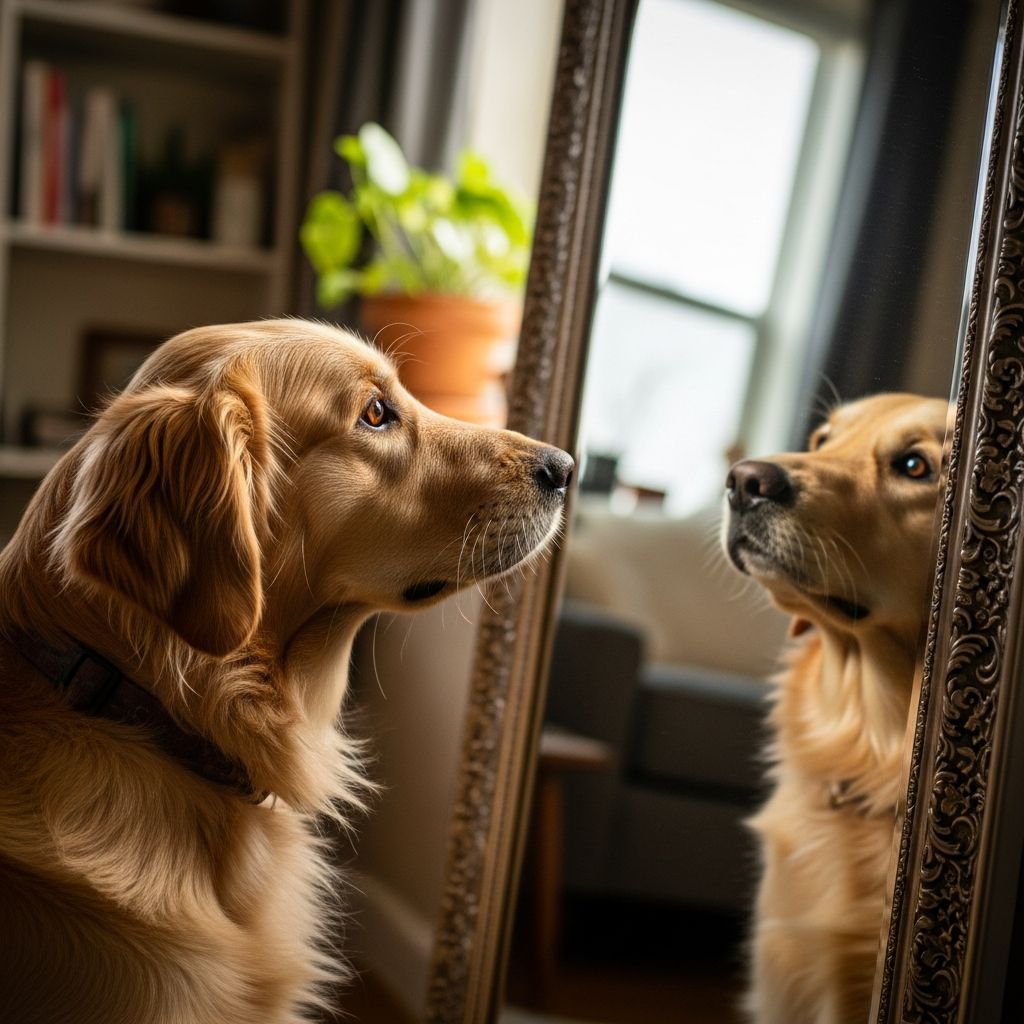
Dogs display forms of self-awareness through olfactory recognition, body manipulation tasks, and spatial navigation decisions, as evidenced by multiple scientific studies that adapt tests to their sensory strengths rather than relying solely on visual cues.
The Limitations of Traditional Self-Recognition Tests
The mirror self-recognition test, long considered a gold standard for assessing self-awareness in animals, involves marking a subject’s body and observing if they use a mirror to investigate the mark. Great apes, dolphins, elephants, and even magpies have passed this test, indicating they recognize their reflection as themselves. Dogs, however, consistently fail it, often treating the mirror image as another dog rather than themselves.
This failure does not necessarily mean dogs lack self-awareness. Vision is not dogs’ dominant sense; their world is primarily olfactory. Researchers argue that the mirror test is visually biased and ecologically invalid for species like dogs, whose primary sensory input is smell. Instead, alternative tests tailored to canine senses provide more accurate insights into their cognitive abilities.
Olfactory Evidence: The Sniff Test Revolution
A groundbreaking approach, the Sniff Test of Self-Recognition (STSR), evaluates self-awareness through scent. Developed by researchers including Prof. Roberto Cazzolla Gatti and validated by Dr. Alexandra Horowitz, this test presents dogs with their own urine scent alongside scents from other dogs or modified versions of their own.
In Horowitz’s study with 36 domestic dogs, subjects spent significantly more time investigating their own urine when it was altered with aniseed oil compared to unaltered samples or others’ scents. This prolonged sniffing suggests dogs distinguish their ‘olfactory image’ and recognize changes to it, implying self-recognition via smell. Cazzolla Gatti’s earlier work proposed this method, confirming dogs’ self-cognition hypothesis and challenging the mirror test’s universality.
- Dogs sniffed modified self-scent longer than unmodified self-scent.
- They differentiated self-scent from other dogs’ urine reliably.
- This behavior holds across ages, sexes, and group-living dogs.
These findings indicate dogs maintain a mental representation of their own odor, a key aspect of self-awareness adapted to their sensory modality.
Body Awareness: Navigating Physical Challenges
Beyond smell, dogs exhibit body awareness—the ability to understand their physical form as an obstacle or tool—in tasks like the ‘body as an obstacle’ experiment. In a study with 32 dogs, researchers attached a toy to a mat under the dog’s body, requiring the dog to give the toy to a human without leaving the mat.
Dogs rarely left the mat in the test condition, instead using body movements like sitting or lying down to free the toy, demonstrating they understood how their body blocked access and adjusted accordingly. Control conditions ruled out simple commands or external pulls: dogs left the mat freely when the toy was loose or tugged by experimenters, but persisted when their own body caused the obstruction.
This behavior reveals dogs represent their body’s consequences in a mental model, separating self-actions from external stimuli. It’s a foundational form of self-representation, precursor to higher cognition.
| Condition | Dog Behavior | Implication |
|---|---|---|
| Body Blocks Toy (Test) | Minimal mat-leaving; body adjustments | Body awareness and action-consequence understanding |
| Loose Toy (Control 1) | Easily retrieved; few mat leaves | Task comprehension confirmed |
| Experimenter Tugs Toy (Control 2) | Frequent mat-leaving | Distinguishes self vs. external causation |
| Invisible Tug (Control 3) | Similar to experimenter tug | No self-body involvement |
Spatial Decisions and Body Size Cognition
Dogs also show self-awareness in naturalistic navigation. A study demonstrated dogs factor in their body size when choosing paths, detouring more often with larger bodies or in confined spaces. This relies on an internal body schema, where dogs assess their physical dimensions relative to obstacles.
In experiments, dogs navigated barrel mazes, opting for wider paths when their size demanded it, indicating dynamic body representation for decision-making. Such adaptability underscores practical self-knowledge in everyday environments.
Broader Cognitive Indicators in Dogs
Self-awareness links to other canine skills: episodic memory (recalling specific events), imitation, empathy, and odor familiarity. Novice dogs learn agility courses precisely, and large breeds adjust for cuddling, hinting at bodily self-concept.
These traits form a modular self-representation, built bottom-up from sensory experiences rather than abstract reflection. Researchers advocate ecologically valid, multi-sensory tests over vision-centric ones.
Implications for Canine Welfare and Training
Recognizing dogs’ self-awareness enhances welfare. Understanding they perceive their bodies and scents informs enrichment: scent games boost mental health, body-aware training reduces frustration.
In multi-pet homes, respecting olfactory self-identity minimizes stress. Training leverages body awareness, like obstacle courses building confidence.
Challenges and Future Research Directions
Debates persist: is olfactory/body awareness full self-consciousness? Mirror failures might reflect limited visual self-modeling, not absence. Future studies could combine modalities or longitudinal tracking of cognitive development.
Cross-species comparisons, including wild canids, may reveal evolutionary roots. Neuroimaging could map brain areas for self-representation.
Common Questions About Dog Self-Awareness
Q: Why do dogs fail the mirror test?
A: Vision isn’t their primary sense; they rely on smell, so olfactory tests better reveal self-recognition.
Q: Can all dogs show self-awareness?
A: Studies include diverse domestic dogs, suggesting it’s widespread, though breed or experience may influence.
Q: How does body awareness help dogs daily?
A: It aids navigation, play, and rest, preventing mishaps in tight spaces.
Q: Is dog self-awareness like humans’?
A: It’s modular and sensory-based, foundational but not equivalent to human metacognition.
Q: What toys promote self-awareness?
A: Scent puzzles and body-obstacle toys encourage olfactory and physical self-exploration.
Key Takeaways for Dog Owners
- Trust smell-based games for cognitive stimulation.
- Observe body adjustments as signs of intelligence.
- Use positive, body-aware training methods.
- Celebrate dogs’ unique self-perception.
References
- Are Dogs Self Aware? New Research Suggests Yes — AKC. 2023-10-10. https://www.akc.org/expert-advice/news/a-new-way-to-look-at-dog-self-awareness/
- The sniff test of self-recognition confirmed: Dogs have self-awareness — ScienceDaily. 2017-09-05. https://www.sciencedaily.com/releases/2017/09/170905111355.htm
- Smell thy self: dog self-awareness and a changing scientific paradigm — Anthropocene Magazine. 2017-09-01. https://www.anthropocenemagazine.org/2017/09/dog-self-awareness/
- Dogs (Canis familiaris) recognize their own body as a … — PMC / NIH. 2021-02-01. https://pmc.ncbi.nlm.nih.gov/articles/PMC7893002/
- Body size awareness matters when dogs decide whether to detour … — PMC / NIH. 2023-10-01. https://pmc.ncbi.nlm.nih.gov/articles/PMC10587091/
Similar Articles








Read full bio of Sneha Tete




