

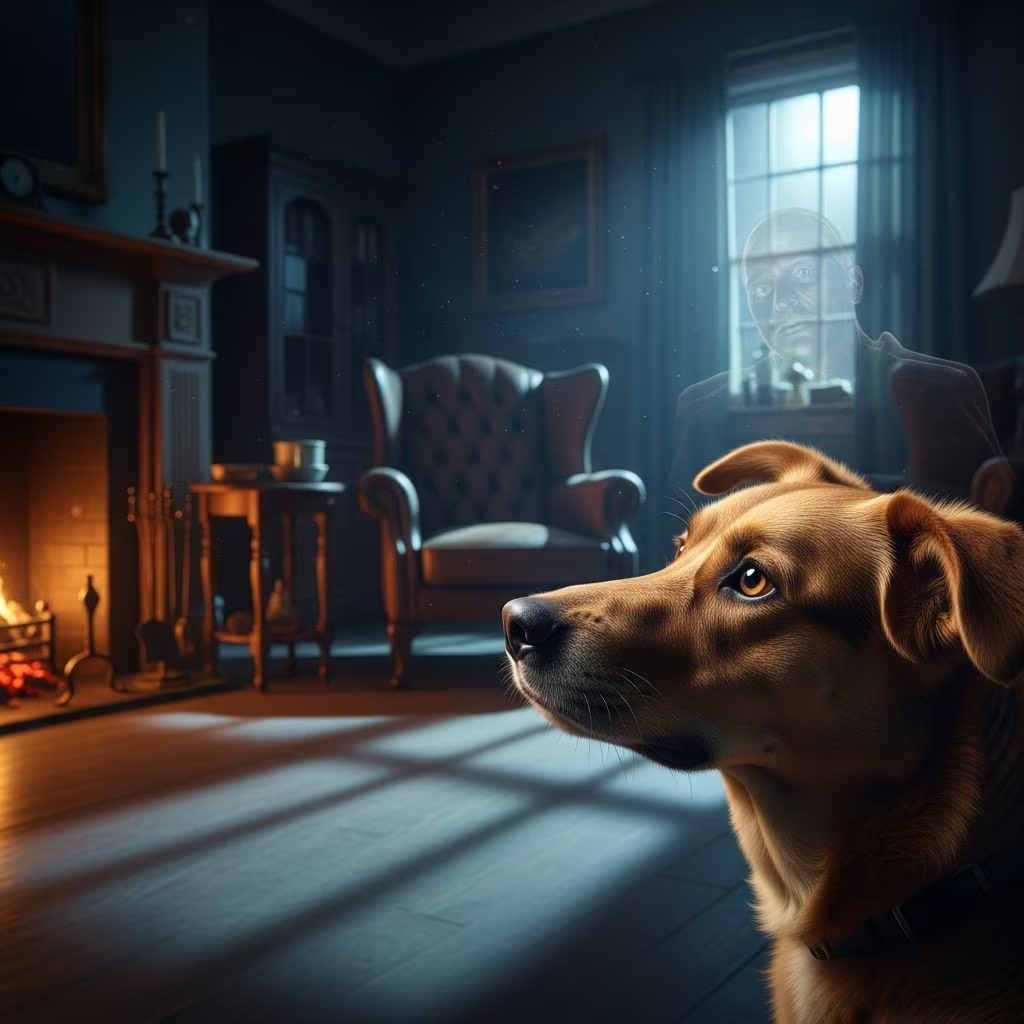
Dogs frequently display reactions to seemingly invisible presences, leading many owners to wonder if they possess the ability to sense ghosts or spirits. While compelling anecdotes abound, scientific analysis points primarily to their exceptional sensory capabilities rather than paranormal detection.
Common Observations of Unusual Canine Behavior
Pet owners worldwide report instances where their dogs stare intently at empty corners, bark aggressively at nothing visible, or follow unseen movements across a room. These behaviors often intensify in older homes or at night, fueling speculation about supernatural encounters. For instance, a dog might suddenly perk up its ears, track something with its eyes, or whine uneasily in a quiet space, prompting questions about ethereal visitors.
Such reactions can feel eerie, especially during moments of grief or in unfamiliar environments. Owners might interpret these as signs that their pet is communicating with departed loved ones or warning of spiritual presences. However, these observations, while intriguing, require scrutiny beyond personal stories to determine their true nature.
The Power of Canine Sensory Systems
Dogs’ perceptual world far exceeds human limits due to evolved sensory organs. Their olfactory system stands out prominently, equipped with approximately 220-300 million scent receptors compared to humans’ mere 5-6 million. This allows detection of odors diluted to parts per trillion, such as garlic oil at 0.00000005 percent concentration with high accuracy, as demonstrated in mid-20th-century research at Duke University.
Hearing capabilities further amplify this superiority. Canines perceive frequencies up to 65,000 Hertz—far beyond the human range of 20,000 Hertz—and sounds as quiet as -15 decibels. This sensitivity enables them to pick up ultrasonic noises from insects, small rodents in walls, or distant environmental shifts that humans entirely miss.
Vision, though dichromatic (lacking full red-green distinction), excels in low-light conditions thanks to abundant rod cells and a reflective tapetum lucidum layer behind the retina. Dogs detect rapid movements and subtle light fluctuations better, such as flickering from older screens or shadows in dim areas. A specialized vomeronasal organ also processes pheromones and chemical signals, adding layers to their environmental awareness.
| Sensory Ability | Dogs | Humans |
|---|---|---|
| Olfactory Receptors | 220-300 million | 5-6 million |
| Hearing Range (Hz) | Up to 65,000 | Up to 20,000 |
| Low-Light Vision | Superior (tapetum lucidum) | Limited |
| Motion Detection | Excellent for fast objects | Moderate |
This table highlights key differences, illustrating why dogs respond to stimuli imperceptible to us.
Scientific Explanations for Apparent Ghost Sightings
Experts attribute most “ghost-seeing” episodes to mundane sensory detections. A dog barking at stairs might hear termites chewing wood or air currents shifting subtly. Staring at walls often correlates with rodents or insects rustling inside, as noted by parapsychologist Loyd Auerbach, whose cats reacted to unseen tiny creatures.
Psychologist Christopher French emphasizes skepticism, stating that superior smell and hearing explain reactions to natural stimuli humans overlook. Ellen Furlong from Transylvania University adds that dogs orient toward odors or sounds to better analyze them, mimicking tracking an invisible entity.
Health factors play a role too. Conditions like Canine Cognitive Dysfunction Syndrome (similar to human dementia) can cause disorientation, hallucinations, or confusion, leading to odd staring or agitation, especially in senior dogs. Stress pheromones from owners, detectable by dogs, might also trigger responses during emotional times.
Anecdotal Stories Versus Empirical Evidence
Personal tales captivate: dogs comforting at gravesides, growling in reputedly haunted sites, or alerting before disasters. Some link this to precognition, citing dogs sensing earthquakes via infrasound or barometric changes. While impressive, these lack controlled validation.
Russell Hartstein, a certified dog behavior consultant, notes vast unknowns in animal behavior but stresses no scientific proof for ghost perception. Dr. Mary Burch from AKC echoes that while dogs sense beyond humans, it’s unlikely supernatural—more likely overlooked physical cues. Sociology professor Marc Eaton recounts a paranormal investigator attributing his dog’s stair-following to his late father’s spirit, biased by grief and belief.
Confirmation bias amplifies this: owners primed by ghost lore interpret neutral behaviors supernaturally, much like with children reacting to imperceptible stimuli.
Parapsychological Claims and Skepticism
Proponents of extrasensory perception (ESP)—telepathy, clairvoyance, precognition—argue animals inherently possess these, accessing non-physical ghost energies. Parapsychologists like Auerbach claim dogs and cats are “psychic like humans,” but supporting studies are scarce, often failing replication.
Mainstream science dismisses ESP due to methodological flaws and absence of reproducible evidence. Peer-reviewed research prioritizes sensory data over metaphysical assertions, aligning with Occam’s razor: simplest explanation (senses) suffices without invoking unproven spirits.
Environmental and Instinctual Influences
- Household Noises: Creaks, drafts, or HVAC vibrations register as threats.
- Wildlife Activity: Squirrels on roofs or bats in attics produce detectable signs.
- Human Cues: Subtle owner anxiety leaks via micro-expressions or scents.
- Territorial Instincts: Guarding against imagined intruders from shadows or scents.
- Low-Frequency Sounds: Infrasound from wind or machinery induces unease.
These factors combine, creating convincing “hauntings” from everyday occurrences.
Practical Advice for Concerned Owners
If your dog seems haunted, investigate practically:
- Check for pests or structural issues with professional inspection.
- Monitor health; consult a vet for cognitive or sensory decline signs.
- Record behaviors with video to identify patterns or triggers.
- Reduce stress through exercise, routine, and enrichment toys.
- Avoid reinforcing fear by staying calm during episodes.
These steps demystify behaviors, enhancing pet well-being without supernatural reliance.
Frequently Asked Questions
Why does my dog stare at nothing?
Likely tracking scents, sounds, or lights beyond human detection. Rarely, it signals medical issues.
Can dogs smell spirits?
No evidence supports this; their smell detects physical chemicals, not ethereal essences.
Do dogs sense death or disasters?
They detect precursors like gases or pressure changes, not metaphysical warnings.
Is night vision why dogs see ghosts?
Enhanced low-light sight spots movements in dark, mistaken for apparitions.
Should I worry about paranormal sensitivity?
Prioritize veterinary checks and environmental scans over supernatural fears.
Broader Implications for Human-Animal Bonds
Dogs’ perceptual edge strengthens our partnerships, from search-and-rescue to medical detection (e.g., 97% accuracy sniffing cancer). Acknowledging this fosters trust without mythologizing. While the supernatural allure persists, science illuminates behaviors, bridging mystery with understanding.
References
- Can dogs sense ghosts? — Popular Science. 2023-10-31. https://www.popsci.com/environment/can-dogs-sense-ghosts/
- Can Dogs See Ghosts? Busting The Myths — Purina NZ. 2024-01-15. https://www.purina.co.nz/care-and-advice/dog/behaviour-and-training/see-ghosts
- Can Dogs See Ghosts? — American Kennel Club. 2023-11-01. https://www.akc.org/expert-advice/lifestyle/can-dogs-see-ghosts-spirits/
- Can Dogs Sense Ghosts? — MyWoof. 2024-05-20. https://mywoof.com/blogs/articles/can-dogs-sense-ghosts



