

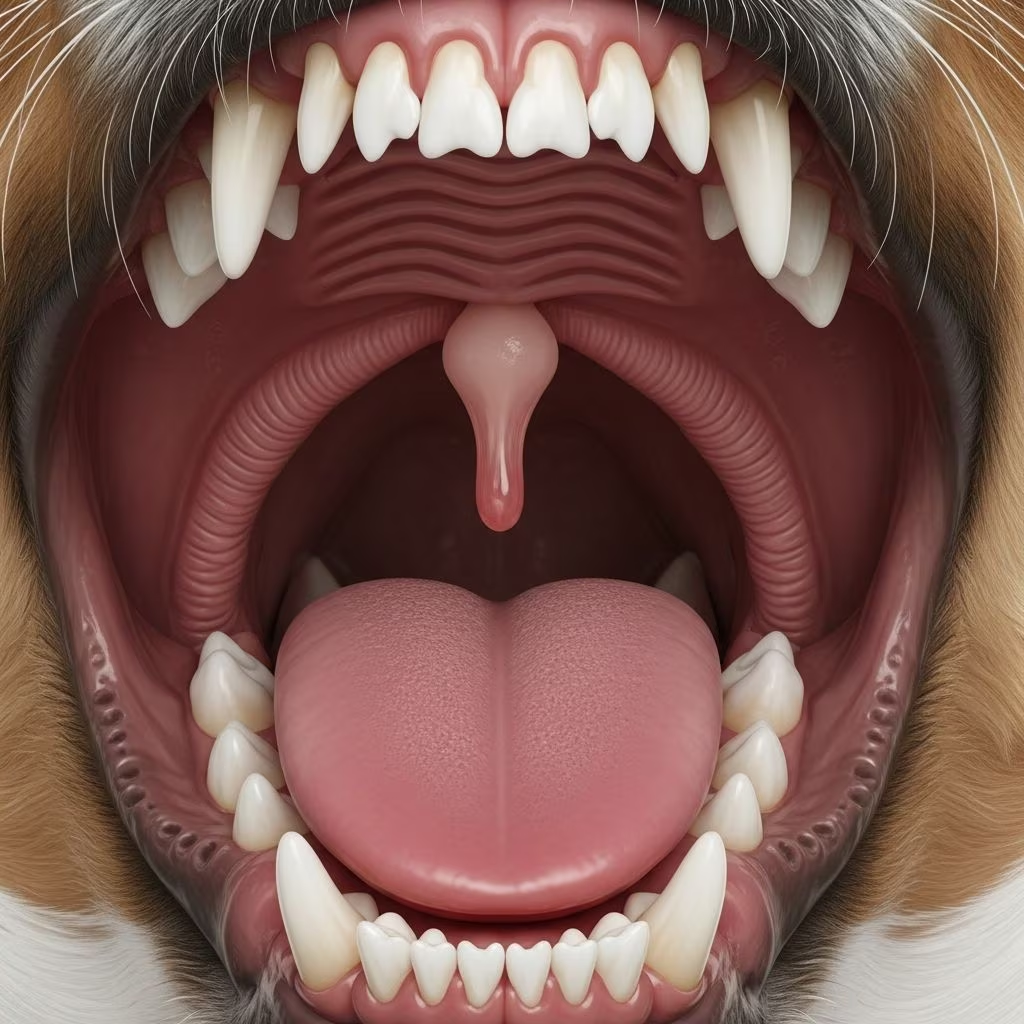
Dogs do not possess uvulas, the dangling tissue found in human throats. This anatomical difference stems from evolutionary adaptations tailored to canine communication, feeding, and respiration needs.
Understanding the Human Uvula and Its Role
The **uvula**, or palatine uvula, is a small, conical projection hanging from the soft palate at the back of the human mouth. Composed of muscle, connective tissue, and glands, it aids in saliva production to lubricate the throat, prevents food from entering nasal passages, and contributes to speech articulation.
Research indicates the uvula may also assist in drinking by sealing the nasal cavity during head flexion, a function hypothesized from studies on mammals. Its glandular structure—mixing serous and seromucous elements—supports mucosal protection. Notably, some humans are born without uvulas or have them surgically removed without major health impacts, underscoring its non-essential status.
Canine Oral Anatomy: Absence of the Uvula
In dogs, the soft palate forms the roof of the mouth’s caudal region, measuring approximately 6 cm long, 3 cm wide, and 5 mm thick, thickening toward the middle before tapering. Unlike humans, it lacks a protruding uvula; instead, it ends in a concave border with a thin fold forming the ventral tonsillar sinus wall.
Veterinary anatomy confirms no uvular structure across canine breeds. The soft palate separates oral and nasal cavities, facilitating swallowing and breathing via coordination with the palatopharyngeal arch, which recesses palatine tonsils. Histological evaluations reveal palatine glands ensuring lubrication, preventing friction during deglutition.
Evolutionary Reasons Behind the Missing Uvula in Dogs
The uvula represents an evolutionary accessory organ, primarily developed in humans for complex vocalization. Dogs communicate via barks, growls, whimpers, and pheromones detected through smell, negating uvula necessity.
Comparative studies across mammals show uvulas are rare; only select primates like baboons exhibit underdeveloped versions. Most animals, including dogs, evolved without this feature, as their lifestyles—upright drinking absent, simpler sounds produced—do not require it.
Common Throat Structures in Dogs Mistaken for Uvulas
Owners sometimes confuse an **elongated soft palate** with a uvula. This condition causes the palate to extend beyond normal limits, past the epiglottis and tonsils, obstructing airways.
| Structure | Location | Function | Potential Issues |
|---|---|---|---|
| Soft Palate | Roof of mouth, caudal | Separates oral/nasal cavities | Elongation leads to snoring, gagging |
| Lingual Tonsil | Base of tongue | Immune defense | Small, rarely problematic |
| Palatine Tonsils | Sides of throat | Larger, visible; immune role | Inflammation causes discomfort |
| Pharyngeal Tonsils | Nasal-throat junction | Protects airways | Can swell with infection |
Dogs feature three tonsil types: lingual (tiny at tongue base), palatine (prominent laterally), and pharyngeal (at nasopharyngeal junction).
Health Concerns Related to Canine Throat Anatomy
Elongated Soft Palate Syndrome
This hereditary issue, prevalent in brachycephalic breeds, narrows airways. Symptoms include snoring, gagging, breathing difficulty, exacerbated during exercise or heat. Untreated, it risks complete obstruction.
- Mild cases: Noisy breathing, mild cough
- Severe cases: Cyanosis, collapse
- Treatment: Surgical shortening via staphylectomy
Tonsil Inflammation and Infections
Palatine tonsils, most visible, fight oral pathogens but can enlarge with bacterial/viral infections, causing swallowing pain or halitosis.
Gag Reflex Without a Uvula
Dogs retain a robust gag reflex, mediated by the larynx rather than uvula. Laryngeal inflammation from irritants triggers gagging; monitor for foreign bodies or allergies.
Comparing Human and Dog Throat Features
| Feature | Humans | Dogs |
|---|---|---|
| Uvula | Present; aids speech, saliva | Absent |
| Soft Palate | With uvula protrusion | Thickens caudally, no protrusion |
| Tonsils | Paired palatine | Lingual, palatine, pharyngeal |
| Gag Trigger | Uvula primary | Larynx primary |
When to Consult a Veterinarian
Seek professional care if your dog exhibits:
- Persistent gagging or retching
- Snoring or labored breathing
- Coughing fits post-eating
- Blue gums or exercise intolerance
- Voice changes or drooling excess
Early diagnosis via laryngoscopy prevents complications. Brachycephalic breeds (e.g., Bulldogs, Pugs) warrant routine checks.
Preventive Care for Canine Throat Health
- Maintain dental hygiene to reduce infections.
- Avoid irritants like smoke or allergens.
- Monitor weight to ease breathing.
- Select breeds with consideration for anatomy.
FAQs on Dog Throat Anatomy
Why don’t dogs need uvulas?
Dogs lack uvulas due to different communication (scent, simple sounds) and feeding mechanics, evolving without this human-specific organ.
Can a dog’s soft palate look like a uvula?
Yes, elongation mimics it but causes obstruction; veterinary correction needed.
Do all dogs gag the same way?
Gag reflex exists via larynx; frequency varies by health, breed.
Are tonsils visible in healthy dogs?
Palatine tonsils may peek during yawning; enlargement signals issues.
Is throat surgery common in dogs?
Yes, for elongated palates in short-nosed breeds to improve airflow.
This comprehensive overview highlights canine throat distinctions, empowering owners for proactive health management. (Word count: 1678)
References
- Do Dogs Have Uvulas? What Is Uvula? Coughing, Gagging and Choking in Dogs — YouTube. Circa 2023. https://www.youtube.com/watch?v=s9u1jssSH4Y
- The riddle of the uvula — PubMed (PMID: 1408233). 1992-10-01. https://pubmed.ncbi.nlm.nih.gov/1408233/
- The Digestive Apparatus and Abdomen — Veterian Key. N/A. https://veteriankey.com/the-digestive-apparatus-and-abdomen/
- ORAL CAVITY, TONGUE, SALIVARY GLANDS, TEETH — Univet.hu (PDF). 2019. https://univet.hu/wp-content/uploads/2019/04/digestive-system_1.pdf
- Understanding the Palatopharyngeal Arch in Dogs — Oreate AI Blog. N/A. http://oreateai.com/blog/understanding-the-palatopharyngeal-arch-in-dogs/5078ad8f155f484594f2e052a89d296c
- The Anatomy of the Dog Soft Palate. II. Histological Evaluation — Anatomical Record (Wiley). 2011. https://anatomypubs.onlinelibrary.wiley.com/doi/10.1002/ar.21417



