

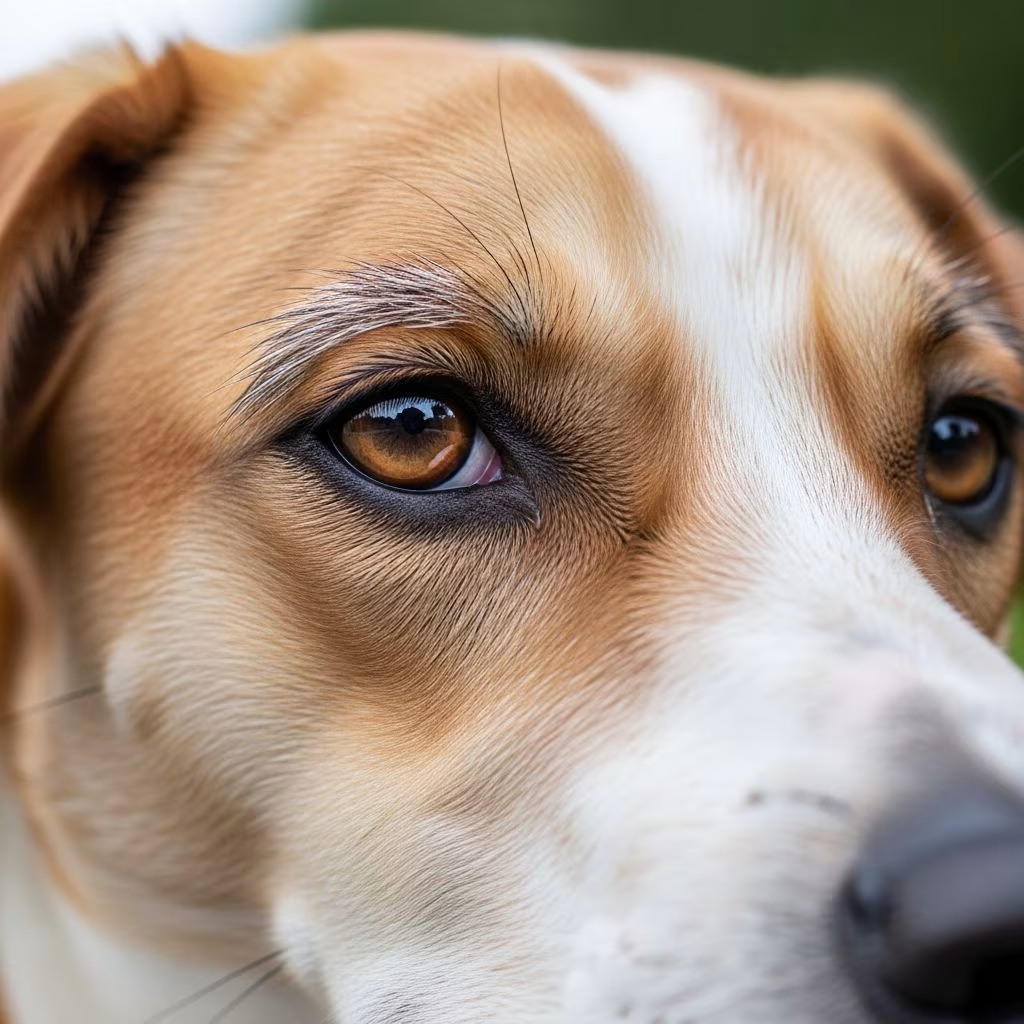
Dogs do not possess eyebrows in the anatomical sense like humans, with distinct hair patches above the eyes. Instead, they feature specialized facial muscles that enable expressive movements mimicking eyebrow raises, creating the iconic “puppy dog eyes” that tug at human heartstrings. This adaptation arose through domestication, distinguishing dogs from their wolf ancestors.
The Anatomy of Canine Facial Expressions
Canine faces rely on a network of muscles for communication, far more nuanced than many realize. Central to this is the levator anguli oculi medialis (LAOM) muscle, a thin strip above the eye that lifts the inner eyebrow area, making eyes appear larger and more infantile. Dissections reveal this muscle is consistently present and well-developed in dogs across breeds, from Chihuahuas to German Shepherds.
In contrast, wolves exhibit only irregular fiber clusters in this region, lacking the structured LAOM. This difference emerged rapidly within roughly 33,000 years of domestication, highlighting intense selective pressure on soft tissues.
Another muscle, the retractor anguli oculi lateralis (RAOL), pulls eyelids laterally in most dogs, exposing more sclera (eye whites), which humans find appealing. Wolves show this muscle less prominently, and even among dogs, ancient breeds like Siberian Huskies often lack it fully.
| Feature | Dogs | Wolves |
|---|---|---|
| LAOM Muscle | Uniformly present, enables intense inner brow raise | Absent or scant fibers |
| RAOL Muscle | Present in most breeds, pulls eyelids outward | Less developed, variable |
| Eyebrow Movement Intensity | High, frequent in human presence | Low or absent |
Evolutionary Origins: From Wolves to Expressive Companions
Domestication transformed wolves into dogs, not just in size and coat but in communicative anatomy. Research published in the Proceedings of the National Academy of Sciences analyzed heads from six dog breeds and four wolves, confirming the LAOM’s dog-specific evolution.
Lead researcher Dr. Juliane Kaminski from the University of Portsmouth notes, “The evidence is compelling that dogs developed a muscle to raise the inner eyebrow after they were domesticated from wolves.” This muscle allows dogs to produce Action Unit 101 (AU101) in facial action coding—a human-like sad expression that enlarges eyes, evoking nurturing instincts.
Behavioral observations support this: when interacting with humans for two minutes, dogs raised their inner brows more often and intensely than wolves, with peak movements exclusive to dogs. Dogs even modulate this based on attention—more eyebrow action when watched, less when ignored.
Why These Traits Captivate Humans
The “puppy dog eyes” effect leverages paedomorphism, retaining juvenile features into adulthood, which humans instinctively protect. This resembles human sadness signals, fostering empathy and bonding.
Studies show dogs producing these expressions get adopted faster from shelters. Humans unconsciously selected for expressiveness during breeding, giving expressive dogs a survival edge through better care.
- Larger, droopy eyes trigger caregiving responses.
- Exposes sclera, rare in mammals except humans.
- Voluntary control: dogs “perform” for attention or food denial avoidance.
Breed Variations in Facial Expressiveness
Not all dogs express equally. Modern breeds outperform ancient ones like Huskies, which retain wolf-like traits. Dissections of Labradors, Bloodhounds, and mutts showed robust LAOM, while Huskies mirrored wolves more closely.
Fur patterns often accentuate these movements—darker “eyebrow” markings on breeds like German Shepherds or Bernese Mountain Dogs enhance visibility, though the muscle drives the action.
Myths and Realities of Dog Eyebrows
Myth 1: Dogs have actual eyebrows like humans. Reality: No hair follicles form defined brows; it’s muscular and fur illusion.
Myth 2: All dogs are equally expressive. Reality: Depends on breed lineage and individual variation; wolves can’t replicate it.
Myth 3: This evolved randomly. Reality: Human preference drove rapid selection on thin muscles with outsized impact.
Implications for Dog-Human Relationships
Understanding these muscles deepens appreciation for dogs’ social intelligence. They read human cues and respond with tailored expressions, strengthening partnerships.
In training or therapy, recognizing voluntary eyebrow raises can improve interactions. This trait underscores dogs’ uniqueness, co-evolved with humans over millennia.
Health Considerations for Canine Eye Areas
While expressive, eye-region muscles can lead to issues. Breeds with heavy brows or folds (e.g., Bloodhounds) risk infections. Regular cleaning prevents dermatitis.
Overuse from stress might strain muscles; watch for asymmetry signaling pain. Consult vets for persistent squinting or brow furrowing.
FAQs
Can wolves make puppy dog eyes?
No, wolves lack the LAOM muscle, limiting intense inner brow raises.
Do all dog breeds have this eyebrow muscle?
Yes, uniformly across breeds studied, though ancient lineages show subtler development.
Is the eyebrow movement voluntary in dogs?
Partially; dogs increase it when humans attend to them.
Why did dogs evolve this trait so quickly?
Human selection favored expressive pups for companionship advantages.
Does fur color create eyebrows?
Fur patterns enhance visibility but don’t enable movement; muscles do.
Further Reading and Experiments at Home
Observe your dog: approach and note brow lifts. Compare breeds or watch wolf videos—spot the difference. This trait cements dogs’ role as ultimate human allies.
References
- Dogs Evolved New Muscles around Eyes to Better Communicate — Sci.News. 2019-10-17. https://www.sci.news/biology/puppy-dog-eyes-domestication-07297.html
- A Wilder View: Why dogs have eyebrows and wolves don’t — KPAX. N/A. https://www.kpax.com/news/a-wilder-view/a-wilder-view-why-dogs-have-eyebrows-and-wolves-dont
- Dogs Have a Special Muscle That Lets Them Make ‘Puppy Dog Eyes’ — Smithsonian Magazine. 2019-10-17. https://www.smithsonianmag.com/smart-news/dogs-have-special-muscle-lets-them-make-puppy-dog-eyes-180972440/
- The science behind ‘puppy dog eyes’ — University of Portsmouth. 2019-10-17. https://www.port.ac.uk/news-events-and-blogs/news/puppy-dog-eyes
- Evolution of facial muscle anatomy in dogs — PNAS. 2019-10-17. https://www.pnas.org/doi/10.1073/pnas.1820653116



