

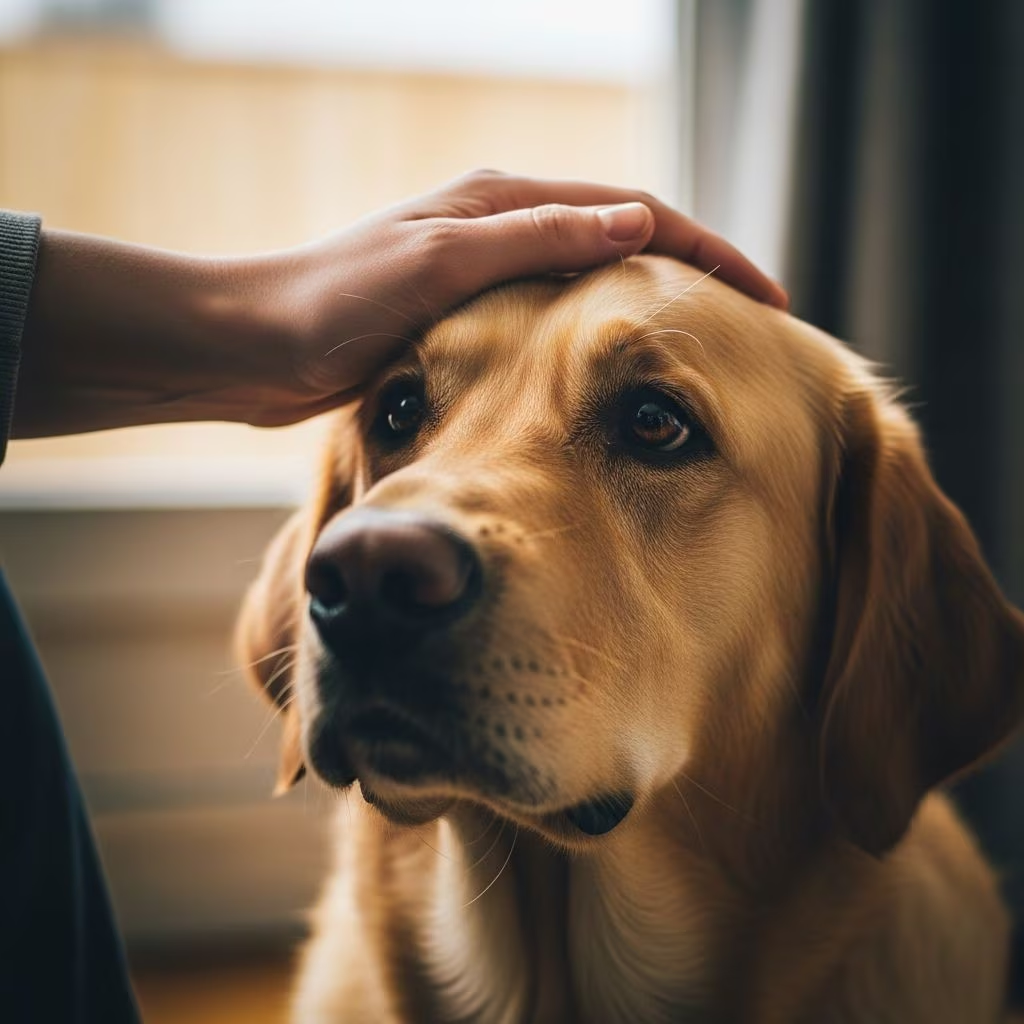
Do Dogs Get Sad When We’re Sad?
Your dog seems to know when you’ve had a rough day: they hover a little closer, curl against your leg, or quietly follow you from room to room. It is natural to wonder if that behavior means your dog is sad along with you or simply reacting to your change in mood and routine.
Modern research suggests that dogs are highly attuned to human emotions, using our facial expressions, tone of voice, posture, and behavior to guide their own actions. At the same time, scientists are cautious about calling this full human-like empathy; in many cases, dogs are reading our emotional cues and adjusting their behavior in ways that help them feel safe, secure, and connected.
This article explores how dogs read your feelings, what they might experience when you’re sad, and how your emotional life can shape your dog’s behavior over time.
How Dogs Read Human Emotions
Dogs evolved and were bred to live closely with humans, and that partnership has given them remarkable social skills for reading us. Studies show that dogs:
- Differentiate between happy and angry facial expressions and respond differently to each.
- Use emotional cues from humans to make decisions in uncertain situations.
- Show physiological changes, such as altered cortisol levels, when they hear human distress, like a baby crying.
- Have brain regions that respond selectively to emotional tone in human voices.
One review in Evolutionary Human Sciences concluded that dogs can not only recognize emotional expressions but also access the affective content (positive vs. negative) and use that information when deciding what to do next.
Visual Cues: Faces, Posture, and Movement
Dogs pay close attention to your face and body language. Research has found that dogs show specific behaviors—such as increased mouth-licking—when looking at human faces that display negative emotions, like anger, compared with happy faces.
- Dogs are more likely to approach and explore in a positive emotional context.
- They are more likely to keep distance, hesitate, or show appeasement behaviors in a negative context (e.g., someone looking tense or upset).
These reactions suggest that dogs are not just noticing that something is different; they are adjusting their behavior in a way that is functionally appropriate to the emotional information they have received.
Vocal Cues: Tone Over Words
While dogs can learn the meaning of specific words, they are especially sensitive to how those words are said. Neuroimaging and behavioral data show that dogs can distinguish between neutral, happy, and angry tones of voice and respond accordingly.
- A bright, relaxed tone tends to invite engagement and play.
- A flat, low, or tense tone can cause hesitation, appeasement signals, or withdrawal.
In other words, a dog may react more to the emotional tone behind your words than to the words themselves.
Context and Routine
Dogs do not interpret emotions in isolation; they also rely heavily on context. They learn, over time, that certain patterns—like you moving slowly, speaking softly, or spending more time on the couch—often accompany specific emotional states. In ambiguous situations, dogs often look to their humans for social referencing: using your emotional response as a guide for how they should feel and behave.
Do Dogs Actually Feel Sad When You’re Sad?
There is no simple way to ask a dog, “Are you sad too?” However, research and careful observation give us some clues about what they might experience when their guardian is upset.
Emotional Contagion vs. Empathy
Researchers often distinguish between emotional contagion and full-blown empathy:
- Emotional contagion is when one individual’s emotion triggers a similar emotion in another, without a clear understanding of the other’s perspective.
- Cognitive empathy involves recognizing what another individual is feeling and responding to that state in a targeted way.
Evidence suggests that dogs experience something close to emotional contagion. For example, their stress hormones and physiological state can change when they hear a human baby crying or observe a person expressing distress. However, whether they fully understand why you feel sad or stressed remains uncertain.
Behavioral Changes When Guardians Are Sad
In one experimental study, dogs behaved differently depending on whether their owners appeared happy, sad, or neutral in real time. Dogs with happy owners performed better on a training task, while dogs with sad owners were less compliant and showed fewer active behaviors such as jumping or gazing.
This does not necessarily mean that dogs are becoming depressed when we are sad, but it does show that our emotional state can:
- Change how motivated and confident dogs feel in that moment.
- Shift their level of engagement in tasks like training.
- Influence whether they approach, hold back, or seek comfort.
Comfort-Seeking or Comfort-Giving?
Many guardians describe their dogs as “comforting” them when they cry or feel low, for example by resting a head on their lap or sitting closer than usual. Some studies have found that dogs will approach crying humans more often than humming or talking humans, which suggests they are sensitive to distress and may offer contact-seeking behaviors in response.
However, researchers also note that dogs might be:
- Seeking comfort themselves in a tense or unfamiliar situation.
- Responding to past learning (e.g., being petted when they come close during sad moments).
- Reacting to changes in body language and tone rather than the abstract concept of sadness.
This does not make their responses less meaningful. It simply means that their apparent sympathy may be a blend of genuine emotional sensitivity, conditioning, and a drive to keep their primary attachment figure close and available.
How Your Mood Shapes Your Dog Over Time
The emotional connection between people and dogs is not a one-time event; it plays out every day in routines, reactions, and shared spaces. Over time, your general emotional style—calm, anxious, energetic, withdrawn—can influence your dog’s behavior profile.
Personality “Mirroring” in Dogs
Research that measures both human and dog traits has found modest but meaningful links between guardian personality and canine behavior. For example:
- Guardians who report higher emotional stability and calmness tend to have more sociable, resilient dogs.
- Guardians with higher levels of anxiety or neuroticism are more likely to have dogs who show fear-based or reactive behaviors.
These are correlations, not destiny. They point to the impact of daily handling style, predictability, and stress management on both sides of the leash.
| Guardian Pattern | Possible Dog Response (Over Time) |
|---|---|
| Calm, predictable, reward-based handling | More confident, sociable, and resilient behavior |
| Inconsistent or tense interactions | Increased vigilance, stress signals, or reactivity |
| Frequent emotional outbursts or conflict at home | Heightened sensitivity to noise, avoidance, or appeasement behavior |
Stress, Conflict, and the Home Environment
Dogs living in homes with high levels of conflict or chronic stress may show signs of increased anxiety, such as startle responses, restlessness, or changes in appetite, though individual sensitivity varies. They also learn quickly which behaviors reduce tension or end unpleasant situations, which can shape how they interact with people.
In contrast, households that emphasize clear communication, positive reinforcement, and consistent routines tend to support dogs who cope better with new situations and recover faster from stressful events.
Are Humans Good at Reading Dog Emotions?
While dogs are adept at reading us, humans may not be equally skilled at reading dogs. Recent research has found that people often rely heavily on context—such as whether a dog just chewed something or is at the vet—rather than on the dog’s actual body language when judging how the dog feels.
This can lead to misinterpretations, such as assuming that a dog’s crouched posture and lip-licking after a scolding are signs of guilt rather than fear or appeasement. Understanding this gap matters because it affects how we respond to dogs in emotionally charged moments.
Commonly Misread Dog Signals
- “Guilty” look: Often a mix of avoidance, head turns, and lip-licking that signals discomfort, not moral guilt.
- Staring and stillness: Can be an early sign of tension or threat, not just concentration.
- Tail wagging: Indicates arousal, not always happiness. The height, speed, and stiffness of the wag matter.
When people misread these signs, they may overestimate or underestimate their dog’s emotional state, which can strain the relationship and contribute to stress on both sides.
Supporting Your Dog When You’re Struggling
Knowing that your dog notices and reacts to your emotions does not mean you must hide every difficult feeling. Instead, it suggests that small, intentional choices can help protect your dog’s well-being, especially during challenging periods.
Practical Ways to Help Your Dog Feel Secure
- Maintain basic routines: Try to keep feeding, walks, and sleep schedules as consistent as possible, even when you feel low.
- Use predictable, gentle handling: Avoid sudden outbursts directed at your dog; if you are overwhelmed, briefly step away to reset before interacting.
- Offer familiar comfort: Quiet petting, brushing, or sitting together can reassure both of you.
- Preserve enrichment: Short training sessions, sniff walks, and puzzle feeders can help your dog burn mental energy when your own energy is limited.
- Ask for support: When possible, enlist friends, family, or professional dog walkers to help with exercise and social contact during especially tough times.
If you notice significant, lasting changes in your dog’s behavior—such as withdrawal, loss of appetite, or new aggression—consult your veterinarian or a qualified behavior professional, as these shifts can reflect a combination of environmental stress and underlying medical or behavioral conditions.
Frequently Asked Questions (FAQs)
Q: Does my dog get sad when I cry?
A: Studies suggest that dogs notice and respond to human crying, sometimes by approaching and seeking contact, and their own stress levels can change in response to human distress. Whether they feel sadness in the same way humans do is unclear, but they are clearly sensitive to your emotional state.
Q: Can my anxiety make my dog anxious?
A: Research has found associations between guardian anxiety or emotional instability and dogs who show more fear-based or reactive behavior. Your dog’s behavior is shaped by many factors, but managing your own stress and using calm, consistent training can lower the risk of anxiety in your dog.
Q: Is my dog trying to comfort me or themselves?
A: Probably both. Dogs often seek proximity and contact when their guardian is upset, which may soothe them and you at the same time. Their behavior is meaningful, even if it is partly driven by their own need for security.
Q: How can I tell if my dog is stressed by my mood?
A: Watch for signs such as lip-licking, yawning outside of sleepiness, turning the head or body away, pacing, hiding, or sudden changes in sociability. If these behaviors cluster around tense interactions or emotional moments, your dog may be feeling the impact of the atmosphere.
Q: What is the best way to support my dog when I’m going through a hard time?
A: Focus on preserving predictable routines, providing gentle, positive interactions, and avoiding punishment or harsh tones. If your capacity is limited, small, consistent moments—like a daily sniff walk or a few minutes of calm petting—can still make a strong, reassuring difference.
References
- Dogs read human emotions and perform better for happy owners — Max Planck Institute for Geoanthropology. 2023-02-14. https://www.gea.mpg.de/104765/dogs-read-human-emotions
- People and Their Dogs Really Do Have Similar Personalities — Kinship. 2023. https://www.kinship.com/pet-behavior/dogs-mirror-humans
- Dogs functionally respond to and use emotional information from human expressions — Albuquerque N. et al., Evolutionary Human Sciences. 2021-01-26. https://www.cambridge.org/core/journals/evolutionary-human-sciences/article/dogs-functionally-respond-to-and-use-emotional-information-from-human-expressions/BFA8227B714FFA69F4BC439D9B8E1337
- How Do Dogs Behave When Presented with Situations of Different Emotional Valences? — Coppola F. et al., Animals (MDPI). 2023-03-17. https://www.ncbi.nlm.nih.gov/pmc/articles/PMC10044040/
- Research sheds light on human misperceptions of dog emotions — Arizona State University / News-Medical. 2025-03-10. https://www.news-medical.net/news/20250310/Research-sheds-light-on-human-misperceptions-of-dog-emotions.aspx
- People Are Not Really Great at Reading Dogs’ Emotions, New Study Finds — Kinship. 2025. https://www.kinship.com/news/humans-bad-at-reading-dog-emotions
- How dogs think — American Psychological Association. 2025-10-01. https://www.apa.org/monitor/2025/10/how-dogs-think



