

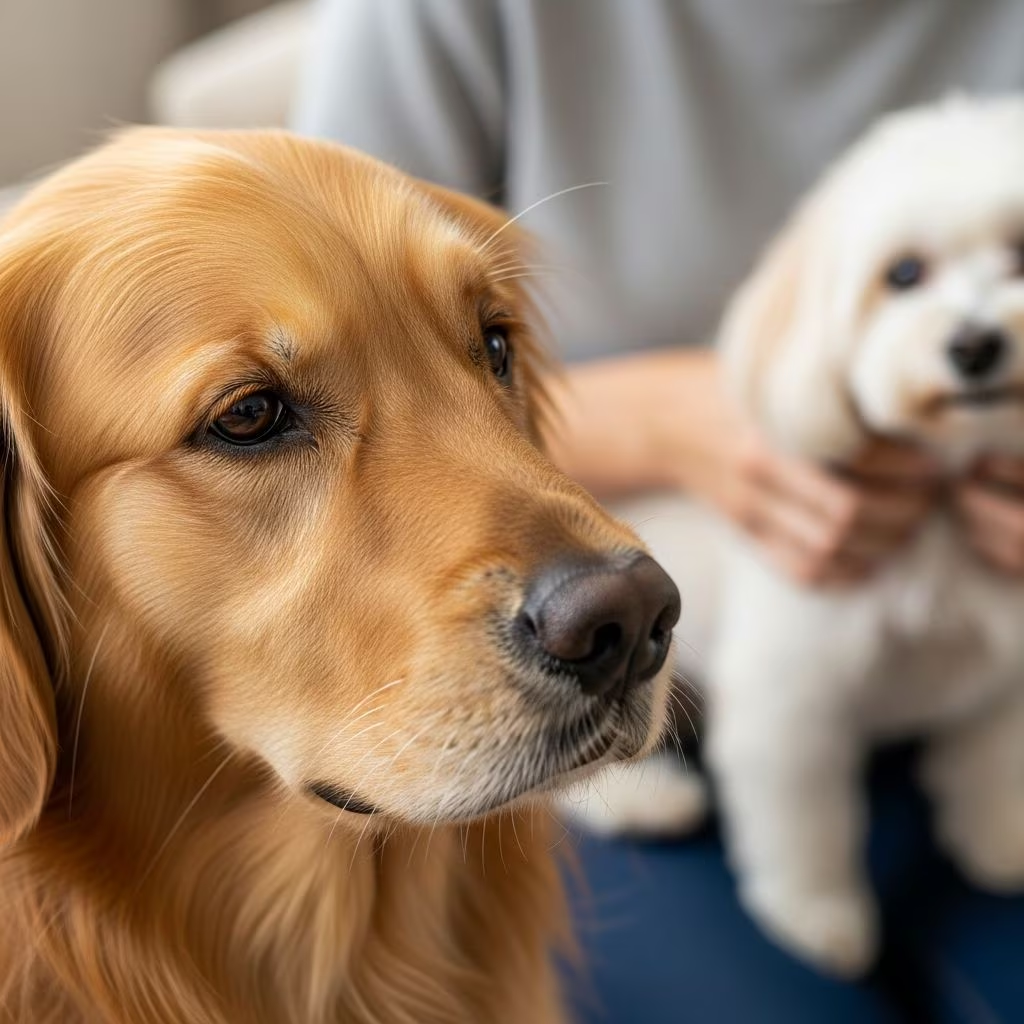
Dogs exhibit jealousy through specific behaviors when their owners interact with perceived rivals, such as pulling on leashes with significant force even when the interaction is hidden from view, mirroring patterns seen in human infants.
Scientific Foundations of Canine Jealousy
Research from academic institutions has provided empirical evidence that dogs display jealousy, challenging earlier skepticism about animals possessing complex secondary emotions. A study conducted at the University of Auckland involved 18 dogs observing their owners interact with a realistic fake dog or a neutral fleece cylinder. Dogs reacted strongly only to the fake dog scenario, attempting to reach their owners despite barriers blocking their view. This response was not merely due to the presence of an object but specifically triggered by social interaction between the owner and a rival-like figure.
Earlier work from the University of California San Diego adapted infant jealousy paradigms to dogs, using stuffed dogs that mimicked lifelike movements. Dogs showed increased snapping, pushing, and positioning themselves between owners and the faux rivals compared to interactions with nonsocial objects like plastic bottles. These findings suggest jealousy in dogs serves to protect social bonds, a primordial form potentially predating advanced self-awareness in humans.
Key Behavioral Indicators in Dogs
Dogs manifest jealousy through a cluster of observable actions rather than a single cue. Common signs include:
- Leash pulling: Forceful tugging to interrupt owner-rival interactions, equivalent in strength whether visible or hidden.
- Physical intervention: Pushing or snapping at the rival or owner to regain attention.
- Increased gazing: Prolonged stares at both owner and rival, higher during affectionate displays than neutral activities like reading.
- Vocalizations and agitation: Whining, barking, or pacing when attention shifts.
- Attention-seeking: Nudging, pawing, or inserting themselves physically.
These behaviors cluster specifically in jealousy conditions, distinguishing them from play, aggression, or mere curiosity. For instance, aggression like snapping occurred in 25% of jealousy trials but rarely elsewhere.
Experimental Evidence: Breaking Down the Studies
To rigorously test jealousy, researchers employed controlled setups isolating variables like visibility and rival type. Here’s a comparison of pivotal studies:
| Study | Key Method | Main Finding | Sample Size |
|---|---|---|---|
| University of Auckland (2021) | Fake dog vs. fleece cylinder; visible/hidden interactions | Dogs pulled leashes equally hard out-of-sight; minimal response to cylinder | 18 dogs |
| UC San Diego (2014) | Stuffed dog vs. nonsocial objects; owner affection vs. reading | More snapping/pushing toward faux dog; broke owner-rival connection | ~250 trials across dogs |
| fMRI Brain Study | Watching caregiver feed fake dog vs. bucket | Aggressive dogs showed amygdala activation; habituated with repetition | Not specified |
These experiments confirm three hallmarks: reactions only to social rivals, triggered by interaction (not presence), and persisting out-of-sight, indicating mental representation of events.
Neurological Underpinnings: What Brain Scans Reveal
Advanced imaging supports behavioral data. In one study, aggressive dogs displayed heightened amygdala activity—linked to emotional processing—while viewing caregivers reward a fake dog over a bucket. This neural response diminished with repeated exposure, hinting at habituation strategies for managing jealousy. Such findings parallel human jealousy circuits, though canine experiences remain subjective and unprovable.
Triggers and Contexts for Jealousy Outbursts
Jealousy surges in scenarios prioritizing social competition:
- New pets or visitors receiving pets/strokes.
- Owner playtime with other animals.
- Family members cuddling puppies or babies.
- Feeding/treating another dog preferentially.
Multi-dog households amplify risks, especially with resource guarding. Surveys indicate over 80% of owners witness these reactions, aligning with lab results. Puppies may show less intensity due to immature cognition, but adults respond robustly.
Distinguishing Jealousy from Other Emotions
Not all attention-seeking is jealousy. Key differentiators:
| Jealousy | Resource Guarding | Play Solicitation | Fear/Anxiety |
|---|---|---|---|
| Owner + social rival interaction | Food/toy possession | Reciprocal bouncing/bows | Avoidance/tail tucking |
| Pushing/snapping at rival | Stiff posture/growling at approach | Loose wagging/invitations | Pacing/whining alone |
| Out-of-sight persistence | Direct threat response | Engages both parties | Calms with isolation |
Context clarifies: jealousy targets owner-rival dyads, not solo threats.
Strategies to Minimize Jealousy in Your Dog
Proactive management fosters harmony:
- Equal attention distribution: Schedule individual sessions to prevent deficits.
- Desensitization training: Gradually expose to rivals with rewards, building tolerance.
- Positive reinforcement: Reward calm behavior during interactions.
- Enrichment toys:
- Professional help:
Redirect energy when alone.
Consult trainers for persistent aggression.
Consistency prevents escalation; early intervention yields best outcomes.
Evolutionary Perspective: Why Jealousy Persists
Jealousy likely evolved to safeguard pair bonds in pack animals, aiding survival via resource sharing. Dogs, domesticated from wolves, retained this trait, enhanced by human bonding. Unlike primates, dogs show jealousy sans mirror self-recognition, suggesting a basal form protecting attachments.
Common Myths Debunked
- Myth: Dogs manipulate owners. Behaviors stem from genuine emotion, not cunning.
- Myth: Only spoiled dogs get jealous. Universal across breeds/ages.
- Myth: Ignore to extinguish. Risks worsening via frustration buildup.
FAQs
Can all dogs feel jealousy?
Most do, per studies, though intensity varies by temperament and history.
Is dog jealousy harmful?
Mild cases are normal; severe can lead to fights or stress—monitor closely.
How to introduce a new dog without jealousy?
Slow, supervised meets with equal treats/attention; use baby gates initially.
Do puppies get jealous like adults?
Less pronounced, but precursors appear early.
Does neutering reduce jealousy?
No direct link; behavior training is key.
Long-Term Implications for Dog-Human Bonds
Recognizing jealousy deepens empathy, improving welfare. Future research may probe subjective feels via tech, but current data affirms dogs mentally simulate rival threats, enriching our view of their rich inner lives. Owners benefit by addressing it proactively, strengthening unbreakable ties.
References
- Yes, dogs do get jealous – new study — University of Auckland. 2021-04-13. https://www.auckland.ac.nz/en/news/2021/04/13/yes-dogs-do-get-jealous-new-study.html
- Dogs Act Jealously Even When They Don’t See Their Rival — Association for Psychological Science. 2021-04. https://www.psychologicalscience.org/news/releases/2021-april-dogs-jealous.html
- Jealousy in Dogs — PMC/PLOS ONE. 2014. https://pmc.ncbi.nlm.nih.gov/articles/PMC4108309/
- Dog Jealousy Study Suggests Primordial Origins — UC San Diego Today. 2014. https://today.ucsd.edu/story/dog_jealousy_study_suggests_primordial_origins_for_the_green_eyed_monster
- Dog Jealousy — Wellbeing International Studies Repository. Year not specified (recent). https://www.wellbeingintlstudiesrepository.org/animsent/vol3/iss22/1/



