

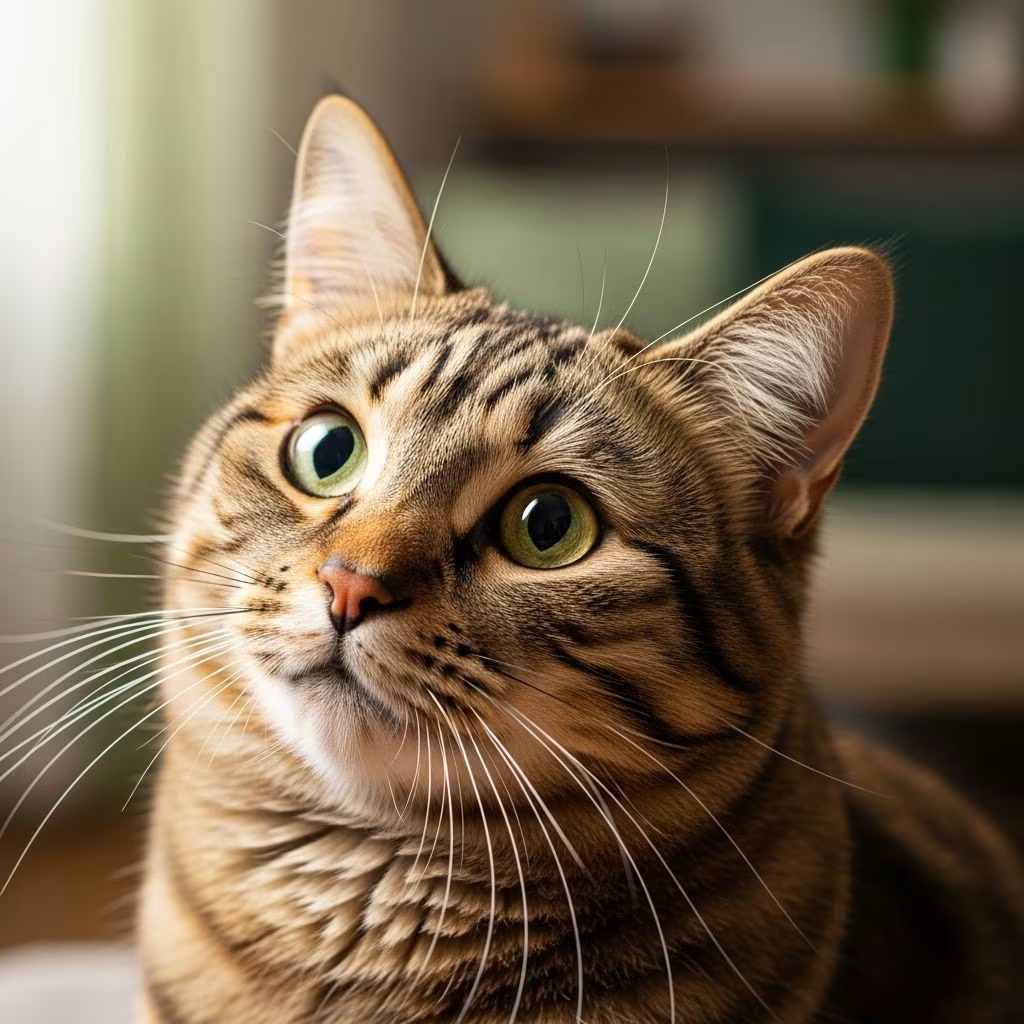
Do Cats Think Humans Are Cute? What Science Reveals About Feline Perception
The relationship between humans and cats has fascinated pet owners for thousands of years. One question that often arises is whether cats find us as adorable as we find them. While cats display affection and bonding behaviors toward their human companions, the question of whether they perceive humans as “cute” involves a deeper understanding of feline cognition, perception, and the mechanisms that drive interspecies bonding.
Understanding Feline Cognitive Limitations
To answer whether cats think humans are cute, we must first understand the cognitive abilities of cats. Unlike humans, cats have significant limitations in self-awareness and abstract thinking. Research has shown that cats typically exhibit three response patterns when faced with their reflection: they may perceive it as another cat and display aggressive behavior, show curiosity or exploratory behavior, or completely ignore it. This pattern indicates that cats likely cannot establish a cognitive connection between their reflection and themselves, suggesting they lack the self-awareness necessary to understand abstract aesthetic concepts like “cuteness.”
This cognitive limitation directly affects their ability to comprehend how humans perceive them. If cats cannot fully recognize themselves as separate entities, they certainly cannot understand the human concept of cuteness as an abstract quality. Instead, their interactions with humans are driven by more fundamental mechanisms rooted in behavior, communication, and evolutionary adaptation.
The Evolution of Human-Cat Cuteness Perception
While cats may not consciously think humans are cute, the domestication of cats has led to fascinating changes in feline facial morphology that influence how humans perceive them. Research published in peer-reviewed journals has documented how domestic cats have evolved differently from their wild ancestors due to human interaction.
Cats kept by humans displayed smaller nose lengths and lower eye angles compared with wildcats and feral cats, and these changes were found to influence cuteness ratings. Study participants rated owned domestic mixed breed cats as cuter than feral mixed breeds, which were rated cuter than African wildcats. When researchers photoshopped images of African wildcats with shorter nose lengths, 264 out of 355 participants chose the manipulated image as cuter than the unmanipulated version.
This demonstrates that **human perception of cat cuteness is deeply tied to specific facial features**—particularly smaller noses and larger eyes—features that resemble human infants. These changes in feline facial morphology appear to be transgenerational and associated with domestication, suggesting that cats have been unknowingly shaped by human preferences over centuries.
Baby Schema and the Cuteness Response
The concept of “baby schema” explains why humans find certain features cute across multiple species. Baby schema refers to infantile facial characteristics such as round faces, large eyes, and high foreheads. When cats’ facial features emphasize these infant-like qualities, they are rated as cuter by humans. This response is thought to be a deep-rooted evolutionary feature that encourages humans to care for young and vulnerable beings.
Research confirms that heightened baby schema features in infant faces are rated as cuter and elicit stronger motivation for caretaking compared with unmanipulated faces. Viewing infant faces with heightened baby schema activates the nucleus accumbens—the brain’s reward system. Interestingly, this cuteness response extends beyond humans to animals. Humans perceive non-mammals like birds and reptiles that require high parental care as cute and have a desire to hold or pet them.
How Cats Adapt to Human Perception (Without Understanding Cuteness)
Although cats likely cannot comprehend the abstract concept of cuteness, they have evolved behavioral strategies that exploit human cuteness-detection mechanisms. This represents a form of interspecies communication shaped by millions of years of domestication.
Vocalization Strategies
One of the most remarkable adaptations is cats’ use of specific vocalizations. Research published in the journal *Ethology* (2009) confirmed that human brains have an innate sensitivity response to specific frequency ranges. When cats produce sounds close to infant crying frequencies, it activates neural circuits related to caregiving behaviors in humans’ brains. This cross-species behavioral adaptation mechanism allows cats—even without understanding the concept of “cuteness”—to learn effective pseudo-cute behaviors through trial-and-error learning.
In essence, cats have learned which sounds trigger caregiving responses in humans, not because they understand cuteness, but because they’ve learned that these vocalizations produce rewarding outcomes: food, attention, and care.
Behavioral Cues
Beyond vocalizations, certain feline behaviors trigger unique “cute responses” within human brains. Yawning, grooming, slow blinks, and playful behavior—while natural cat behaviors—activate humans’ caregiving instincts. These behaviors are not deliberately cute; rather, they trigger the same neurological responses that our brains are evolutionarily programmed to have toward human infants.
The Neuroscience of Human Cuteness Perception
To understand whether cats think humans are cute, it’s equally important to understand the science behind human cuteness perception. The human brain responds to cat cuteness in measurable, predictable ways.
A large-scale psychological study conducted by Professor Myrick’s team at Indiana University in 2015 discovered that viewing images of cats could significantly alter participants’ emotional states. The study included 6,973 participants who were measured using standardized emotional scales:
- Participants’ positive emotion index increased by an average of 27% after exposure to cat imagery
- Anxiety levels decreased by 35%
- This emotional regulation effect was positively correlated with exposure time; just 15 minutes watching cat videos produced significant effects
Functional magnetic resonance imaging showed synchronous activation within subjects’ brains—the nucleus accumbens (pleasure center) and orbitofrontal cortex (reward evaluation area)—when viewing cat images; this neural activity pattern closely resembles brain responses during material rewards.
Gender Differences in Cuteness Perception
Research has revealed interesting differences in how men and women perceive cat cuteness. While both genders respond to cute cats neurologically, they may express this differently. Women tend to be more sensitive to objective measures of cuteness, rating objectively less cute cats as less cute and providing lower scores. Men, meanwhile, often verbally deny finding cuteness appealing while showing similar neurological responses to women when tested behaviorally and through brain imaging.
This suggests that cuteness perception is not inherently gendered but that social norms may influence how people express their response to cute animals.
Cross-Cultural Perspectives on Feline Cuteness
Human perceptions about cuteness attributes vary greatly across cultures. In East Asian cultural spheres, preferences lean toward smaller and rounder physical features. Research indicated that Japanese owners tend to infantilize pets, employing high-pitched “baby talk,” whereas German studies revealed families prioritize establishing equal partnership relations.
These differences provide vivid examples illustrating that the notion of “cuteness” is subjectively constructed, shaped by cultural values and social norms rather than being a universal, objective standard.
The Reality: Cats’ Perspective vs. Human Perception
So, do cats think humans are cute? The honest answer is: **probably not in the way humans understand cuteness**. Cats lack the cognitive framework to comprehend abstract aesthetic concepts. They cannot recognize themselves in mirrors, and they certainly cannot evaluate human appearance against standards of beauty or cuteness.
However, this doesn’t mean cats don’t bond with humans or that the relationship is one-sided. Cats have adapted—through domestication and evolutionary pressure—to respond to human caregiving with behaviors that trigger our cuteness detection systems. They may not think we’re cute, but they have learned that behaving in ways that make us think *they* are cute results in food, shelter, and affection.
This represents a sophisticated interspecies symbiosis: humans find cats cute because of their facial features and behaviors, which activates our caregiving instincts. Cats exploit these instincts—not through conscious manipulation but through evolved behavioral strategies that benefit both species. Humans receive the emotional rewards of caring for a cute animal, while cats receive the survival and comfort benefits of human companionship.
The Role of Domestication in This Bond
The changes in cat facial morphology over domestication suggest that humans have unconsciously selected for traits that appear cute to us. This means our perception of cat cuteness has literally shaped the species. Over generations, cats with smaller noses, larger eyes, and more infantile features were preferred by humans, were more likely to be kept, fed, and allowed to breed. This created a feedback loop: the cuter cats became, the more humans wanted to keep them, which further reinforced the selection for cute traits.
From the cats’ perspective, appearing cute to humans became a survival advantage. Those traits were not adopted because cats consciously chose to be cute; rather, they persisted because cuteness enhanced reproductive success in the human-dominated environment.
Cute Aggression and the Intensity of Human Response
The human response to cat cuteness is so powerful that it sometimes manifests in unexpected ways. “Cute aggression”—the impulse to bite, pinch, or squeeze cute creatures—seems counterintuitive but is a recognized psychological phenomenon. This overwhelming response to cuteness demonstrates just how deeply embedded our reaction to cute animals is in our neurobiology.
Frequently Asked Questions
Q: Can cats understand the concept of cuteness?
A: No, cats lack the cognitive framework to understand abstract aesthetic concepts like cuteness. While they may not recognize themselves in mirrors, they certainly cannot evaluate human or feline appearance as cute or not cute.
Q: Why do cats’ facial features look cute to humans?
A: Domestic cats have evolved smaller noses, larger eyes, and more infantile facial features through domestication. These features trigger human baby schema responses—evolutionary mechanisms that make us respond positively to infant-like characteristics across species.
Q: Do cats intentionally make themselves cute to humans?
A: Cats do not consciously try to be cute, but they have evolved behavioral strategies—such as specific vocalizations and grooming behaviors—that trigger human caregiving responses. These behaviors are natural cat actions that happen to activate human cuteness-detection systems.
Q: Do male and female cats perceive human cuteness differently?
A: There is no evidence that cats of different sexes perceive humans differently regarding cuteness. The gender differences in cuteness perception are observed in humans, not cats.
Q: Has domestication changed how humans perceive cat cuteness?
A: Yes, domestication has changed cats’ facial morphology in ways that align with human cuteness preferences. Domestic cats are rated as cuter than wildcats, partly because their features more closely resemble human infants.
Q: Why do I feel the urge to squeeze cute cats?
A: The urge to squeeze, bite, or pinch cute creatures is a phenomenon called cute aggression, which stems from the intensity of the human emotional response to cuteness. This response is rooted in our evolutionary psychology.
Conclusion: A Symbiotic Understanding
While cats almost certainly do not think humans are cute in any meaningful sense, the bond between humans and cats has been shaped by mutual evolutionary and behavioral adaptation. Humans find cats cute because of features that resemble human infants, triggering deep caregiving instincts. Cats have evolved and behaved in ways that exploit these instincts, creating a relationship that benefits both species.
Rather than a one-sided admiration of human cuteness, the human-cat relationship is better understood as a sophisticated form of interspecies communication and symbiosis—one forged over thousands of years of domestication and reinforced by both neurobiology and behavior. Cats may not consciously appreciate our cuteness, but they have certainly learned to appreciate the benefits of living alongside creatures who find them irresistibly adorable.
References
- Changes in Cat Facial Morphology Are Related to Interaction with Humans — National Center for Biotechnology Information (NCBI). 2022. https://pmc.ncbi.nlm.nih.gov/articles/PMC9774281/
- Do Cats Have Awareness of Their Own Cuteness? A Behavioral and Psychological Perspective — Orea AI. Accessed 2026. https://www.oreateai.com/blog/do-cats-have-awareness-of-their-own-cuteness
- Why are people obsessed with how cute cats are? — Oxford Sparks, University of Oxford. Accessed 2026. https://www.oxfordsparks.ox.ac.uk/podcasts/obsessed-with-how-cute-cats-are/
- Manipulation of Infant-Like Traits Affects Perceived Cuteness of Faces — Little et al. Accessed 2026. http://www.alittlelab.com/littlelab/pubs/Little_12_infant-like_Eth.pdf
- Millions of pet videos deepen our understanding of human–cat interactions — Journal of Behavioral Ecology and Sociobiology, Wiley. Accessed 2026. https://besjournals.onlinelibrary.wiley.com/doi/full/10.1002/pan3.70111
- Cute Aggression: Why You Want to Squeeze Adorable Creatures — Brainfacts.org. 2019. https://www.brainfacts.org/thinking-sensing-and-behaving/emotions-stress-and-anxiety/2019/cute-aggression-why-you-want-to-squeeze-adorable-creatures–091019



