

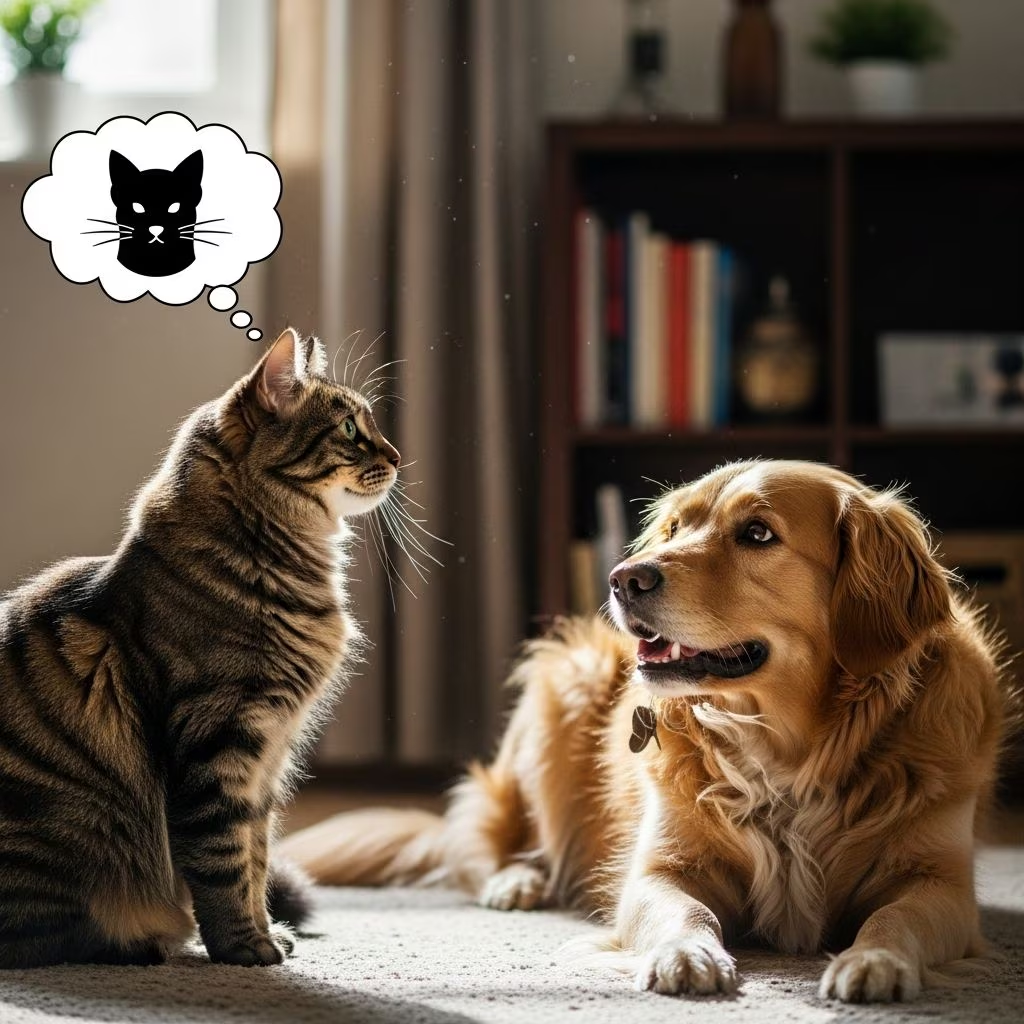
Cats do not think dogs are cats. They perceive dogs as distinct species through differences in size, movement, scent, vocalizations, and behavior, despite occasional playful interactions that might suggest otherwise.
How Do Cats Perceive the World?
Cats rely on heightened senses to interpret their environment, distinguishing familiar species like other cats from unfamiliar ones like dogs. Their vision excels at detecting motion, with excellent low-light capabilities but limited color perception compared to humans. Cats see blues and greens well but struggle with reds, focusing instead on ultraviolet light patterns invisible to us.
A cat’s sense of smell is 14 times stronger than a human’s, featuring over 200 million olfactory receptors versus our 5 million. This allows them to identify individual scents, including the unique canine odor from apocrine glands in dogs’ skin and fur. Hearing spans up to 64 kHz, capturing high-pitched dog barks and growls that convey threat or excitement.
Whiskers act as sophisticated tactile sensors, detecting air currents and spatial changes, helping cats gauge if a dog’s approach is predatory. These sensory tools enable cats to categorize dogs separately from cats based on consistent differences.
- Vision: Motion-sensitive eyes prioritize quick movements like a dog’s bounding gait over a cat’s stealthy prowl.
- Smell: Dogs’ stronger, muskier scent profiles differ markedly from cats’ subtler aromas.
- Hearing: Distinct bark frequencies signal ‘dog’ immediately.
- Touch: Whiskers and fur detect size and fur texture variances.
Physical and Behavioral Differences Cats Notice
Cats quickly note dogs’ larger size, wagging tails, pack-oriented play, and bounding movements, contrasting their own solitary hunting style, slow blinks, and upright tails. A dog’s enthusiastic jumping or herding contrasts a cat’s arched-back hiss or low crawls during tension.
Dogs vocalize loudly with barks and whines, while cats meow softly or growl deeply. Tail language differs: cats raise tails vertically for greeting, dogs wag horizontally. Play styles vary—dogs mouth and chase boisterously, cats pounce silently. These cues lead cats to classify dogs as ‘other,’ prompting caution or curiosity rather than kinship.
| Aspect | Cats | Dogs |
|---|---|---|
| Size | Smaller, agile | Larger, bulkier |
| Tail Movement | Straight up greeting | Side-to-side wag |
| Play Style | Pounce, stalk | Chase, wrestle |
| Vocalizations | Meows, purrs | Barks, howls |
Do Cats Recognize Dogs as a Separate Species?
Yes, cats recognize dogs as separate through early exposures and innate responses. Kittens socialized with dogs by 2-7 weeks learn amicable behaviors, but wild or feral cats treat dogs as predators. Studies show cats in multi-pet homes adapt, using scent glands to mark dogs as ‘household members’ without confusing them for cats.
Securely attached cats (65% per research) view owners as safe bases, extending tolerance to dogs introduced properly. Incompatibility arises from misread signals—dogs’ direct stares seem aggressive to cats, who avert eyes for peace.
How Cats React to Dogs: Fear, Curiosity, or Play?
Reactions vary: fear (hissing, hiding), curiosity (watching from afar), aggression (swiping), or play (chasing). Positive bonds form with slow introductions, shared spaces, and positive reinforcement. Research indicates cats initiate threats more often than dogs in mixed homes, showing awareness of dynamics.
- Fear: Puffed fur, dilated pupils.
- Curiosity: Ears forward, slow blinks.
- Play: Loose body, batting paws.
The Role of Scent and Pheromones in Feline Perception
Scent is paramount; cats’ vomeronasal organ detects pheromones signaling species and intent. Dogs’ anal sac scents and urine marks scream ‘canine,’ prompting investigative flehmen responses. Mutual rubbing exchanges scents, building familiarity without species confusion.
Body Language: Why Cats and Dogs Miscommunicate
Mismatched signals cause tension: dogs’ play bows look like attacks to cats, who respond with claws. Cats’ tail lashes signal irritation, ignored by excited dogs. Learning mutual respect reduces conflicts.
Socialization: Can Cats and Dogs Become Friends?
Early socialization fosters bonds; studies show cats comfortable with dogs rely on their confidence, not the dog’s. Positive experiences build tolerance, with 70% of mixed households reporting harmony.
Scientific Studies on Cat-Dog Interactions
Oregon State research (2019) used Ainsworth’s Strange Situation test, finding 65% of cats securely attached to owners like dogs, using humans for security amid unfamiliarity—relevant for dog introductions.
A PMC study noted better human-cat relationships due to lower perceived costs, with greater emotional closeness to dogs but more interaction with cats.
CABI research showed dog presence impacts human-cat bonds via interaction frequency and space sharing.
Frequently Asked Questions (FAQs)
Do cats think dogs are cats?
No, cats distinguish dogs via senses and behaviors, treating them as different despite occasional play.
Can cats and dogs get along well?
Yes, with proper socialization; early exposure yields amicable relations in most cases.
Why do cats hiss at dogs?
Hissing signals fear or warning due to misread body language or unfamiliar scents.
How long for cats to accept dogs?
Weeks to months, using scent swapping and supervised meetings.
Do cats see dogs as threats?
Initially yes, especially larger breeds, but familiarity reduces this.
References
- Cats bond just as strongly to their owners as dogs do, study indicates — dvm360. 2019-12-01. https://www.dvm360.com/view/cats-are-just-bonded-dogs-their-owners-study-says
- New OSU Research Says Your Cat Loves You Just As Much — OPB. 2019-12-04. https://www.opb.org/news/article/cats-dogs-attachment-love-oregon-state-research/
- Pet–Human Relationships: Dogs versus Cats — PMC / NIH. 2021-09-21. https://pmc.ncbi.nlm.nih.gov/articles/PMC8470704/
- Exploring the impact of dogs on the human-cat relationship — CABI Digital Library. 2024. https://www.cabidigitallibrary.org/doi/10.1079/hai.2024.0007



