

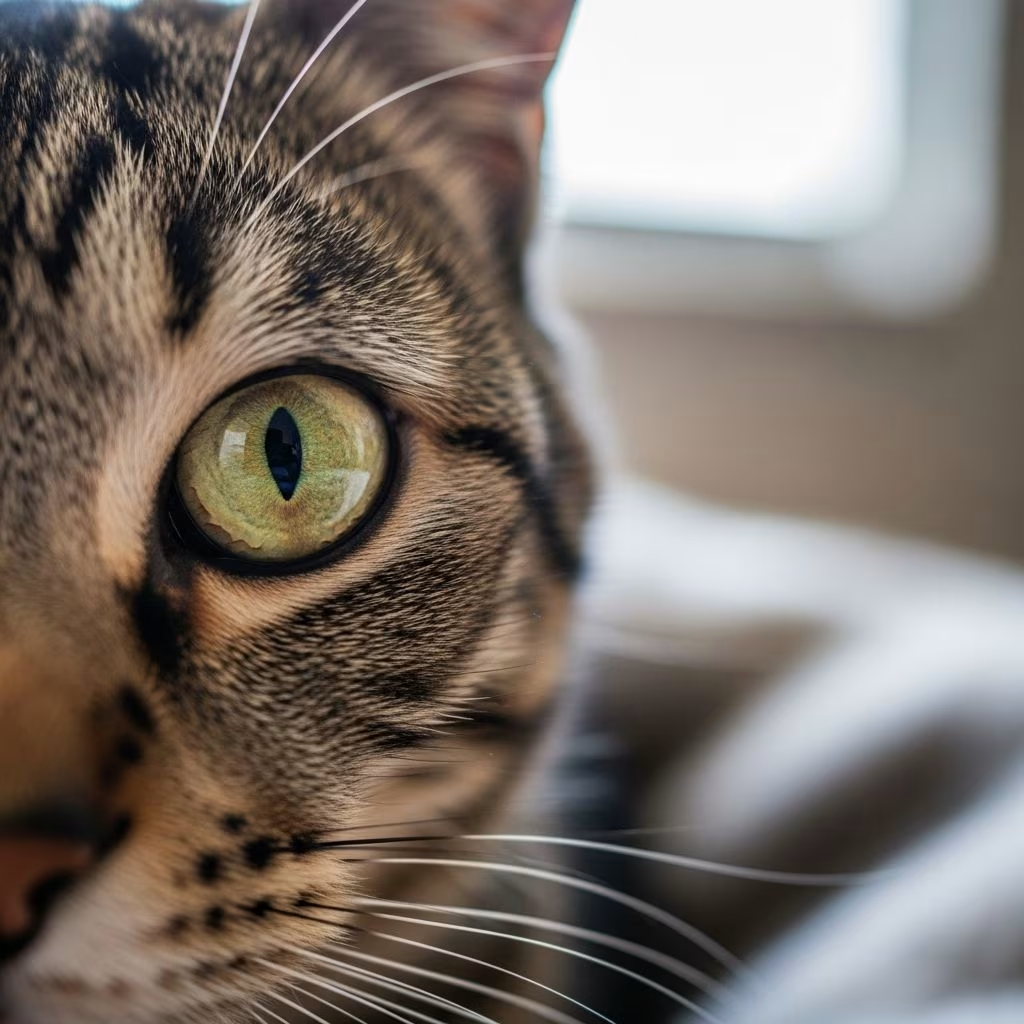
Do Cats See Color? Understanding Feline Vision
When you look at a rainbow in the sky, you see shades of red, orange, yellow, green, blue, indigo, and violet. But have you ever wondered what your cat sees when they gaze at that same rainbow? Can your feline friend distinguish the same spectrum of colors that you do? Do they perceive bands of black and white, or do the colors appear blurred to them? The question of feline color vision has long fascinated pet owners and scientists alike, sparking decades of research into how our feline companions perceive the world around them.
How cats see color is a fascinating topic of scientific research, and the results are genuinely remarkable. While cats cannot appreciate all the colors that humans do, their world is not entirely black and white as once believed. In fact, cats live in a colorful world, though one that differs significantly from our own perception. Understanding your cat’s color vision not only satisfies curiosity but can also help you create a more engaging and stimulating environment for your beloved pet.
What Colors Can Cats See?
Color perception is determined by specialized nerve cells in the eye called cones. The retina, which is the light-sensitive tissue lining the back of the eye, contains two main types of cells: rods, which detect light levels and motion, and cones, which differentiate colors. The fundamental difference between human and feline color vision lies in the number and type of cone cells each species possesses.
Humans have three types of cones that can identify combinations of red, blue, and green wavelengths. Cats, however, have only two types of cones, making them dichromatic vision creatures. This significant difference means cats process color information differently than we do. Because humans have approximately 10 times more cones than cats do, humans appreciate a much broader range of color variations and see more vibrant, nuanced hues than our feline friends.
From scientific observations, cats do not appear to perceive the full range of colors that humans can. The exact colors cats see remain somewhat debated among researchers. Some scientists believe that cats see only blue and gray, while others think they also see yellow, similar to their canine counterparts. This variation in perception would make their vision comparable to someone who has red-green color blindness.
The most likely answer based on available research is that cats see in muted tones of blues, yellows, greens, and greys. Reds and pinks appear confusing to cats and may look more like greenish tones, whereas purple may seem like another shade of blue. This means when you bring home a bright red toy, your cat might not perceive it as the vivid color you see but rather as a muted, possibly greenish shade.
The Science Behind Feline Color Vision
The way cats see color is a direct result of the construction and composition of their eyes. Each eye is a complex optical instrument, but the key to understanding color perception lies in understanding cone cells. Cats have dichromatic vision, which means they possess only two types of cone cells in their retinas. In contrast, humans have three types, enabling what’s called trichromatic vision.
Research has provided compelling evidence about the specific wavelengths cats can detect. Cats can see blue and yellow colors, but they struggle with red, orange, and brown tones. These colors either blend into the background or appear as different shades altogether to feline eyes. This is not a form of blindness but rather a different way of processing visual information based on the specific cone cells present in their retinas.
Interestingly, scientific studies have shown that cats possess more than one type of cone. The presence of rare opponent color units in the lateral geniculate nucleus of the brain indicates that cats do process color information, even if that information differs from human perception. These opponent color units have input from both green-absorbing and blue-absorbing cones, confirming that cats engage in actual color discrimination rather than simply viewing the world in grayscale.
How Does a Cat’s Vision Compare to Human Vision?
While cats have a more limited color palette than humans, this is just one aspect of the broader comparison between feline and human vision. In many other ways, cats’ visual abilities are actually superior to ours, reflecting their evolution as nocturnal hunters.
Similarities and Differences
Cats can perceive different colors, even if they cannot appreciate the entire spectrum that humans do. They simply may not see the “true” color of an object in the way we understand it. Additionally, cats are less sensitive to changes in brightness, so they cannot perceive color in the rich, vibrant tones that humans experience. This results in a more muted, less saturated color world for felines.
In some respects, feline vision is not as acute as human vision. Cats are more near-sighted than humans. When looking at an object from the same distance, the object may appear crisp and clear to a human but blurred to a cat. For example, if a human sees an object clearly from 100 feet away, a cat viewing the same object from that distance would see it as blurry. The object would not appear sharp to the cat until it was approximately 20 feet away. This difference in visual acuity reflects cats’ evolutionary adaptation for hunting at closer ranges.
Where Cats Excel
Despite their limitations in color perception and visual acuity, cats possess several remarkable visual advantages. Cats have elliptical pupils that dilate maximally, allowing them to capture as much light as possible. This pupil shape is crucial for their ability to function effectively in low-light conditions. Additionally, cats possess reflective cells under the retina called the tapetum, which reflects all light information back through the retina. This reflection effectively increases a cat’s ability to see in dim light by up to six times better than humans. It is also what creates the distinctive glow of a cat’s eyes at night or when a photograph is taken with a flash.
When compared to humans, cats see better in dim light conditions such as dusk and dawn, and they can more accurately detect motion. Cats have a higher concentration of rod cells in the retina than humans. Rods are responsible for detecting motion, including small movements at great distances. This enhanced motion detection ability is essential for their role as hunters, allowing them to spot prey movement from considerable distances and in low-light environments.
Cats also possess a wider field of view than humans, spanning approximately 200 degrees compared to the human field of view of 180 degrees. This broader peripheral vision aids cats in detecting movement from different angles, a critical survival and hunting advantage. However, their visual acuity, or the sharpness of vision, is not as high as humans, meaning cats see blurrier versions of scenes that humans perceive in sharp detail.
Implications for Cat Owners
Understanding how your cat perceives the world can help you make informed decisions about your pet’s environment and enrichment. Knowing that cats see better in low light and are particularly sensitive to blue and green hues can guide your choices when selecting toys and interactive objects. Toys and interactive objects in blue and green colors may be more attractive and engaging to cats than those in red or orange.
Creating a stimulating environment means considering your cat’s unique visual capabilities. Vertical spaces where cats can climb and perch serve their natural hunting instincts, and understanding their visual preferences can enhance their quality of life. Additionally, recognizing that cats need hiding spots that cater to their visual and behavioral nature helps create a home where your feline companion can thrive.
Common Questions About Cat Vision
Q: Are cats completely color blind?
A: No, cats are not completely color blind. They can see colors, though not the full spectrum that humans perceive. They see muted tones of blue, yellow, green, and gray, making their vision similar to humans with red-green color blindness.
Q: Can cats see in complete darkness?
A: While cats have exceptional night vision and can see in very low light conditions, they cannot see in complete darkness. However, they only need about one-sixth of the light that humans require to see effectively.
Q: Why do cat eyes glow in the dark?
A: Cat eyes glow in the dark due to the tapetum lucidum, a reflective layer of cells beneath the retina. This structure reflects light back through the retina, enhancing their night vision and creating that distinctive glowing appearance.
Q: Do cats see movement better than humans?
A: Yes, cats are excellent at detecting movement. They have more rod cells in their retinas and a wider field of view, making them superior at spotting motion, especially in low-light conditions.
Q: What color toys are best for cats?
A: Toys in blue and green colors are typically more visible and engaging to cats, as these are the colors they see most clearly. Avoiding red or orange toys in favor of these colors may increase your cat’s interest and engagement.
References
- Cat colour vision: evidence for more than one cone process — National Center for Biotechnology Information (NCBI). 2006. https://pmc.ncbi.nlm.nih.gov/articles/PMC1395586/
- Can Cats See Color? — Purina. Updated 2025-06-05. https://www.purina.com/articles/cat/behavior/understanding-cats/can-cats-see-color
- Cat Vision: How Does Your Cat See the World? — Meowtel. https://meowtel.com/blog/post/cat-vision-how-does-your-cat-see-the-world
- Discovering the Colors that Cats and Dogs See: Exploring Their World — Assil Eye. https://assileye.com/blog/colors-that-cats-and-dogs-see/
- Do Cats See Color? — VCA Animal Hospitals. https://vcahospitals.com/know-your-pet/do-cats-see-color



