

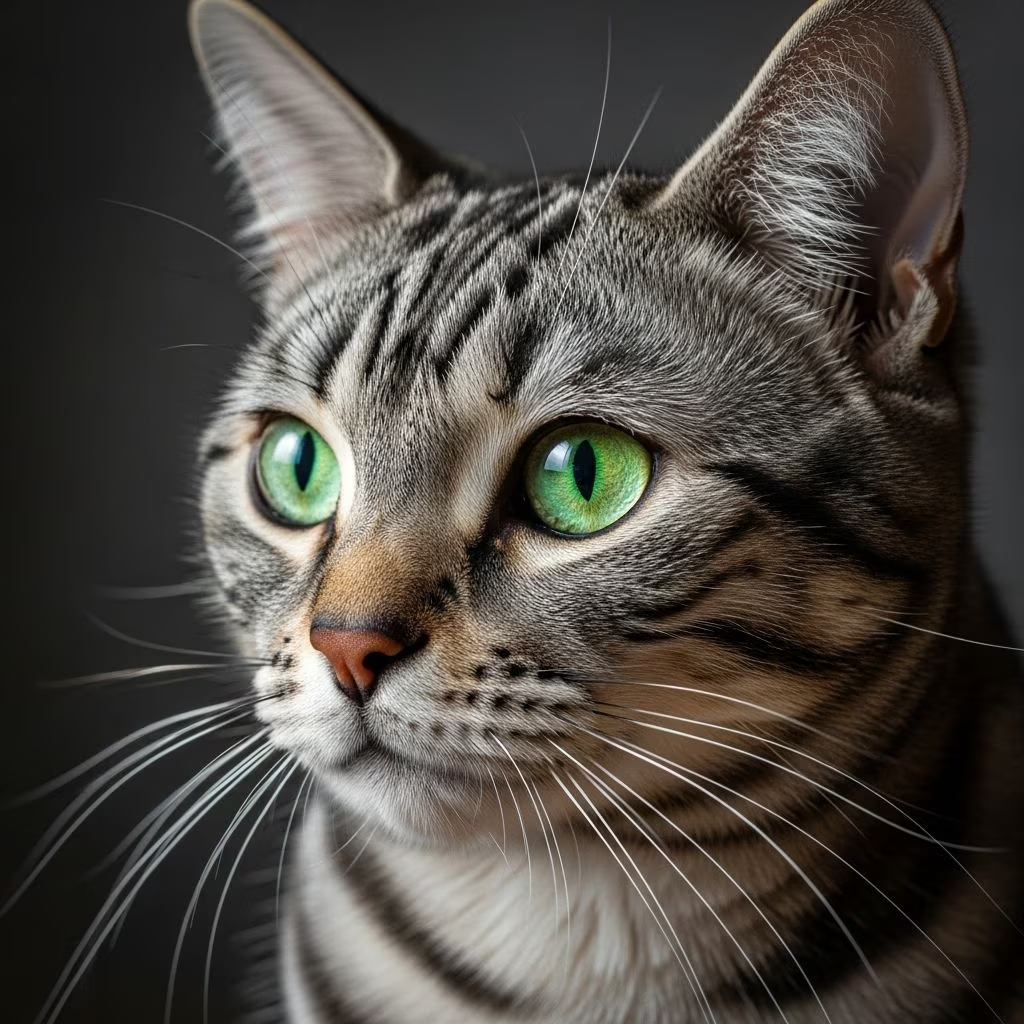
When you gaze at a rainbow spanning the sky, you see vibrant shades of red, orange, yellow, green, blue, indigo, and violet. But have you ever wondered what your feline companion sees when they look at the same rainbow? Can your cat distinguish the same spectrum of colors that you do, or do they perceive the world in shades of black and white? This question has fascinated pet owners and scientists alike for decades, and the answer reveals something truly remarkable about how cats experience their world.
The truth is that cats do not live in a purely monochromatic world as once believed. While their color perception differs significantly from human vision, cats inhabit a colorful world with its own unique palette. Understanding how your cat sees color can help you better appreciate their perspective and create an environment that engages their visual capabilities in meaningful ways.
Can Cats See Color?
Yes, cats can see color. However, their ability to perceive colors is more limited compared to what humans experience. From scientific observations, cats do not perceive the full range of colors that humans can. Rather than seeing in monochrome as was once widely believed, cats view their surroundings through a different chromatic lens than ours.
The common misconception that cats see only in black and white has been thoroughly debunked by modern research. Instead, cats possess the ability to distinguish certain colors, though not with the same vibrancy or variety that humans enjoy. Their color vision is fundamentally shaped by the biological structure of their eyes and the types of photoreceptor cells within their retinas.
What Colors Can Cats See?
The specific colors cats can perceive remain a subject of ongoing scientific debate among researchers. However, there is considerable consensus on certain aspects of feline color vision.
Colors Cats Can Distinguish
Scientific research suggests that cats have the ability to see shades of blue and gray most clearly. Beyond these primary colors, opinions diverge among researchers. Some scientists believe cats can only perceive blue and gray, while others contend that cats can also see yellow, similar to how dogs perceive colors. The most widely accepted explanation is that cats view colors in a manner comparable to a person with red-green color blindness, experiencing muted tones of blues, yellows, greens, and grays.
In this color-blind spectrum, reds and pinks present particular challenges for feline vision. These warm colors may appear confusing to cats and could resemble greenish hues rather than their true red appearance. Similarly, purple might seem to a cat like another shade of blue rather than a distinct color.
The Science Behind Color Perception
Color perception in both cats and humans is determined by specialized nerve cells in the eye. The retina, which is the light-sensitive tissue at the back of the eye, contains two primary types of cells: rods and cones. Rods are responsible for detecting light levels and motion, particularly in low-light environments, while cones differentiate between colors.
Interestingly, both humans and cats possess three types of cone cells that can identify combinations of red, blue, and green wavelengths. However, humans have approximately ten times more cone cells than cats do. This significant difference in cone density directly impacts the richness and variety of colors each species can appreciate. With fewer cones, cats perceive a more limited palette of colors, though they can still distinguish between different hues.
How Does a Cat’s Vision Compare to Human Vision?
While cats may not see the full spectrum of colors that humans perceive, feline vision possesses unique advantages and disadvantages compared to human eyesight. Understanding these differences provides insight into how cats navigate and interact with their environment.
Color Perception Differences
Cats perceive different colors than humans, though they cannot appreciate the entire spectrum. They may not see the “true” color of an object as we do. Additionally, cats are less sensitive to changes in brightness, meaning they cannot perceive colors in the rich, vibrant tones that humans experience. A color that appears bright and saturated to us might appear muted and less distinctive to a cat.
Visual Acuity and Focus
In some respects, feline vision is not as acute as human vision. Cats tend to be more near-sighted than humans. When both species view an object from the same distance, what appears crisp and clear to human eyes may appear blurred to a cat. For example, if a human can see an object clearly from 100 feet away, that same object will appear blurry to a cat until the cat is approximately 20 feet away. This difference in visual acuity is an important consideration when positioning toys or objects you want your cat to notice.
Light Sensitivity and Night Vision
Where cats excel in vision compared to humans is in their ability to see in low light conditions. Cats possess several anatomical features that give them superior night vision. They have elliptical pupils that can dilate maximally, allowing them to capture the maximum amount of light possible. Additionally, cats possess reflective cells beneath the retina called the tapetum. This reflective layer bounces light information back through the retina, substantially increasing a cat’s ability to see in dim conditions.
The tapetum is also responsible for the striking glow you see when light reflects off a cat’s eyes in darkness or when a camera flash captures them. This eyeshine demonstrates the advanced light-gathering capabilities of feline eyes.
Motion Detection Abilities
Cats also possess significantly more rod cells in their retinas compared to humans. Rod cells are responsible for detecting motion, including small movements at considerable distances. When compared to humans, cats see better in dim light conditions, particularly during dusk and dawn when they are most active as hunters. Their superior ability to accurately detect motion makes them exceptionally skilled predators capable of spotting prey movements that might escape human notice.
Field of View
Another advantage cats enjoy is a wider field of view than humans. While humans have a field of view of approximately 180 degrees, cats can see roughly 200 degrees around them. This expanded peripheral vision aids cats in detecting movement from various angles and helps them maintain awareness of their surroundings while hunting or exploring their territory.
Creating a Cat-Friendly Visual Environment
Understanding how cats perceive colors and vision can help you create a more enriching and stimulating environment for your feline companion. By considering feline visual capabilities, you can select toys, furnishings, and decor that will be more engaging and appealing to your cat.
Since cats see blue and green hues more clearly than other colors, toys and interactive objects in these colors may be more attractive and visible to them. Bright blue or green toys will stand out more vividly in your cat’s visual world than toys in red or orange. This knowledge can inform your choices when purchasing play items designed to keep your cat mentally and physically active.
Additionally, recognizing cats’ natural need for vertical spaces and hiding spots caters to their evolutionary hunting instincts. Cats’ superior motion detection and low-light vision make them effective ambush predators that hunt by pouncing from elevated positions. Providing cat trees, wall-mounted shelves, and enclosed spaces allows your cat to utilize these innate visual and predatory skills.
Frequently Asked Questions
Q: Are cats completely color blind?
A: No, cats are not completely color blind. They can see certain colors, particularly blues and greens, though their color perception is more limited than human vision. Their color vision is similar to that of a person with red-green color blindness.
Q: What colors should I use for cat toys to make them more visible?
A: Blue and green toys will be more visible and appealing to your cat since these colors stand out more clearly in their visual spectrum. Red and orange toys may appear as shades of gray or brown to your cat.
Q: Why can cats see better in the dark than humans?
A: Cats have evolved exceptional night vision through several adaptations: they have more rod cells in their retinas for low-light detection, elliptical pupils that dilate fully to capture maximum light, and a reflective layer called the tapetum that bounces light back through the retina.
Q: Is a cat’s eyesight better than human eyesight?
A: Cat eyesight is better than human eyesight in some ways and worse in others. Cats excel at night vision and motion detection but are more near-sighted and cannot perceive colors as vividly as humans do. They require only one-sixth of the light humans need to see clearly.
Q: Can cats see red?
A: Cats can see red wavelengths to some degree, but red appears confusing to them and may look more like green or brown. Red is not a color that stands out clearly in a cat’s visual world.
Q: How far can a cat see clearly?
A: Cats are more near-sighted than humans. While a human might see an object clearly at 100 feet, a cat would not see that same object clearly until they are approximately 20 feet away.
References
- Cat colour vision: evidence for more than one cone process — National Institutes of Health (NIH/PMC). 2025-11-28. https://pmc.ncbi.nlm.nih.gov/articles/PMC1395586/
- Can Cats See Color? — Purina Pet Expertise. 2025-06-05. https://www.purina.com/articles/cat/behavior/understanding-cats/can-cats-see-color
- Do Cats See Color? — VCA Animal Hospitals. 2025-11-28. https://vcahospitals.com/know-your-pet/do-cats-see-color
- Discovering the Colors that Cats and Dogs See: Exploring Their World — Assil Eye Center. 2025-11-28. https://assileye.com/blog/colors-that-cats-and-dogs-see/
- Cat color vision: the effect of stimulus size — PubMed (National Library of Medicine). 2025-11-28. https://pubmed.ncbi.nlm.nih.gov/628838/



