

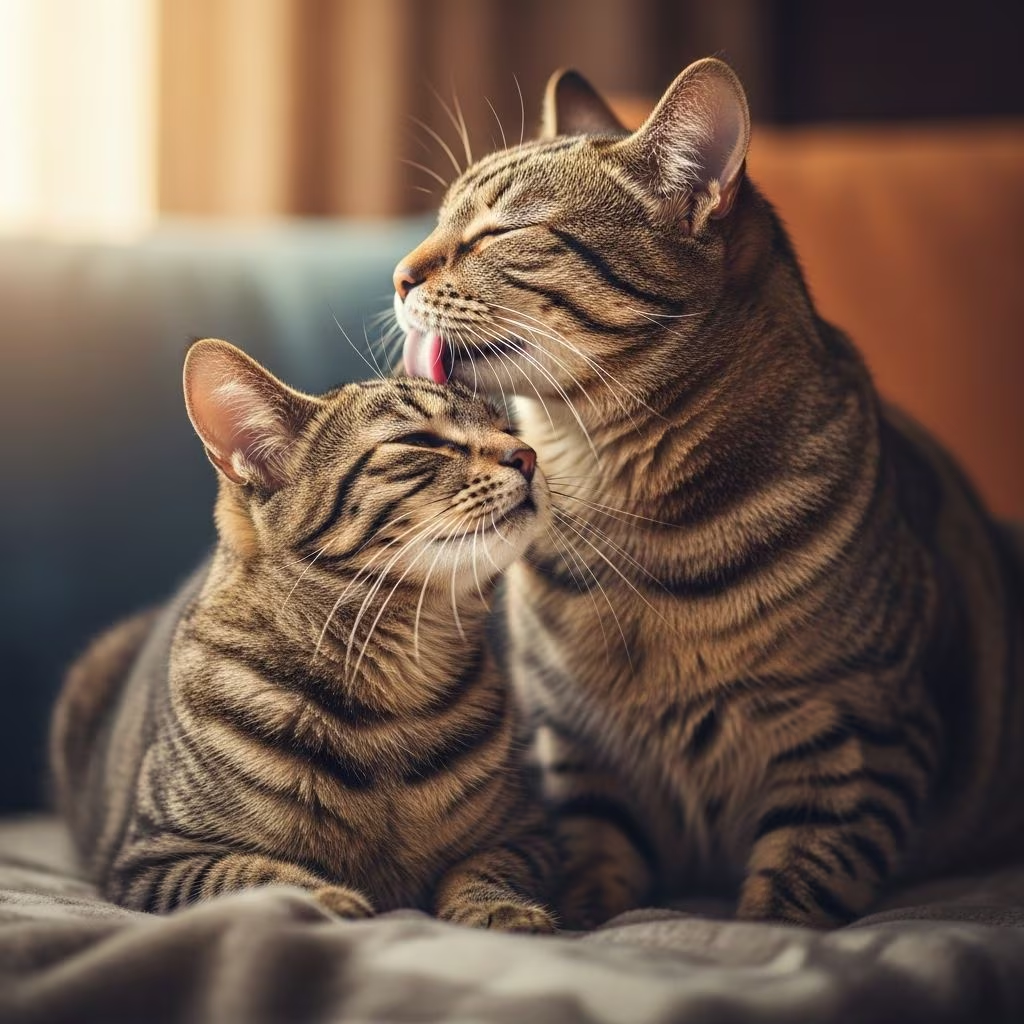
Cats possess remarkable olfactory memories that allow them to recognize their mother’s body odor well into adulthood, as demonstrated by scientific studies on domestic kittens. This long-term retention challenges common assumptions about feline memory and highlights the stability of individual scent signatures in cats.
How Do Cats Recognize Each Other?
Cats primarily rely on their highly developed sense of smell to identify familiars, including family members. Unlike humans who prioritize visual cues, felines use pheromones and body odors for recognition. Research indicates that cats maintain unique odor profiles that remain consistent over time, enabling discrimination between related and unrelated individuals.
The olfactory system in cats contains over 200 million scent receptors, far surpassing human capabilities. This allows kittens to imprint on their mother’s scent during critical developmental periods. Body odors serve as individual signatures, influenced by genetics, diet, and environment but stable enough for long-term memory formation.
Scientific Studies on Feline Maternal Recognition
A pivotal 2021 study published in Animal Cognition tested kittens from 15 litters, separated from their mothers at weaning (around 8 weeks old). Researchers presented swabs with the mother’s odor, an unfamiliar female’s odor, and a blank control at multiple ages: weaning, 4 months, 6 months, and over 1 year.
- Weaning (2 months): Kittens sniffed the unfamiliar female’s scent longer, showing novelty preference typical in young mammals.
- 4 months: Male kittens preferred their mother’s scent; females showed no clear preference.
- 6 months and 1 year: Both sexes strongly preferred the mother’s odor, indicating persistent memory.
This shift from novelty-seeking to familiarity preference suggests kittens form enduring olfactory memories of their dam. The study concludes that mothers retain distinguishable odor signatures across reproductive changes.
Do Adult Cats Recognize Their Mothers?
Yes, evidence supports adult cat recognition of maternal scent up to at least one year post-weaning. However, behavioral implications remain unclear—does this constitute true “recognition” or mere preference for familiar scents? Functional benefits might include kin discrimination to avoid inbreeding, though cats often mate with relatives.
Contrasting views exist: some sources suggest adult cats may not recognize separated family due to scent changes post-weaning. Yet, peer-reviewed data prioritizes olfactory memory persistence, with stable signatures aiding social dynamics.
Factors Influencing Long-Term Memory in Cats
Several elements contribute to feline scent memory:
- Critical Periods: Weaning (4-12 weeks) imprints maternal odors.
- Sex Differences: Males may show earlier preference shifts.
- Environmental Stability: Consistent exposure reinforces memories.
- Individual Signatures: Genetic and microbial factors create unique profiles.
| Age Tested | Preference Observed | Key Finding |
|---|---|---|
| 2 months | Unfamiliar female | Novelty seeking |
| 4 months | Mother (males) | Emerging familiarity |
| 6+ months | Mother (both sexes) | Long-term memory |
Implications for Cat Reunions and Rehoming
Understanding maternal memory aids rehoming practices. Kittens separated early may still respond positively to their mother’s scent later, potentially easing stress in multi-cat households. However, practical recognition in visual or social contexts requires further study.
Scent stability supports theories of broader cat social structures, where familiars maintain bonds via olfaction regardless of cohabitation. This has relevance for feral colonies and owned cats introduced to kin.
Cat Memory Compared to Other Animals
Cats’ olfactory memory aligns with dogs and rats, which show weaning novelty preferences shifting to familiarity. Unlike highly visual primates, felines emphasize chemosensory cues. Human-raised kittens may transfer maternal behaviors to owners, blurring species lines.
FAQs
Do kittens forget their mother after adoption?
No, studies show they retain her scent memory for over a year, preferring it as adults.
Can cats recognize siblings?
Similar olfactory mechanisms likely apply, though untested specifically; shared scents aid early identification.
How long do cats remember scents?
At least 1+ years for maternal odors, potentially lifelong based on stability evidence.
Do feral cats reunite with mothers?
Possible via scent, supporting kin avoidance hypotheses, but mating patterns suggest limited discrimination.
Should kittens stay with mom longer?
Yes, until 8+ weeks minimum for full socialization and scent imprinting.
Broader Insights into Feline Cognition
These findings expand our view of cat intelligence beyond independence stereotypes. Olfactory memory underpins social behaviors, from family bonds to territory marking. Future research could explore visual/auditory maternal cues or sibling discrimination.
Owners benefit by respecting scent worlds—familiar items reduce rehoming anxiety. Cross-species parallels show cats treating humans maternally, responding to ‘cat-directed’ speech.
References
- Are you my mummy? Long-term olfactory memory of mother’s body odour by offspring in the domestic cat — Péter Szenczi et al. 2021-07-26. https://pubmed.ncbi.nlm.nih.gov/34312746/
- Do kittens recognize their mothers even after they’ve lived apart? — AVSAB. 2021. https://avsab.org/do-kittens-recognize-their-mothers-even-after-theyve-lived-apart/
- On “mother-child” communication between the same and inter-species — Japanese Association for Animal Nutrition and Physiology. 2023. https://www.jstage.jst.go.jp/article/janip/73/2/73_73.2.10/_article
- Do cats recognise their owners — Cats Protection. N/A. https://www.cats.org.uk/cats-blog/do-cats-recognise-their-owners



