

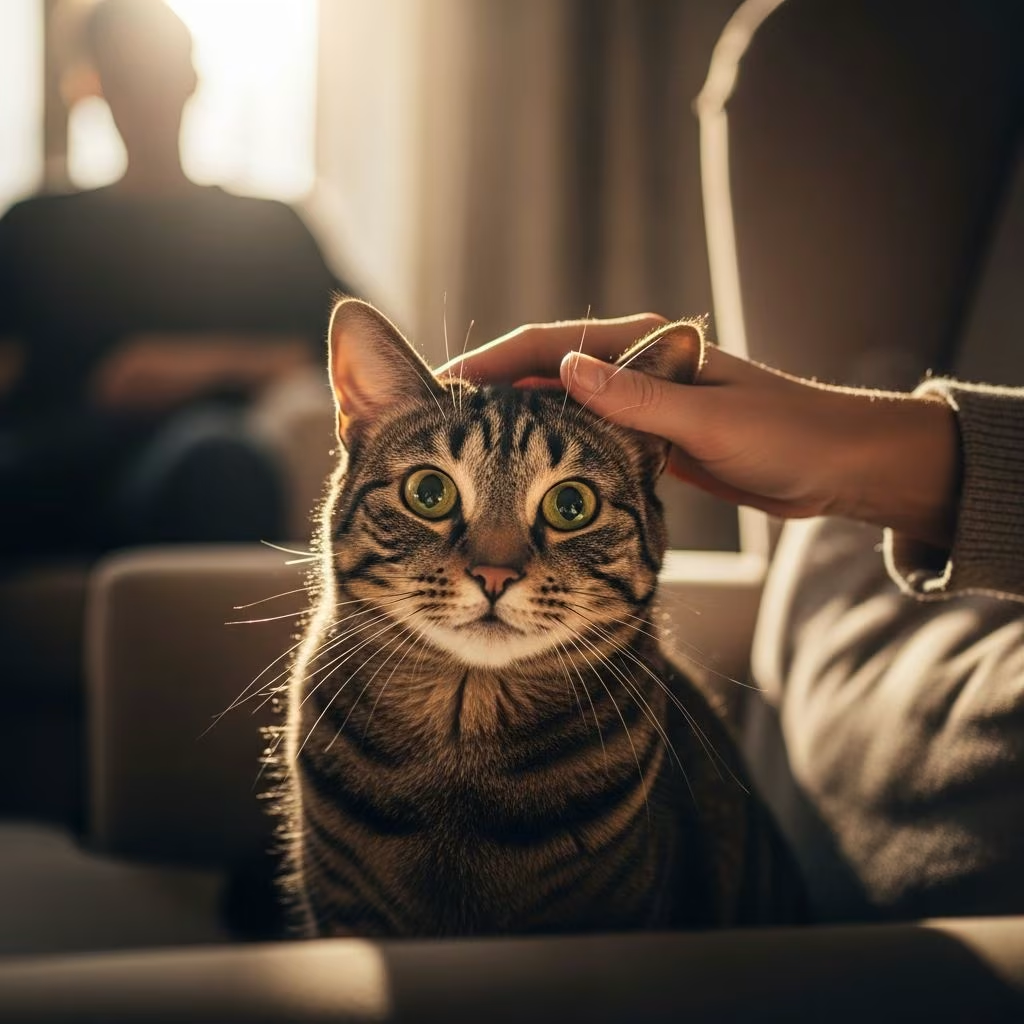
Cats often appear aloof and independent, but scientific research reveals they possess sophisticated abilities to recognize their owners through multiple senses. Studies demonstrate that domestic cats can distinguish familiar humans via scent, voice, facial features, and even emotional expressions, fostering a subtle yet profound bond.
How Do Cats Recognize Their Owners?
Cats rely on a combination of olfactory, auditory, visual, and behavioral cues to identify their owners. Unlike dogs, which show overt excitement, cats exhibit more restrained responses, such as subtle head rubs or prolonged gazes, reflecting their evolutionary history as semi-domesticated hunters.
Research indicates cats integrate multisensory information for recognition. For instance, they match voices to faces and adjust behaviors based on emotional tones, suggesting advanced socio-cognitive skills honed through domestication.
How Cats Recognize Their Owner’s Scent
Cats possess an acute sense of smell, with over 200 million olfactory receptors compared to humans’ 5 million. A 2025 study from Tokyo University of Agriculture tested 30 domestic cats by presenting swabs rubbed on owners or strangers from underarms, behind ears, and between toes. Cats spent significantly longer sniffing unfamiliar scents, indicating familiarity with their owner’s odor.
This preferential sniffing of novel smells suggests cats categorize humans as familiar or not based on pheromones and body odors. Initially, cats used their right nostril for unknown scents—linked to the brain’s right hemisphere processing novel stimuli—switching to the left for familiar ones, a pattern observed in dogs and birds.
Post-sniffing, some cats exhibited rubbing behavior, marking territory and potentially integrating the scent into their environment. Male cats with neurotic personalities sniffed repetitively, while agreeable males were calmer; female behavior showed no personality correlation.
While this proves discrimination between familiar and unfamiliar, identifying specific individuals requires further multi-owner tests. Owners’ questionnaires highlighted relationship quality influencing responses, underscoring scent’s role in cat-human bonds.
How Cats Recognize Their Owner’s Voice
Cats distinguish their owner’s voice from strangers, as shown in a 2013 University of Tokyo study published in Animal Cognition. Domestic cats reacted selectively to owners calling their names, with ear twitches, head turns, and vocalizations, but less to strangers. However, they rarely approached, confirming the ‘aloof cat’ stereotype while revealing vocal recognition.
Cats responded more strongly to their own names amid multiple words, indicating word association superior to human infants in some tasks. This selective response aligns with cats’ self-domestication for rodent hunting near humans, prioritizing independence over commands.
Despite recognition, cats often ignore calls, modulating behavior based on context rather than obedience. This underscores their perceptive yet autonomous nature in auditory processing.
Do Cats Recognize Their Owner’s Face?
Cats recognize owners’ faces through cross-modal matching, linking voices to visuals. A study found cats predict owners’ faces upon hearing voices, limited to familiars—not strangers.
Visual acuity suits close-range identification; cats fixate longer on owners’ faces in photos or videos, showing subtle tail flicks or pupil dilation. Multisensory integration enhances accuracy, as cats align auditory and visual owner cues seamlessly.
This ability, innate rather than solely learned, suggests phylogenetic roots from shared human environments, enabling emotional attunement.
Can Cats Recognize Their Owner’s Emotions?
Cats perceive and respond to human emotions via facial expressions, tones, and body language. In emotion recognition tests, cats matched angry/fearful faces with distressed sounds and happy ones with positive cues, modulating proximity accordingly.
They approach owners more during happy displays, retreating from anger, even from unfamiliar humans—indicating general emotional representation beyond individual experience. Younger cats (2-3 years) excelled, hinting at innate phylogeny over ontogeny.
Cats discriminate owners’ reactions to objects: positive owner emotions prompt contact and play; negative ones elicit avoidance. This sensitivity improves welfare, as owners expressing calm foster secure bonds.
Signs Your Cat Recognizes You
- Slow Blinking: Mutual eye narrowing signals trust and affection, akin to a cat smile.
- Head Butts and Rubbing: Scent-marking with facial glands claims you as family.
- Tail Up Greeting: Vertical tail with hook tip denotes familiarity and joy.
- Purring and Kneading: Vibration and paw pressing indicate comfort and bonding.
- Following You: Trailing without demand shows attachment.
- Waiting at Door: Anticipating return demonstrates memory and preference.
These subtle cues, absent with strangers, confirm recognition. Observe consistency across contexts for true bonding signs.
Why Don’t Cats Show Recognition Like Dogs?
Cats’ subtlety stems from evolution: dogs bred for cooperation, cats for independence. Vocal recognition exists, but responses prioritize self-interest.
| Aspect | Cats | Dogs |
|---|---|---|
| Recognition Style | Subtle (gaze, rub) | Overt (jumps, barks) |
| Response to Voice | Orient but rarely approach | Approach eagerly |
| Domestication | Self-selected | Human-bred |
| Social Structure | Solitary hunters | Pack animals |
This table highlights divergence: cats bond deeply but expressively restrained, valuing autonomy.
How to Strengthen Your Bond with Your Cat
- Play daily with toys mimicking prey to fulfill hunting instincts.
- Use slow blinks and soft voices to build trust.
- Provide vertical spaces and hiding spots for security.
- Feed consistently, associating you with comfort.
- Groom gently to enhance scent familiarity.
- Respect boundaries to avoid stress-induced aloofness.
Positive reinforcement amplifies recognition behaviors, deepening mutual understanding.
Frequently Asked Questions (FAQs)
Do cats recognize their owners by smell?
Yes, cats spend less time sniffing owner scents, showing familiarity via olfactory discrimination.
Can cats tell their owner’s voice?
Cats distinguish owner voices and names, responding with subtle cues despite aloof appearances.
Do cats recognize faces?
Cats match owner voices to faces cross-modally, recognizing familiars visually.
Why is my cat ignoring me if it recognizes me?
Cats prioritize independence; recognition doesn’t mandate overt displays like dogs.
Do kittens recognize their owners early?
Kittens develop recognition rapidly through scent and voice, strengthening with interaction.
Can cats recognize multiple owners?
Evidence suggests primary owner preference, but multi-human households show broader familiarity.
References
- Cats recognize their owner’s scent, study suggests — Phys.org. 2025-05. https://phys.org/news/2025-05-cats-owner-scent.html
- Cats Can Recognize Their Owner’s Scent Compared to a Stranger’s — Smithsonian Magazine. 2025. https://www.smithsonianmag.com/smart-news/cats-can-recognize-their-owners-scent-compared-to-a-strangers-new-research-suggests-180986710/
- Aloof cats recognize but do not respond to owner’s voice — University of Tokyo. 2013. https://www.u-tokyo.ac.jp/focus/en/articles/a_00138.html
- Emotion Recognition in Cats — PMC (PubMed Central). 2020-07-15. https://pmc.ncbi.nlm.nih.gov/articles/PMC7401521/
- Do Cats Love Us? New Study Findings — Pet Health Network. N/A. https://www.pethealthnetwork.com/news-blogs/a-vets-life/do-cats-love-us-new-study-findings



