

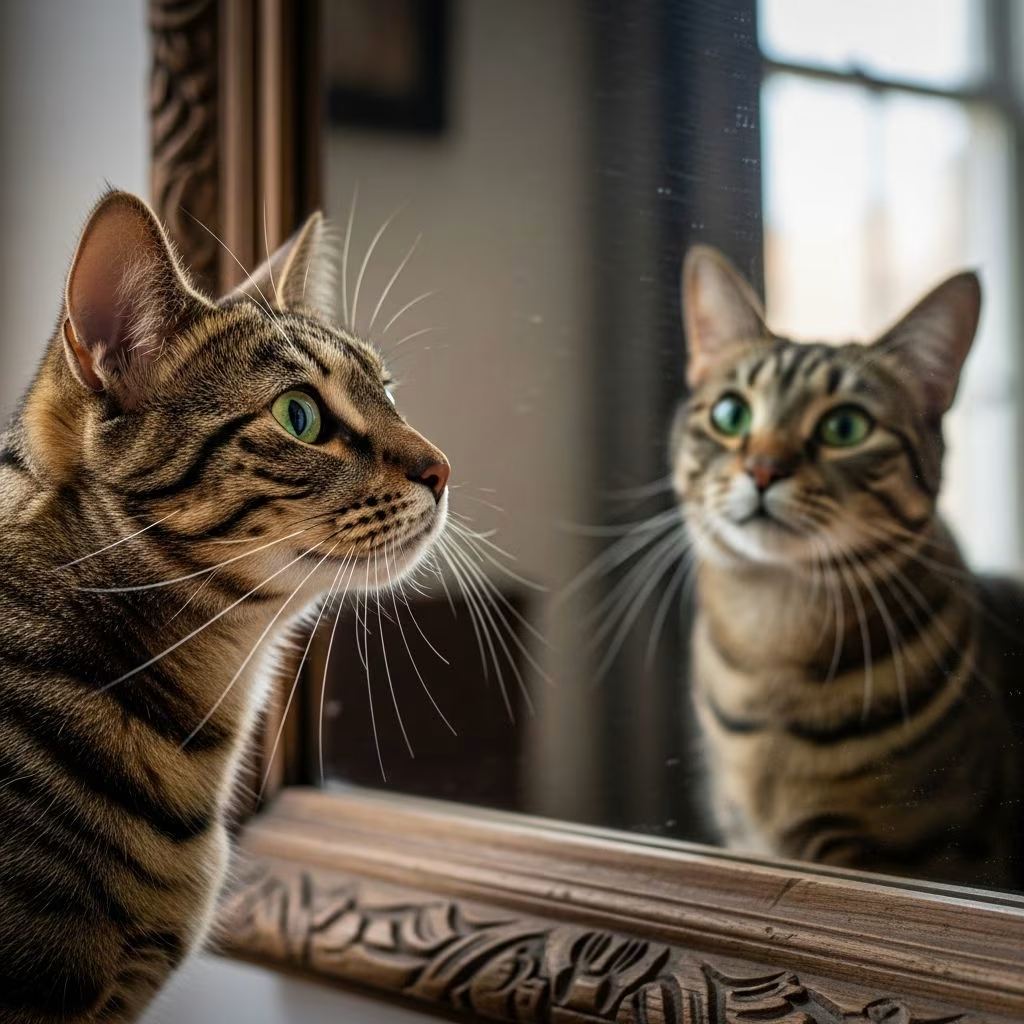
Cats often react dramatically to their mirror images, swatting, hissing, or ignoring them entirely, sparking curiosity about their self-perception. Scientific consensus indicates that cats do not recognize themselves in mirrors, treating reflections as other cats or novel stimuli due to reliance on non-visual senses.
The Science of Self-Recognition in Animals
The mirror self-recognition (MSR) test, developed by Gordon Gallup in 1970, assesses self-awareness by marking an animal with a visible stain and observing if it uses the mirror to investigate the mark on its own body. Species like chimpanzees, dolphins, elephants, and magpies pass this test, demonstrating an understanding that the reflection represents themselves.
Cats, however, have not passed rigorous MSR tests. A study analyzing YouTube videos of cat-mirror interactions found no evidence of self-directed behaviors, such as touching marks while viewing the reflection. Instead, cats displayed aggression, curiosity, or indifference, suggesting they perceive the image as a separate entity.
Why Cats Perceive Reflections Differently
Feline vision and sensory priorities explain much of this behavior. Cats excel in low-light conditions but have poorer close-range acuity, struggling to focus sharply beyond 25 cm—precisely the distance of most mirrors. This visual limitation hinders piecing together that the moving image matches their own actions.
More critically, cats prioritize smell and sound over sight for identity. A real intruder would carry a scent and make independent noises, absent in a reflection. Without these cues, the mirror cat seems like a scentless, silent impostor, triggering territorial responses.
Common Feline Reactions to Mirrors
Cat owners report diverse responses, categorized into three main types:
- Curiosity and Play: Kittens and young cats often paw, chase, or crouch before the reflection, treating it as a playmate. This fades with exposure as they habituate.
- Aggression or Fear: Arched backs, puffed tails, hissing, and swatting signal perceived threats. These defensive postures stem from mistaking the image for a rival.
- Aloofness or Ignoring: Mature cats may glance briefly then walk away, deeming the reflection non-threatening and uninteresting after initial assessment.
These reactions provide behavioral insights: playfulness indicates low stress, while persistent aggression might signal anxiety or environmental changes.
Does Mirror Failure Mean Cats Lack Self-Awareness?
Passing the MSR test correlates with higher cognition in social species, but its absence does not equate to zero self-awareness. Cats exhibit body awareness in feats like precise leaps and hunting, recognizing their physical limits without mirrors.
Training studies with rhesus monkeys, initial MSR failures, showed learned self-recognition, hinting cats might too with adaptation. However, the test’s visual bias suits primates more than olfactory felines. Alternative assessments, like scent-based self-recognition, could better gauge cat cognition.
How to Test Your Cat’s Mirror Response Safely
Replicate a simple home MSR variant:
- Apply a non-toxic, colored sticker (e.g., dot of odorless paint) to your cat’s forehead or ear while it’s relaxed or asleep.
- Position a mirror 30-50 cm away where the cat can see its reflection clearly.
- Observe without interference: Does it touch or groom the mark using the mirror? Or ignore/react to the image?
Most cats bat at the mirror or flee rather than self-inspect, reinforcing non-recognition. Avoid stress; cover the mirror if reactions escalate.
| Species | Passes MSR? | Notes |
|---|---|---|
| Chimpanzees | Yes | Quickly remove marks |
| Dolphins | Yes | Use mirrors for body inspection |
| Cats | No | Treat as other cat; no self-touch |
| Dogs | No | Olfactory focus similar to cats |
Implications for Cat Cognition and Care
Understanding mirror reactions enhances welfare. Mirrors in multi-cat homes can provoke unnecessary stress; use them sparingly or as enrichment for playful cats. Habituation reduces aggression—gradual exposure teaches the reflection poses no real threat.
This ties into broader feline intelligence: cats navigate complex territories via spatial memory, learn tricks, and manipulate humans subtly. Self-awareness manifests practically, not visually.
Evolutionary Perspectives on Feline Perception
Solitary hunters like cats evolved minimal need for visual self-recognition. Social animals benefit from distinguishing self from group members, but cats rely on pheromones and vocalizations for social cues. Mirror unfamiliarity mimics ancestral encounters with rivals at water sources or borders.
Human infants also fail MSR until 18-24 months, developing visual self-concept gradually. Cats’ lifelong non-recognition reflects species-specific adaptations, not inferiority.
FAQs
What do cats think their reflection is?
Cats perceive it as another cat or intruder, lacking scent/sound confirmation of self.
Why do some cats ignore mirrors?
After investigation, they classify it as non-threatening, conserving energy.
Can kittens recognize themselves?
No, but playful responses are common before habituation sets in.
Is aggressive mirror behavior a problem?
Usually harmless, but persistent cases warrant vet checks for anxiety.
Do mirrors enrich cat environments?
For some, yes—provides stimulation; monitor for stress.
Advanced Insights: Future Research Directions
Emerging studies explore multi-sensory tests, like combining mirrors with self-scent. Neuroimaging could map feline brain responses to reflections, akin to dog fMRI research. As of 2025, vet insights affirm cats’ unique awareness form, tailored to predatory lifestyles.
Owners can foster cognitive health via puzzle feeders, training, and sensory toys, bypassing mirror limitations.
References
- Do Cats Recognize Themselves in the Mirror? – PetMD — PetMD. 2023. https://www.petmd.com/cat/general-health/do-cats-recognize-themselves-in-the-mirror
- Do Cats Understand Mirrors & Their Reflection? – Hill’s Pet Nutrition — Hill’s Pet. 2023. https://www.hillspet.com/cat-care/behavior-appearance/do-cats-understand-mirrors
- Do Cats Recognize Themselves In The Mirror? – Cats.com — Cats.com. 2024. https://cats.com/cat-self-awareness
- Do Cats Recognize Themselves in the Mirror? – Basepaws — Basepaws. 2024. https://basepaws.com/blog/do-cats-recognize-themselves-in-the-mirror
- Do Cats Recognize Themselves in the Mirror? Vet Insights 2025 — Ask A Vet (Dr. Duncan Houston BVSc). 2025-01-01. https://askavet.com/blogs/news/do-cats-recognize-themselves-in-the-mirror-vet-insights-2025-%F0%9F%90%B1



