

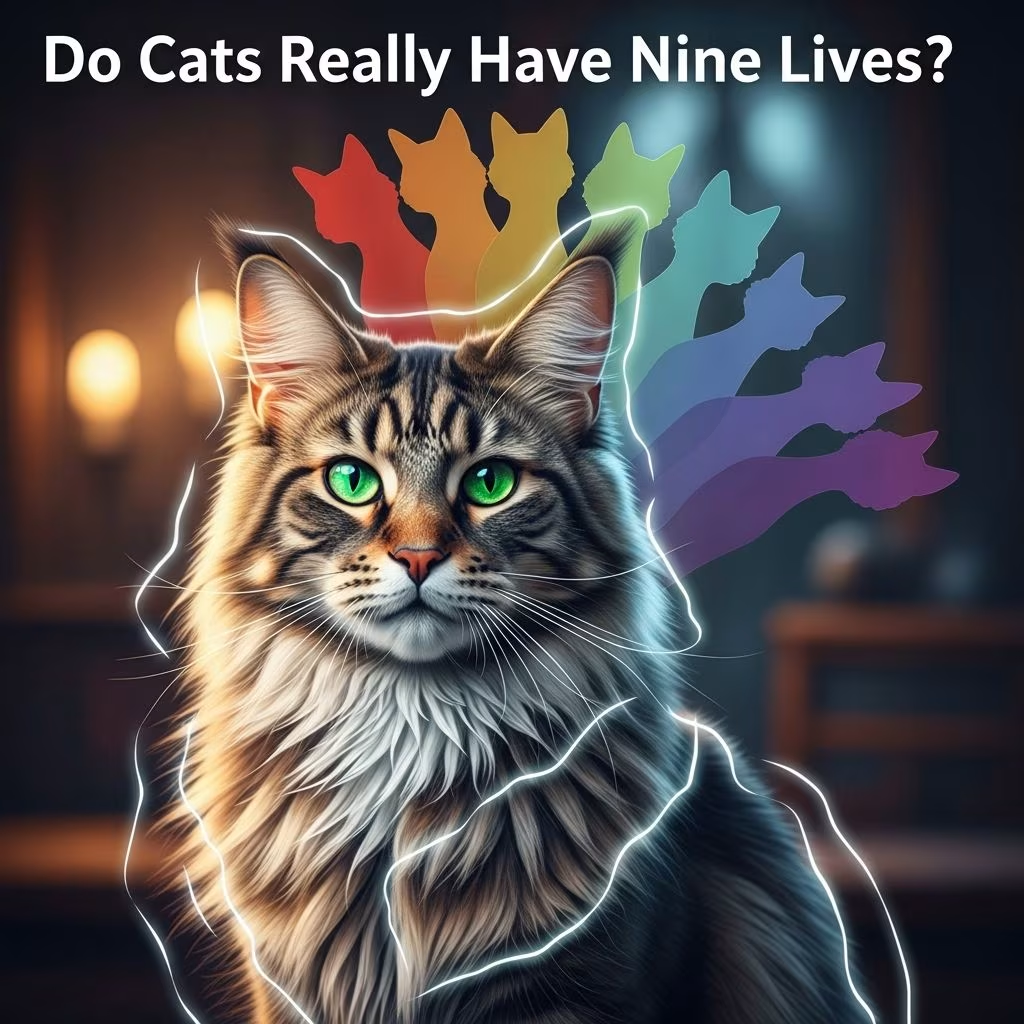
The notion that cats possess nine lives has captivated imaginations for centuries, symbolizing their uncanny ability to evade danger and bounce back from mishaps. While this idea stems from deep-rooted folklore and observations of feline prowess, science confirms cats have only one life, bolstered by extraordinary physical adaptations.
The Cultural Roots of the Feline Immortality Myth
Across civilizations, cats have been shrouded in mystery, often linked to the divine or supernatural. In ancient Egypt, felines were sacred, embodying protection and grace. They were associated with Bastet, the goddess of home and fertility, and even the sun god Ra, who was sometimes depicted with cat-like features. Egyptians mummified cats and believed they served as messengers between worlds, fueling tales of extended lifespans.
European folklore amplified this reverence. Norse mythology credits the goddess Freya with riding a chariot pulled by cats across nine realms, tying felines to multiplicity of existence. Medieval tales portrayed cats as witches’ familiars, capable of resurrection or shape-shifting, further embedding the multi-life concept. In Islamic and Turkish traditions, cats received gifts of lives from deities for their vigilance against pests and agility in peril.
Why Specifically Nine? Decoding the Magic Number
The choice of nine lives isn’t arbitrary; it carries profound symbolic weight. In numerology, nine represents completeness, as the highest single-digit number formed by three triads—echoing trinities in Christianity, Islam, and ancient Greek philosophy. Anglo-Saxon culture, influential in early England, revered nine in laws and literature, per historical records.
Cultural variations highlight this flexibility: Spanish and Arabic lore grants cats seven lives, while Turkish and Persian stories limit them to six. Yet, nine dominates Western proverbs, like the 17th-century saying by Thomas Fuller: “A cat hath nine lives—for three he plays, for three he strays, and for the last three he stays”. This numeric mysticism underscores humanity’s awe at cats’ repeated escapes from death.
Biological Marvels: Nature’s Design for Survival
Cats’ legendary resilience arises from evolutionary traits, not mysticism. Their **righting reflex**, active from birth, allows mid-air twists to land feet-first. Even newborns exhibit this, twisting head first, then spine and limbs, thanks to a highly flexible structure.
A cat’s skeleton boasts 30 vertebrae—seven more than humans—enabling rubber-like bending. Loose abdominal muscles act as shock absorbers, while light body weight (reaching terminal velocity quickly) minimizes impact from heights. Whiskers provide spatial awareness, detecting air currents for precise orientation.
These features explain survival anecdotes. Cats often walk away from falls or scrapes that would fell other animals, perpetuating the myth through witnessed “miracles.”
Scientific Evidence: High-Fall Studies and Vet Insights
Empirical data debunks immortality but affirms toughness. A landmark 1987 study in the *Journal of the American Veterinary Medical Association* analyzed 132 cats falling from New York high-rises (up to 32 stories). Shockingly, survival rates exceeded 90% with treatment, peaking for falls beyond six stories. Why? Cats relax into a parachute-like spread, hitting terminal velocity (~60 mph) early, reducing injury versus shorter, tense drops.
| Fall Height | Survival Rate | Key Observation |
|---|---|---|
| 1-5 stories | ~75% | Higher injury from tension |
| 6-32 stories | >90% | Terminal velocity effect |
Another 19th-century experiment by French physiologist Etienne-Jules Marey used chronophotography to capture falling cats, revealing their twist mechanics—head rotates first, conserved angular momentum aligns the body. Modern vets note cats’ low center of gravity and strong legs further cushion landings.
Debunking the Myth: One Life, Extraordinary Odds
Despite prowess, cats remain mortal. High-fall survivors often suffer fractures, lung damage, or shock requiring intensive care. The myth persists because near-misses outnumber fatalities, and cats’ stoic nature hides pain—hiding injuries until critical.
Statistics show cats face real risks: road accidents, fights, poisoning. Preventive care—indoor living, supervision—saves lives more than any supposed extras. The proverb celebrates resilience, not invincibility.
Cats in Global Lore: Variations on a Theme
- Ancient Egypt: Cats as divine guardians with Ra’s gift of nine lives.
- Norse Myth: Freya’s chariot cats traverse nine worlds.
- Europe: Witch associations breed resurrection tales.
- Middle East: Seven lives in Arabic/Spanish lore; six in Turkey/Persia.
- England: Proverbs codify the nine-life idiom.
These stories reflect universal admiration for cats’ stealth, hunting skill, and nocturnal prowess.
Modern Implications: From Myth to Pet Parenthood
The nine-lives legend influences culture—cartoons, idioms, even idioms like “curiosity killed the cat, but satisfaction brought it back.” For owners, it underscores vigilance: spay/neuter, vaccinations, microchipping prevent tragedies.
Understanding biology empowers better care. Recognize righting reflex limits (blind twists fail), so secure windows. Nutrition supports bone health; agility training hones instincts.
Frequently Asked Questions (FAQs)
Can cats really survive falls from any height?
No, but studies show paradoxical survival from extreme heights due to terminal velocity. Always prevent access.
Why do some cultures say seven lives instead of nine?
Nine symbolizes completeness in Western numerology; seven holds similar magic in Arabic/Spanish traditions.
Do all cats have the righting reflex?
Yes, from 3-4 weeks old, though tailless breeds manage less effectively.
Is the nine-lives myth harmful?
It can foster complacency; cats need protection like any pet.
How can I help my cat live a long, healthy life?
Indoor lifestyle, balanced diet, regular vet visits—aim for 12-18 years average lifespan.
References
- Do Cats Really Have Nine Lives? — Hill’s Pet Nutrition. 2023. https://www.hillspet.com/cat-care/resources/do-cats-really-have-nine-lives
- The Origin of Cats’ “Nine Lives” — Petmate Academy. 2023. https://www.petmate.com/blogs/petmate-academy/the-origin-of-cats-nine-lives
- Do Cats Actually Have 9 Lives? The Myth vs. Science Explained — WoPet. 2023. https://wopet.com/cats/do-cats-actually-have-9-lives/
- The 9 Lives Of Cats – Fact Or Fiction? — Cats Meow. 2019-05-09. https://catsmeow.com.au/2019/05/09/the-9-lives-of-cats-fact-or-fiction/
- The facts behind cats’ nine lives — Petplan. 2023. https://www.petplan.co.uk/cat-insurance/cat-care-and-advice/the-facts-behind-a-cats-nine-lives.html



