

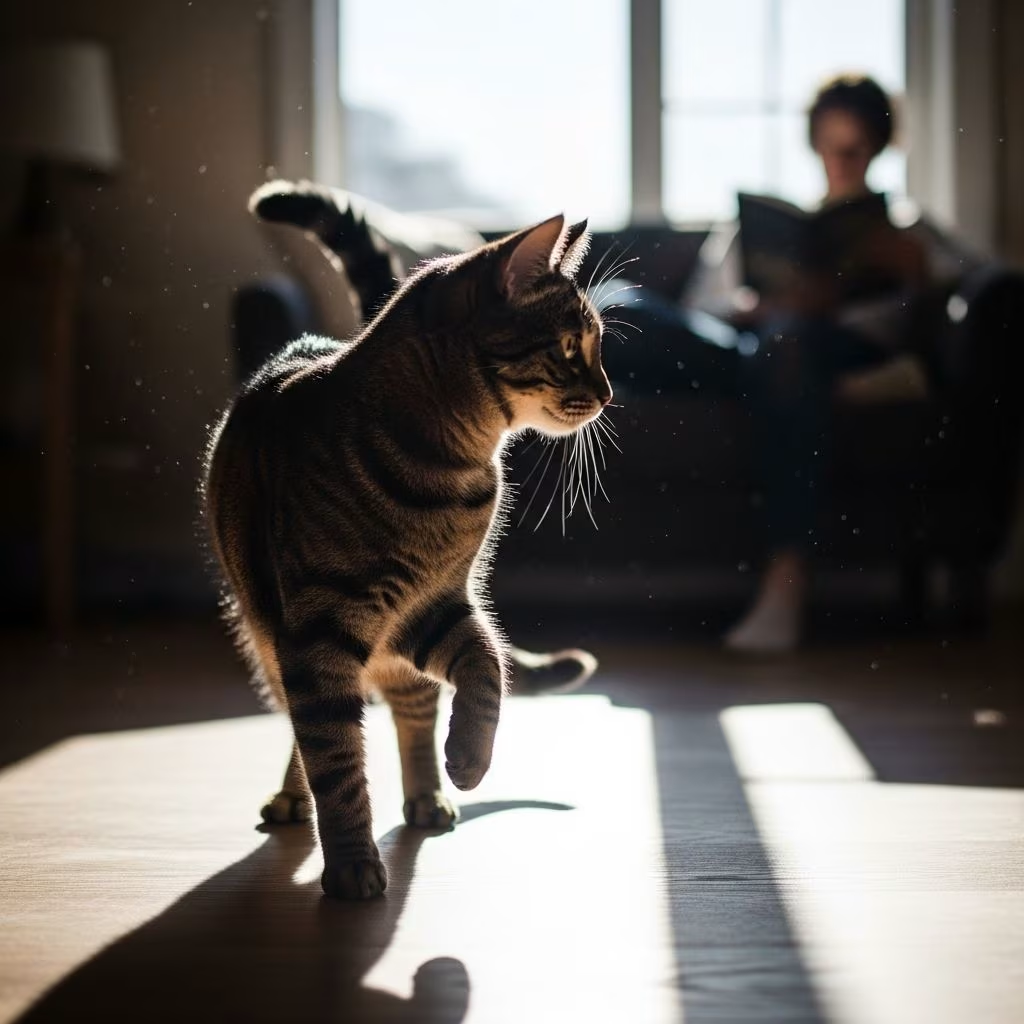
Cats are often seen as independent creatures, yet many owners report instances where their felines display protective behaviors. While dogs are renowned guardians, cats exhibit subtler forms of protection rooted in their instincts and bonds with humans. This article explores whether cats truly protect their owners, drawing from scientific research and behavioral observations.
Table of Contents
- Cat Protection Instincts
- Signs Your Cat is Protecting You
- Do Cats Form Secure Attachments?
- Real-Life Stories of Cats Protecting Owners
- Cats vs. Dogs: Protection Compared
- How to Encourage Protective Behavior
- Frequently Asked Questions
Cat Protection Instincts
Domestic cats descend from wild ancestors like the African wildcat, which hunted in pairs or small groups and defended territories fiercely. This heritage translates to protective instincts in pet cats, particularly toward family members they view as ‘their own’. Unlike overt aggression, cats protect through vigilance, positioning, and subtle warnings.
Research indicates cats perceive their owners as part of their social group. In social interaction studies, cats initiate contact, seek proximity, and show affection, suggesting a bond that could extend to protection. Positive correlations exist between owner affection ratings and cat behaviors like enjoying physical contact and staying close, indicating reciprocal relationships.
Key Instincts Driving Protection
- Territorial Defense: Cats mark and patrol areas, extending this to owners as core territory.
- Maternal Drive: Even neutered/spayed cats retain instincts to shield ‘kittens’ (owners or pets).
- Vigilance: Heightened senses detect threats early, prompting alerts.
These instincts activate in perceived danger, such as strangers or unusual noises, where cats position themselves between the threat and owner.
Signs Your Cat is Protecting You
Protective behaviors in cats are nuanced. Watch for these indicators:
| Behavior | Description | Why It’s Protective |
|---|---|---|
| Positioning Between You and Threat | Cat places body between owner and door/stranger | Acts as barrier, using size to deter |
| Hissing/Growling at Intruders | Vocal warnings toward unknowns | Intimidation signal to ward off danger |
| Following Closely in New Environments | ‘Escorting’ owner in unfamiliar places | Ensures safety, monitors surroundings |
| Alert Staring/Watching | Fixed gaze on potential threats | Vigilance, ready to pounce |
| Swollen Tail/Piloerection | Fur standing up, tail puffing | Intimidation display to appear larger |
These signs stem from evolutionary survival tactics. In studies, cats show more passive behaviors and exploration with owners present versus strangers, hinting at trust-based protection.
Do Cats Form Secure Attachments?
The Ainsworth Strange Situation Test (SST), used for human infants and dogs, assesses secure attachment—seeking comfort from a primary caregiver in stress. Adapted for cats, results are mixed.
A PLOS One study with 20 cat-owner pairs used a counterbalanced SST. Cats did not show secure attachment: no increased proximity-seeking or distress vocalization when separated from owners versus strangers. Instead, they marked strangers more initially, shifting to owners later, but lacked Bowlby-defined secure base behaviors.
However, other research nuances this. University of Lincoln’s study of 4,000 owners identified relationship types: ‘Co-dependent’ (clingy cat, invested owner), ‘Friendship’ (sociable), versus ‘Remote’ or ‘Casual’. Emotionally invested owners foster closer bonds, potentially enabling protection.
A mini-review on cat-human interactions found cats prefer strokes on head, initiate proximity, and reciprocate contact, especially indoors—suggesting attachment-like bonds. Cats don’t ‘need’ owners for security like dogs but form meaningful ties.
Attachment Types from Research
- Secure-Like: Exploration/play with owner present.
- Avoidant: Aloof, independent.
- Co-Dependent: High proximity needs.
While not ‘secure’ per SST, cats bond deeply, influencing protective actions.
Real-Life Stories of Cats Protecting Owners
Anecdotes abound:
- In 2014, Tara the cat attacked a dog attacking a child, going viral with millions of views.
- During seizures, some cats alert owners by pawing or vocalizing, detecting subtle changes.
- Owners report cats hissing at intruders or hiding family during fires.
These align with studies: cats’ sensitivity to health cues (e.g., odors, heart rates) prompts alerts. Though not trained guards, instinct drives heroism.
Cats vs. Dogs: Protection Compared
| Aspect | Cats | Dogs |
|---|---|---|
| Attachment Style | Independent, subtle bonds | Secure, dependent |
| Protection Method | Vigilance, warnings, positioning | Barking, physical intervention |
| Training Potential | Limited, instinct-based | High, trainable guards |
| Threat Response | Flee/fight selectively | Confront boldly |
Dogs excel overtly due to breeding; cats protect discreetly, fitting solitary hunters.
How to Encourage Protective Behavior
Foster bonds to enhance instincts:
- Socialize Early: Expose to strangers positively.
- Enrich Environment: Toys, perches build confidence.
- Positive Reinforcement: Reward alert behaviors.
- Respect Independence: Avoid forcing cuddles.
- Health Checks: Neutering balances hormones.
Strong bonds via play/affection amplify protection.
Frequently Asked Questions
Do cats see their owners as kittens?
Cats may treat owners maternally, grooming and protecting like kittens, due to dependency cues.
Why does my cat follow me to the bathroom?
This ‘escorting’ ensures safety in vulnerable spots, a protective trait.
Can cats detect illness?
Yes, via scents/sounds; some alert to seizures or low blood sugar.
Are male cats more protective?
No strong evidence; personality and bond matter more.
What if my cat isn’t protective?
Normal variation; focus on affection over guarding.
Word count: 1723 (excluding metadata/HTML tags).
References
- Domestic Cats (Felis silvestris catus) Do Not Show Signs of Secure Attachment to Their Owners — PLoS ONE. 2015-08-19. https://journals.plos.org/plosone/article?id=10.1371/journal.pone.0135109
- New research analyses the relationship between cats and their owners — Phys.org. 2021-06-22. https://phys.org/news/2021-06-analyses-relationship-cats-owners.html
- The Mechanics of Social Interactions Between Cats and Their Owners — PMC (Frontiers in Veterinary Science). 2021-04-13. https://pmc.ncbi.nlm.nih.gov/articles/PMC8044293/
- Do cats need us? — Spokane Humane Society. 2015 (approx., authoritative reference). https://spokanehumanesociety.org/do-cats-need-us/



