

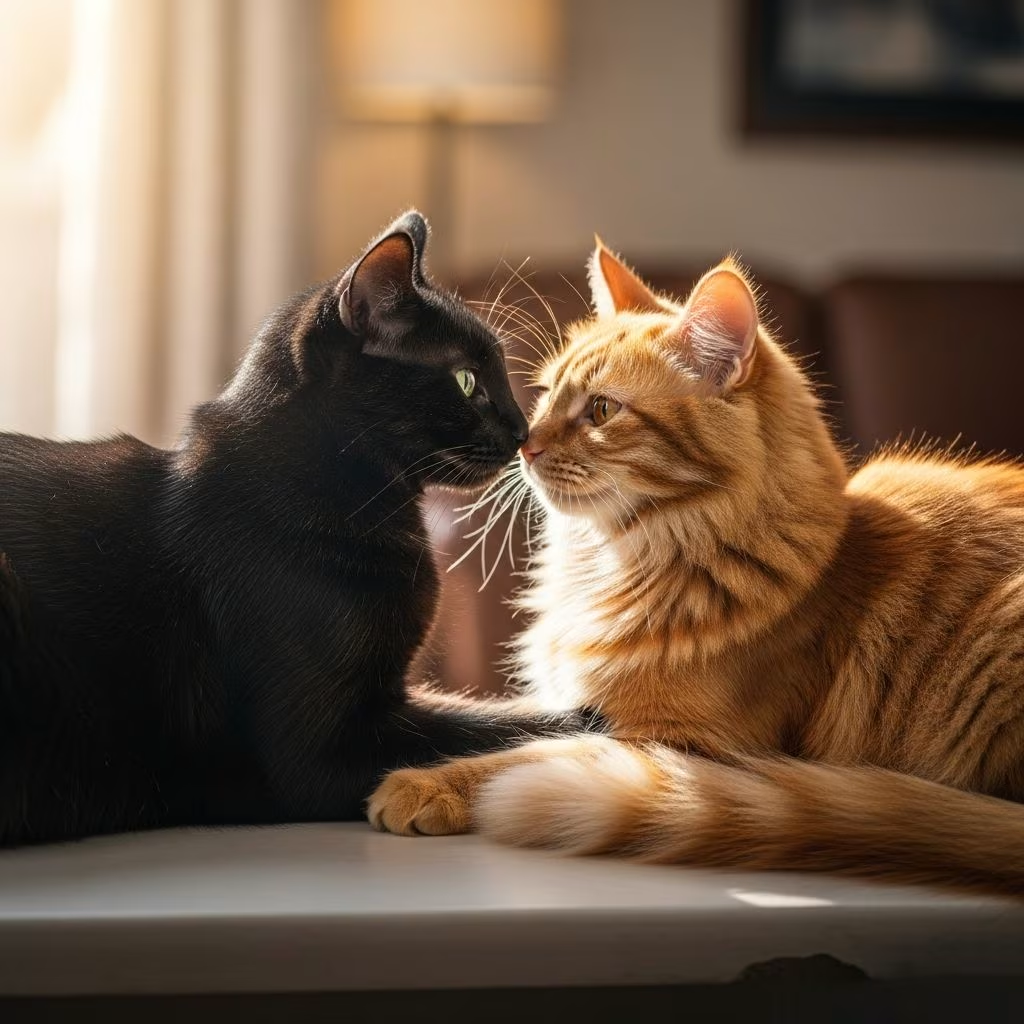
Cats do not practice monogamy; they exhibit a promiscuous mating system where both males and females mate with multiple partners, driven by evolutionary adaptations to maximize reproductive success in varied environments.
The Evolutionary Roots of Feline Mating Strategies
Domestic cats, descendants of the African wildcat, have retained mating behaviors suited to solitary or loosely social lifestyles. In natural settings, cats prioritize genetic diversity over exclusive partnerships, allowing females to select from multiple suitors for stronger offspring and males to spread their genes widely. This system contrasts sharply with truly monogamous species like prairie voles, where pair bonds form due to specific hormonal receptor distributions in the brain.
Environmental factors heavily influence these patterns. In resource-scarce areas, such as remote islands, female cats experience limited oestrus cycles—often just one per year—due to harsh conditions. Conversely, in urban or rural areas with abundant food, females may cycle multiple times annually, each lasting four to five days on average. This flexibility ensures survival but precludes long-term monogamous pairings.
How Feline Reproduction Works: Induced Ovulation and Multi-Partner Mating
Unlike many mammals, cats are induced ovulators, meaning ovulation triggers only after repeated mating sessions. A female requires multiple copulations—often with different males—for eggs to release, occurring 24 to 50 hours post-coitus. Male sperm also needs about 24 hours to capacitate within the female’s tract, further encouraging encounters with several partners to boost fertilization chances.
This biology fosters promiscuity. In high-density urban colonies, multi-male/multi-female groups form where low aggression among males during breeding allows even subordinates to mate. Studies show no single male monopolizes a female’s litter; multiple paternity is common, with litters sired by two or more fathers regardless of oestrus synchronization.
- Key reproductive traits: Short oestrus periods (4-5 days), induced ovulation, sperm capacitation delay.
- Outcome: Promotes genetic mixing, reduces infanticide risks from rival males.
- Environmental impact: More cycles in food-rich areas increase mating opportunities.
Male Competition and Social Dynamics in Cat Colonies
Male cats organize territories around female breeding sites rather than fixed resources. In one French urban study, females centered home ranges on single feeding spots, while males overlapped up to three such sites—despite needing only one for sustenance—purely to access receptive females. This spacing reflects male responses to female distribution, not hunger.
Breeding success hinges on oestrus timing. Asynchronous female cycles heighten male rivalry, favoring dominant individuals who sire most kittens—variance in male success can quadruple in such years. Synchronous cycles dilute this edge, as no male can guard all females, enabling broader participation. Sexual dimorphism plays a role too: males average 20% heavier than females, aiding competition, yet high-rankers do not always copulate more due to strategic flexibility.
| Scenario | Male Strategy | Reproductive Outcome |
|---|---|---|
| Asynchronous Oestrus | High competition; dominants prevail | Top males sire majority; high success variance |
| Synchronous Oestrus | Group mating; less guarding | Multiple males per litter; even success distribution |
| Low-Density Rural | Territorial defense | Dominants monopolize more effectively |
Domestic Cats vs. Wild Ancestors: Has Taming Changed Mating?
Domestication has introduced behavioral plasticity, including stronger human bonds, but not shifted core mating to monogamy. Pet cats remain aloof in reproduction, mating multiply if unsterilized. Free-ranging unowned cats—neither feral nor owned—mirror wild patterns: solitary or colonial based on resources, always promiscuous.
Urban adaptations include social tolerance, with males less aggressive to stay near females. Yet, no evidence supports pair bonding for kitten-rearing; mothers handle offspring solo, males provide no paternal care. This aligns with feline evolution prioritizing female investment in litters over male fidelity.
Human-Cat Bonds: Attachment Without Romantic Monogamy
While cats shun monogamy with each other, they form secure attachments to humans akin to infants or dogs. In attachment tests, 65% of cats and kittens showed secure bonding—reunion behaviors mirroring human child-caregiver dynamics—challenging the ‘independent’ stereotype. This socio-cognitive skill likely aided domestication success.
Secure cats seek proximity post-separation, insecure ones avoid or ambivalently react. These bonds persist into adulthood, influenced by early socialization. Shelter studies explore if fostering boosts security, potentially reducing abandonment. Thus, cats offer companionship loyalty without sexual exclusivity.
Comparing Cats to Monogamous Animals
Monogamy in animals often evolves to counter infanticide or when females disperse widely, forcing males to guard mates for offspring survival. Prairie voles exemplify this via oxytocin/vasopressin receptors promoting bonding; engineering these in promiscuous meadow voles induced monogamy.
Cats diverge: no paternal care needed, low infanticide in colonies due to kinship, and clustered females enable mate-guarding without exclusivity. Only ~3-5% of mammals are monogamous; cats join the promiscuous majority, optimizing selfish genes via multiple matings.
- Monogamous traits (e.g., voles): Hormone receptors, biparental care, dispersed territories.
- Promiscuous feline traits: Induced ovulation, male roaming, female selectivity.
Implications for Cat Owners and Breeders
Understanding promiscuity informs spaying/neutering: unsterilized pets risk multi-sired litters, health issues from cycles, and overpopulation. Indoor cats avoid stray matings, but outdoor ones perpetuate feral colonies. Owners foster human bonds via play, feeding—mimicking secure attachment cues.
Breeders note pedigree challenges from multiple paternity; genetic testing verifies sires. Conservation-wise, island populations show density-dependent mating shifts, guiding management.
FAQs on Feline Mating Habits
Can pet cats form lifelong pairs like some birds?
No, cats lack biological mechanisms for pair bonding; they mate promiscuously even in homes.
Do male cats stay with one female after mating?
Males roam post-mating, seeking others; no paternal investment occurs.
How does neutering affect mating behavior?
It eliminates urges, preventing promiscuous encounters and health risks.
Are there monogamous cat breeds?
No breeds alter species-typical promiscuity; behavior stems from genetics.
Why do cats seem loyal to owners but not mates?
Separate systems: human attachment via socio-cognitive evolution, mating via reproduction.
References
- Coexistence between Humans and ‘Misunderstood’ Domestic Cats — Natoli E. et al. 2022-07-01. https://pmc.ncbi.nlm.nih.gov/articles/PMC9264925/
- Cats are securely bonded to their people, too — ScienceDaily (Cell Press). 2019-09-23. https://www.sciencedaily.com/releases/2019/09/190923111229.htm
- Why Some Animals Are Monogamous – but not Higgs the cat — WHYY. Undated (accessed 2026). https://whyy.org/articles/why-some-animals-are-monogamous-but-not-higgs-the-cat/
- Monogamy in animals — Wikipedia (informational). Undated. https://en.wikipedia.org/wiki/Monogamy_in_animals



