

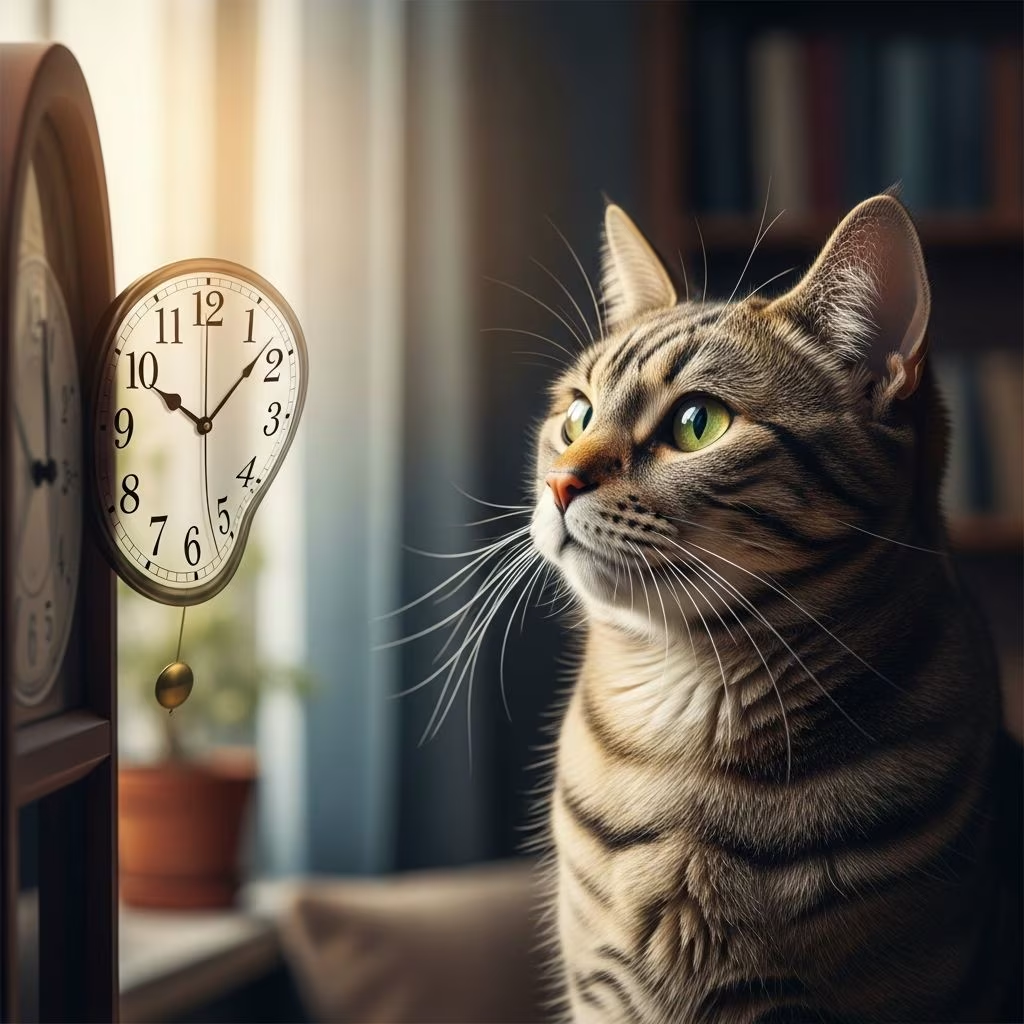
Cats exhibit a remarkable knack for knowing when dinnertime arrives or when their owners are due home, suggesting they possess some form of time awareness distinct from human clock-reading. Scientific studies indicate that felines rely on biological rhythms, memory patterns, and environmental signals rather than precise hour tracking.
The Biological Foundations of Feline Timekeeping
At the heart of a cat’s temporal sense lies the circadian rhythm, a 24-hour internal cycle that governs sleep, activity, and feeding. This rhythm synchronizes with light-dark transitions, making cats—known as crepuscular animals—most active during dawn and dusk. Unlike humans with strict diurnal patterns, cats’ clocks adapt to these twilight peaks, influencing when they hunt, play, or rest.
Research highlights how this internal mechanism operates independently of external clocks. For instance, veterinary behaviorists note that cats attune to subtle shifts in daylight, atmospheric pressure, or even household sounds to maintain their schedule. Disruptions, like travel across time zones, can induce jetlag-like symptoms, underscoring the pineal gland’s role as a key zeitgeber—or time-giver—in regulating these cycles.
How Cats Distinguish Short from Long Absences
Owners often observe cats greeting them enthusiastically after brief outings but lounging indifferently upon longer returns. This isn’t mere coincidence; studies on temporal discrimination reveal cats behave differently based on elapsed intervals, such as 30 minutes versus two hours. Animal cognition experts confirm most mammals, including cats, gauge passage of time post-event, though not with second-by-second precision.
In experiments akin to those measuring light pulse perception, smaller predators like cats process visual information at a frame rate of about 55 hertz, slightly slower than humans’ 65 hertz. This metabolic trait stems from their need for longer retinal exposure in low light, yet it doesn’t drastically impair overall time sense. Dopamine-related neural patterns, observed in rodents, likely contribute similarly in cats, allowing pattern recognition over exact chronology.
Memory’s Role in Feline Temporal Awareness
Cats’ short- and long-term memories enable them to recall routines, toy locations, and feeding spots, predicting events accordingly. A pivotal concept is episodic-like memory, where cats remember specific event sequences, potentially allowing ‘mental time travel’—projecting to past or future moments.
A 2017 study demonstrated cats forming such memories, though researchers debate if this equates to human-like time comprehension. Proving it requires ruling out biological cues, a challenge in feline testing. Lead investigator Saho Takagi affirms cats hold episodic-like representations but questions necessity for true time sense. This memory integration helps cats link owner arrivals with meals, fostering learned expectations.
| Time Perception Aspect | Cats | Humans |
|---|---|---|
| Circadian Rhythm | Crepuscular (dawn/dusk active) | Diurnal (day active) |
| Frame Rate | ~55 Hz | ~65 Hz |
| Memory Type | Episodic-like | Episodic (full mental travel) |
| Key Cues | Light, sound, routine | Clocks, calendars |
Environmental Cues and Learned Associations
Beyond biology, cats master environmental predictors. The jingle of keys, car engines, or schoolchildren’s footsteps signal returns home, prompting window vigils. These associations form through repeated exposure, blending with internal clocks for reliable anticipation.
Cats’ independence amplifies reliance on body rhythms over scents, unlike dogs. Routine stability reduces separation anxiety; deviations trigger distress, as pets expect consistency. Interactive toys or puzzle feeders mitigate this during absences, maintaining mental engagement.
Scientific Evidence from Key Studies
- A 2015 Physiology study linked cats to circadian regulation of sleep and feeding, showing heightened temporal awareness.
- Animal Cognition research confirmed pets’ interval discrimination, with cats reacting variably to absence durations.
- 2017 findings by Takagi et al. evidenced episodic-like memories in cats, challenging prior assumptions on animal cognition.
These converge to affirm cats perceive time broadly, though human parallels remain debated.
Practical Implications for Cat Owners
Harnessing cats’ time sense enhances welfare. Consistent schedules for meals, play, and litter access minimize stress. For multi-cat homes, synchronized routines prevent conflicts tied to feeding times.
Travel preparations include gradual light adjustments to ease circadian shifts. Enrichment devices timed to routines reinforce positive associations, combating boredom during solos.
Debates in Animal Time Perception
While consensus holds mammals sense elapsed time, feline specifics lag. Experts like Katherine Pankratz emphasize environmental attunement over innate clocks alone. Zoology researcher Kevin Healy notes cats’ perception suits predatory lifestyles without human acuity.
Neural studies on rodents suggest time representations via activity patterns, hinting at cat parallels. Yet, definitive episodic memory proof demands advanced tech, leaving room for future breakthroughs.
FAQs
Can cats tell the difference between 1 hour and 4 hours alone?
Yes, research shows cats display varied behaviors based on absence length, indicating interval awareness.
Do cats experience jetlag?
Absolutely; their circadian clocks disrupt sans zeitgebers like consistent light, mimicking human jetlag.
How does a cat’s crepuscular nature affect time sense?
It peaks activity at twilight via light cues, but human schedules often override for domestic cats.
Can I train my cat to a new routine?
Yes, through gradual changes and cues, leveraging their associative learning.
Do all cats have the same time perception?
Varies by age, health, and environment, but core mechanisms persist across felines.
Enhancing Your Cat’s Daily Rhythm
Introduce timed feeders syncing with returns, promoting security. Dawn/dusk play mimics natural hunts, aligning crepuscular instincts. Monitor anxiety via vocalizing or hiding; adjust routines promptly.
For seniors, stable patterns counter cognitive decline, preserving memory-driven timing. Multi-pet dynamics benefit from staggered schedules, reducing resource competition.
References
- Can Cats Tell Time? Yes, But It’s Complicated — Inverse. 2023. https://www.inverse.com/science/can-my-cat-tell-time-heres-what-experts-say
- Your Cat Knows Your Schedule Better Than You Do — YouTube (Jaw-Dropping Facts). 2023. https://www.youtube.com/watch?v=bggdNt28zDM
- Do Pets Have a Sense of Time? How Dogs & Cats Understand Time — Vet Products Direct. 2024. https://www.vetproductsdirect.com.au/blog/do-pets-have-a-sense-of-time
- Animals can experience time very differently to humans. Here’s why — BBC Science Focus Magazine. 2023. https://www.sciencefocus.com/science/animal-time-perception



