

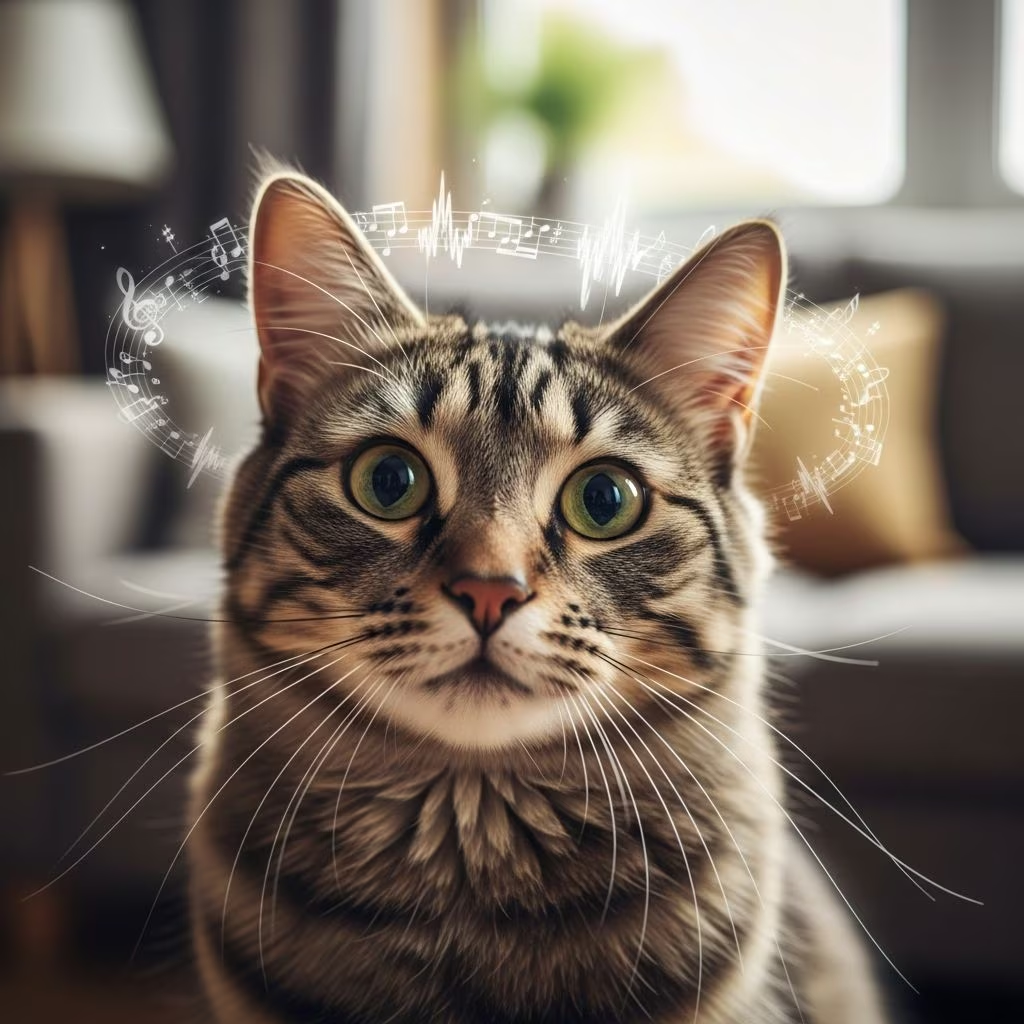
Many cat owners report that their pets perk up, become more affectionate, or even seem to have favorite songs when they start singing. While no direct scientific study confirms cats enjoy human singing specifically, anecdotal evidence and research on feline music preferences suggest they respond positively to certain sounds and associated behaviors.
Is It Our Singing?
Cats may not necessarily like the singing itself but could be reacting to the sound of your voice, your happy mood, or rewards like treats and playtime that often accompany it. Domesticated cats are attuned to human emotions; they seek closeness when owners appear happy, which singing typically signals.
Environmental cues play a role too. If singing coincides with positive experiences, cats associate the activity with good outcomes rather than the melody. Additionally, cats perceive music differently from humans, preferring species-specific sounds over typical human genres.
What Music Do Cats Like?
Scientific studies reveal cats have distinct musical preferences. Research shows they respond more favorably to music tailored to their hearing range, tempos mimicking purring or suckling, and familiar vocalizations.
- A study comparing pop, heavy metal, and classical music on anesthetized cats found classical music reduced stress indicators like respiration and pupil dilation, while heavy metal increased them.
- In a 2015 study, cats showed greater interest in music composed for felines, featuring tempos and frequencies matching cat communication, with younger and older cats responding most strongly.
- A 2019 clinical study exposed cats to 10-minute samples of classical music, cat-specific music, or silence before vet exams. Cat music significantly lowered stress scores and improved handling compared to the others.
Cat-specific music incorporates high-pitched, drawn-out tones from instruments like violins, xylophones, and pianos, overlaid with purring and suckling sounds. These evoke positive emotions tied to nursing periods, promoting relaxation.
| Music Type | Cat Response | Key Study Findings |
|---|---|---|
| Human Classical | Moderate relaxation | Lower stress vs. heavy metal; no significant edge over silence in clinics. |
| Cat-Specific | High interest, reduced stress | Lower CSS and HS; faster approach to speakers. |
| Silence | Neutral | No stress reduction; baseline for comparisons. |
| Heavy Metal/Pop | Increased stress | Higher anxiety indicators. |
What Should You Sing to Your Cat?
To appeal to your cat, incorporate elements of cat music into your singing: low rumbling purr-like sounds, high-pitched legato tones, and their name. Cats distinguish their names from others and associate them with rewards.
Experiment by weaving your cat’s name into popular songs or creating simple tunes with purring imitations. Observe reactions—purring, rubbing, or approaching indicate approval. Avoid loud, fast genres; opt for slow, soothing melodies.
- Sing their name repeatedly: Enhances recognition and positive association.
- Mimic purring: Low, vibrating hums soothe like maternal sounds.
- Use high pitches sparingly: Matches feline vocal ranges without overwhelming.
- Pair with affection: Petting or treats during singing reinforces bonds.
Owner experiences vary: some cats excitedly approach and nuzzle during singing, while others bite or flee if it reminds them of past trauma or if too loud. Individual history influences responses.
Individual Cat Reactions to Singing
Not all cats react positively. Forums report cases where cats bite feet when owners sing loudly, seeking attention, or climb and bite due to overstimulation. Others ignore singing entirely or react negatively only to specific voices, possibly linked to early experiences.
These variations highlight that while general trends favor soothing, cat-specific sounds, personality and background matter. Socialized kittens exposed to varied sounds adapt better.
Science Behind Cat Music Preferences
Cats’ superior hearing detects ultrasonic frequencies up to 64 kHz, far beyond human limits. Music mimicking their 25-150 Hz purring range or 400-800 Hz suckling activates calming responses. Studies confirm autonomic nervous system changes: slower heart rates and relaxed postures with preferred music.
In veterinary settings, pre-exam cat music reduced Cat Stress Scores (CSS) and Handling Scores (HS) significantly, though neutrophil:lymphocyte ratios (physiological stress markers) showed no change. This suggests behavioral calming without altering deep physiological stress.
Researchers like Charles Snowdon developed cat music based on species-specific elements, proving cats approach and orient toward it faster than classical alternatives.
Tips for Singing to Your Cat
- Start soft: Begin with whispers or hums to gauge reaction.
- Observe body language: Ears forward and tail up mean interest; flattened ears signal discomfort.
- Make it interactive: Sing during play or feeding for strong associations.
- Record and playback: Test your voice recordings to isolate singing effects.
- Try playlists: Use apps with cat music as background for your vocals.
Frequently Asked Questions (FAQs)
Do all cats like singing?
No, reactions vary. Some love it, others bite or hide due to volume, pitch, or past associations.
What if my cat hates my singing?
Lower volume, mimic purring, or stop if stressed. Try cat-specific music instead.
Can singing reduce my cat’s stress?
Yes, if it includes calming elements; studies show cat music lowers stress in clinics.
Do cats recognize songs?
They may recognize patterns or their name in songs, responding to familiarity.
Is cat music scientifically proven?
Yes, multiple peer-reviewed studies confirm preferences and stress reduction.
Final Thoughts
Whether your cat loves your singing for the tune, your joy, or rewards, it fosters bonding. Science supports music’s positive feline impact—experiment confidently. Sing away; a happy cat (and owner) is the real win.
References
- Do Cats Like When You Sing to Them? Fun Facts — Catster. 2023. https://www.catster.com/cat-behavior/do-cats-like-when-you-sing-to-them/
- Effects of music on behavior and physiological stress response of cats handled in a veterinary clinic — PMC/NIH. 2024-01-08. https://pmc.ncbi.nlm.nih.gov/articles/PMC10814571/
- Snowdon, C.T., et al. Music for Cats: Considering Feline Species-Specific Factors in Music Composition to Enhance Post-Surgical Recovery — Frontiers in Veterinary Science (via PMC references). 2023. https://doi.org/10.3389/fvets.2023.1277367
- Classical Music, Sonata for Two Cats: Would Cats Prefer Music Made for Them? — Snowdon & Teie, University of Wisconsin. 2015. https://doi.org/10.1177/2156869315580199
- Effects of Music on Anesthesia Recovery in Cats — Journal of Feline Medicine and Surgery. 2012. https://journals.sagepub.com/doi/10.1177/1098612X12443290



