

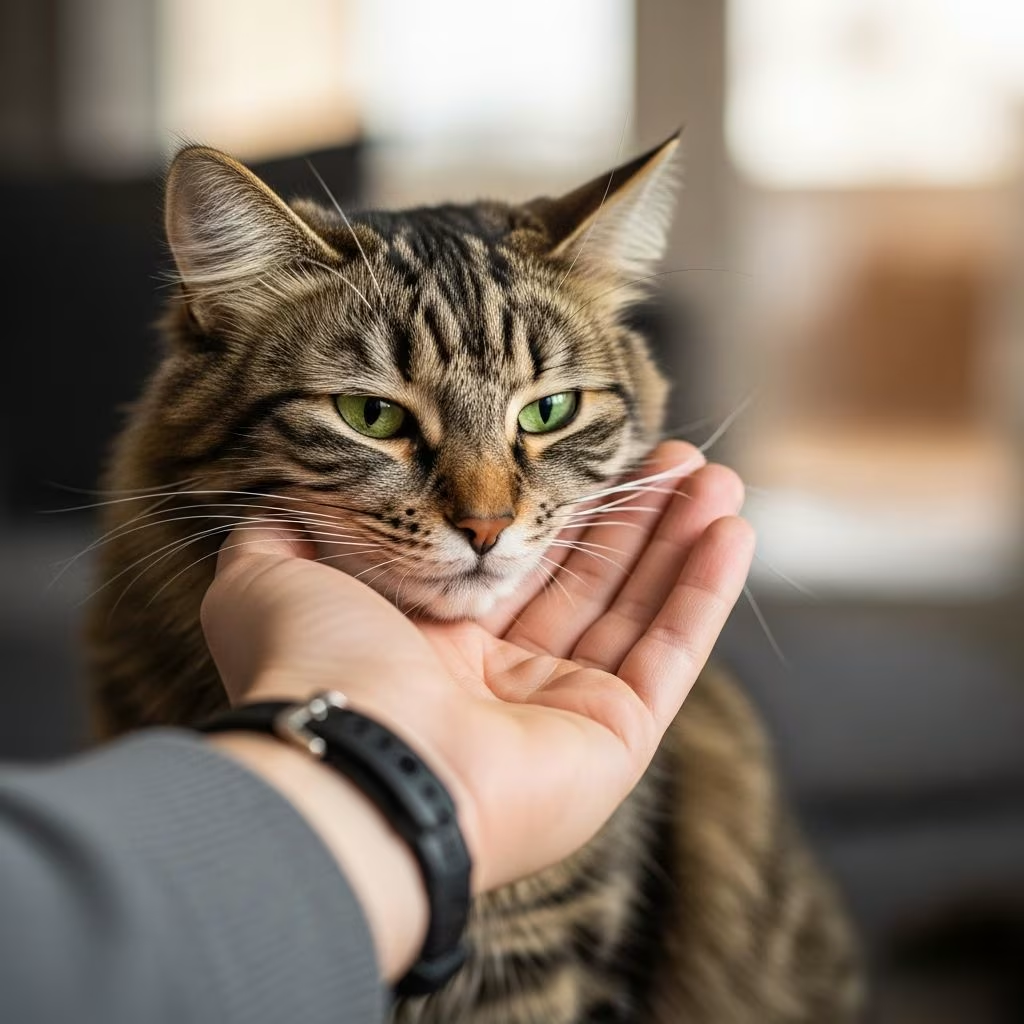
Cats have long been shrouded in mystery when it comes to their feelings toward humans. Unlike dogs, who wear their hearts on their sleeves with wagging tails and eager greetings, cats often appear aloof, independent, and selective in their affections. But do cats actually like humans? Scientific studies reveal a more nuanced picture: cats form genuine bonds with their owners, recognize human emotions, and engage in reciprocal social interactions, though on their own terms.
Domestic cats (Felis catus) evolved from solitary wildcats, yet thousands of years of cohabitation have shaped them into social creatures capable of deep attachments to people. Research shows that well-socialized cats treat humans as family members—sometimes even as oversized kittens—responding to our cues while setting boundaries. This article dives into the evidence, debunking myths and offering insights to strengthen your cat-human relationship.
How Do Cats Show Affection to Humans?
Cats express affection subtly but meaningfully, often through behaviors rooted in their evolutionary history. Slow blinks, head bunting, purring, and kneading are hallmarks of feline love. A slow blink from your cat is akin to a human smile, signaling trust and relaxation. When cats rub their heads or flanks against you, they’re marking you with scent glands as part of their social group—a clear sign of acceptance.
Purring isn’t just for contentment; cats purr at frequencies (25-150 Hz) that promote healing in themselves and humans, often during close contact. Studies observe cats initiating these behaviors more with familiar owners, adjusting postures to encourage petting in preferred areas like the head and cheeks. Unlike overt displays, cat affection respects personal space, aligning with their solitary ancestry while adapting to human companionship.
- Slow blinking: Mimics a kiss; return it to build trust.
- Head bunting/rubbing: Scent-marking claims you as family.
- Purring and trilling: Vocal signs of happiness and greeting.
- Kneading (making biscuits): Reminiscent of nursing, showing comfort.
- Tail wrapping: Around your leg indicates security.
Do Cats Recognize Their Owners?
Yes, cats distinguish their owners from strangers through sight, sound, scent, and even emotional cues. Observational studies in cat-owning households show cats respond preferentially to their primary caregiver, vocalizing more and seeking proximity. Cats use multimodal recognition: they match human facial expressions with voices, particularly for intense emotions like joy or anger.
In experiments, cats showed heightened stress to unfamiliar scents but relaxed around owner-associated odors. They also react to owners’ voices with ear twitches and approaches, ignoring strangers. This selectivity stems from early socialization; kittens handled gently by humans form secure attachments lasting into adulthood.
The Science Behind Cat-Human Social Interactions
Quantitative studies of cat-human dyads reveal symmetrical compliance: cats and owners respect each other’s interaction wishes, leading to longer, positive engagements when initiated by the cat. In 158 households, cats controlled interaction duration—successful human initiations correlated with shorter sessions, emphasizing feline autonomy.
Gender and age influence dynamics: women and children lower to cat level, prompting more vocalizations and acceptance, while men often remain seated, eliciting less response. Cats don’t prefer genders inherently but react to human behavior. Reciprocity is higher with adults than kids, with better ‘goal meshing’—mutual distance regulation and contact.
| Human Group | Typical Behavior | Cat Response |
|---|---|---|
| Women/Girls | Get on floor, talk softly | More vocalizations, acceptance |
| Men/Boys | Stay seated, direct approaches | Fleeing, less engagement |
| Adults vs. Children | Higher reciprocity in adults | Longer close contact bouts |
Do Cats See Humans as Family or Kittens?
Cats often treat humans as giant kittens rather than parents or predators. This ‘kittenization’ theory posits cats regress owners to kitten status through behaviors like meowing (rare among adult cats) and soliciting grooming. Wildcats are asocial, but domestic cats solicit human play and feeding like nursing kittens.
John Bradshaw’s research highlights cats’ flexible predation adapted to human routines. They form attachments but misunderstand human hierarchies, viewing us through a feline lens. Positive early socialization predicts lifelong trust; negative experiences require multiple positives to rebuild.
Can Cats Sense Human Emotions?
Cats are attuned to human emotions via visual, vocal, and olfactory cues. They cross-modally match emotional faces with voices, distinguishing joy from anger. A 2023 study exposed cats to sweat odors from fearful, happy, stressed, or neutral humans: fear scents triggered severe stress (flattened ears, retreat), processed via the right nostril linked to intense emotions.
Owners’ emotions elicit stronger responses; cats relax (ears forward, calm sitting) to positive scents via the left nostril. Galvan and Vonk found modest sensitivity overall, but owners’ cues prompt behavioral shifts.
Cats’ Impact on Human Well-Being
Interactions with cats alleviate human anxiety, depression, and introversion, comparable to human partners. Depressed owners initiate less but accept cat approaches, with cats responding by rubbing and vocalizing more. Women’s moods improve more across subscales. Rieger and Turner noted cats enhance negative mood relief via presence and contact.
Signs Your Cat Doesn’t Like Humans (or You)
Watch for avoidance: flattened ears, dilated pupils, hissing, swatting, or tail thrashing signal discomfort. Cats may flee direct stares or forced petting, preferring self-initiated contact. Unsociable cats from poor socialization or trauma withdraw.
- Ears back/tail low: Fear or irritation.
- Arched back, fur raised: Aggression/defense.
- Avoidance of touch: Especially belly or base of tail.
- Biting after petting: Overstimulation.
How to Build a Stronger Bond with Your Cat
Respect their lead: let cats initiate, use slow blinks, and pet preferred areas. Enrich environments with toys, perches, and scratching posts to curb frustration. Play daily mimics hunting, strengthening ties. Avoid punishment; use positive reinforcement.
- Socialize kittens 2-7 weeks.
- Match energy: interactive toys for zoomies.
- Provide vertical space.
- Learn body language.
- Offer choices in interaction.
Frequently Asked Questions (FAQs)
Do cats like humans more than dogs do?
No, cats bond differently—independently but deeply. They control interactions, unlike dogs’ deference.
Why does my cat ignore me sometimes?
Cats prioritize autonomy; ignoring prevents overstimulation. Wait for their approach.
Can stray cats learn to like humans?
Yes, with patience and positive experiences, though feral adults are harder.
Do cats prefer men or women?
No inherent preference; they respond to gentle, floor-level behaviors more common in women.
Is purring always a sign of happiness?
Mostly, but cats purr when stressed or healing too.
Conclusion
Cats do like humans—they form emotional bonds, recognize us uniquely, and enhance our well-being. Understanding their subtle cues unlocks profound companionship. Embrace their independence for a rewarding relationship.
References
- The Mechanics of Social Interactions Between Cats and Their Owners — Dennis C. Turner. 2021-04-08. https://pmc.ncbi.nlm.nih.gov/articles/PMC8044293/
- Cats and human emotions: A stronger bond than we thought? — Noldus. 2023. https://noldus.com/blog/cats-react-to-human-emotional-scents
- Confirmed—Cats see humans as giant kittens, not as their owners — Blanquivioletas. 2023. https://www.blanquivioletas.com/en/cats-see-humans-as-giant-kittens/
- Human interaction with cats — Wikipedia (informational, primary sources referenced). N/A. https://en.wikipedia.org/wiki/Human_interaction_with_cats
- What’s going on inside your cat’s head? — American Psychological Association. 2023. https://www.apa.org/news/podcasts/speaking-of-psychology/cat-human-bond



