

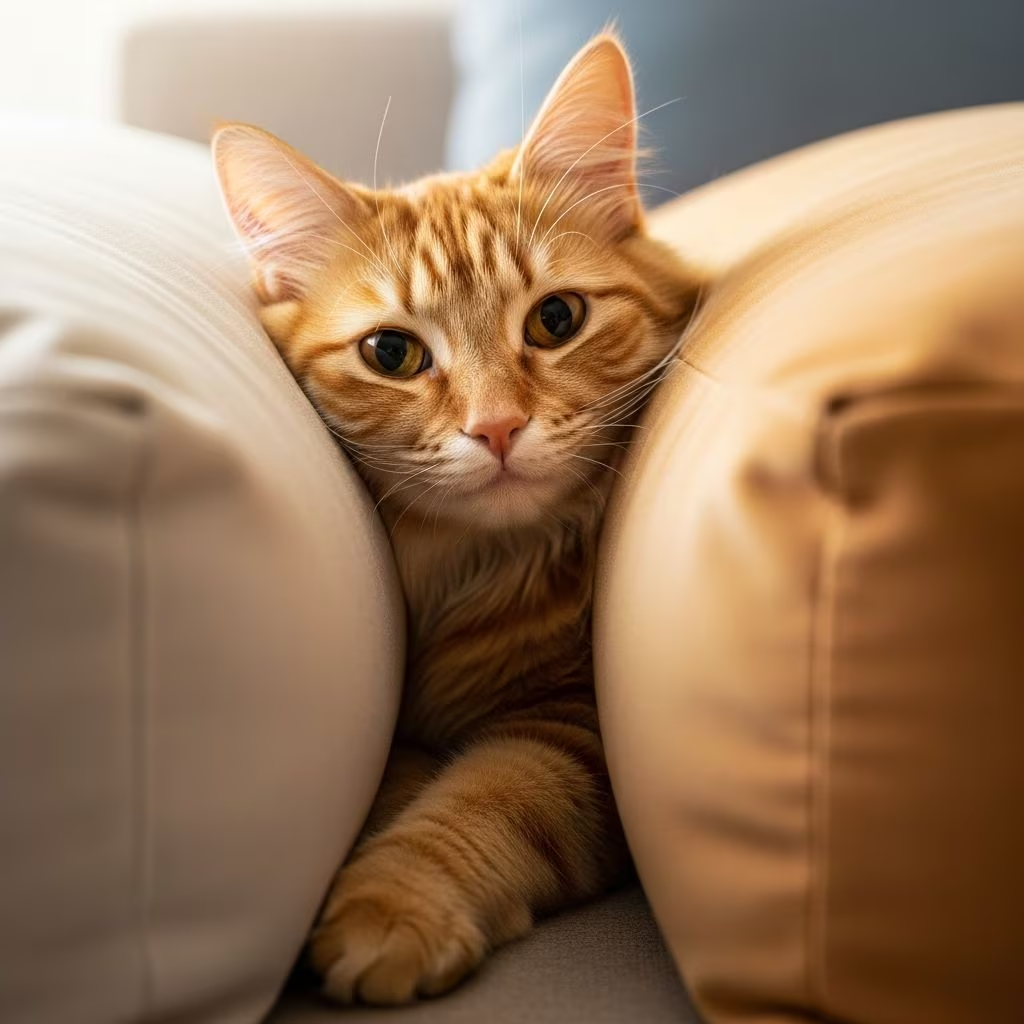
Cats often seek out tight spaces like boxes, bags, or even your lap, prompting many owners to wonder: do cats like being squished? The answer is yes for many felines, as gentle pressure mimics the security of a mother’s embrace or a cozy den, promoting relaxation through deep touch pressure stimulation (DTPS). This phenomenon ties into cats’ liquid-like ability to squeeze through narrow gaps, revealing their acute body awareness. Veterinarians note that while not all cats enjoy squishing, those that do show clear signs of contentment, and it can even help manage anxiety when done correctly.
Why Do Cats Like Small, Tight Spaces?
Cats’ affinity for confined areas stems from instinctual behaviors rooted in their wild ancestry. In nature, small spaces offer protection from predators, allowing cats to hide while observing their surroundings. Domesticated cats retain this trait, squeezing into boxes or shelves to feel secure. Research demonstrates cats possess sophisticated body awareness, enabling them to fluidly navigate tight openings without hesitation unless the space poses a risk.
A 2024 study by Péter Pongrácz at Eötvös Loránd University tested 38 cats with panels featuring holes of varying heights and widths. Cats effortlessly flowed through narrow slits (trial-and-error strategy) but hesitated at short openings, suggesting they mentally map their body dimensions to avoid vulnerability. Only 8 of 30 completing cats paused at the narrowest width, versus 22 at the shortest height, highlighting height as a greater barrier due to self-preservation instincts. This “liquid behavior” underscores why cats love squishing: they know their limits and seek safe compression.
- Security and warmth: Tight spaces trap body heat and block drafts, creating a womb-like environment.
- Reduced stress: Enclosed areas limit visual stimuli, lowering overstimulation in multi-cat homes or busy households.
- Territorial marking: Cats rub against edges, depositing pheromones to claim the spot.
- Body awareness: Felines gauge fit instinctively, hesitating only at risky proportions.
The Science of Deep Pressure Therapy for Cats
Deep pressure therapy (DPT), or squishing, applies firm, even pressure to calm the nervous system. This mirrors swaddling in infants or weighted blankets in humans, triggering oxytocin release and endogenous opioids for relaxation. Animal behaviorist Temple Grandin’s 1992 research showed light pressure reduces anxiety in livestock, allowing lower sedative doses during procedures—a principle applicable to cats.
Kristyn Vitale, a feline behavior expert, explains that petting with pressure around the head and cheeks elicits purring and nuzzling in enjoying cats. A 2017 study links touch to physiological relaxation via opioid secretion, fostering bonding. However, forced contact stresses some cats; a 2013 University of Veterinary Medicine Vienna study found 85/120 cats enjoyed stroking, while 13 “tolerators” showed elevated fecal glucocorticoid metabolites (stress hormones). Owners must read cues to avoid misinterpreting tolerance as enjoyment.
| Pressure Type | Effect on Cats | Supporting Evidence |
|---|---|---|
| Gentle Squishing | Promotes oxytocin, reduces cortisol | Vitale 2024; Grandin 1992 |
| Forced Restraint | Increases stress hormones | Palme 2013: 13/120 cats stressed |
| Self-Initiated Squeezing | Lowers anxiety, enhances security | Pongrácz body awareness study |
Signs Your Cat Likes Being Squished
Not every cat craves hugs, but receptive ones display unmistakable signals. Observe these positive indicators during squishing sessions:
- Your cat doesn’t try to escape but relaxes into the pressure.
- Your cat purrs rhythmically, a hallmark of pleasure (not always stress).
- Your cat nuzzles or head-butts your hand, seeking more contact.
- Your cat dozes off, eyes half-closed in bliss.
- Your cat protests (meows/paws) if you stop prematurely, requesting continuation.
Conversely, watch for distress: flattened ears, dilated pupils, tail thrashing, or vocal protests mean stop immediately. Stress in cats manifests as hiding, reduced play, or redirected aggression, per a 2024 review on feline welfare. Individual personality matters—confident cats may love it, while anxious ones prefer space.
How to Safely Squish Your Cat: Vet-Approved Techniques
To provide beneficial squishing, prioritize consent and gentleness. Start with short sessions, building trust:
- Choose the right moment: When your cat is relaxed, not eating or sleeping deeply.
- Use proper form: Place one hand on the shoulders, the other over the back/hips. Apply even, moderate pressure like a firm hug—avoid belly or legs.
- Incorporate petting: Combine with strokes on cheeks and head, prime squish zones.
- Duration: 1-5 minutes; release if tension builds.
- Alternatives: Cat burritos (towel wraps), snug boxes, or thunder shirts for self-squishing.
Veterinarians caution against over-squishing, which can immobilize temporarily but risks panic if excessive. For aggressive squishers, consult a vet to rule out pain or hyperthyroidism.
Risks and When Squishing Isn’t Right
While beneficial, squishing carries pitfalls. Overly tight pressure causes respiratory distress or injury, especially in brachycephalic breeds. Stressed cats may lash out, linking to redirected aggression from uncontrollability. A 2013 study debunked myths that all stroking stresses cats—only reluctant ones suffer.
- Medical red flags: Arthritis, injuries, or obesity amplify discomfort.
- Behavioral cues: Escape attempts signal dislike; respect boundaries to preserve trust.
- Household dynamics: Multi-cat stress elevates glucocorticoids, making squishing therapeutic only if welcomed.
FAQs: Common Questions About Cats and Squishing
Do all cats like being squished?
No, preferences vary by personality and history. About 70% enjoy it per owner reports, but observe individual cues.
Why does my cat squeeze into tiny spaces?
Instinct for security, warmth, and body-aware navigation of safe confines.
Is squishing good for anxious cats?
Yes, deep pressure therapy calms via oxytocin and opioids, but only if the cat consents.
What if my cat hates being held?
Provide self-squish options like boxes; forced contact raises stress hormones.
Can squishing replace vet care for stress?
No—it’s complementary. Persistent anxiety warrants professional evaluation.
Conclusion: Embrace Your Cat’s Squishy Side Safely
Many cats adore being squished, leveraging innate body awareness and deep pressure’s calming effects. By reading signs and applying techniques mindfully, you enhance bonding and welfare. Always prioritize your cat’s comfort for a purring partnership.
References
- Analyze This: When do cats move like liquids? — Science News Explores. 2024-09-17. https://www.snexplores.org/article/cats-liquid-behavior-body-awareness
- What’s the Best Way To Pet Your Cat? Squish Them, Says Science — Inverse. 2024. https://www.inverse.com/science/best-way-to-pet-your-cat-squish-them-science
- At-home experiments shed light on cats’ liquid behavior — Science News. 2024-09-17. https://www.sciencenews.org/article/home-experiments-cats-liquid-behavior
- Misinterpretation of cat study? Anxious cat owners can carry on … — ScienceDaily (Veterinärmedizinische Universität Wien). 2013-10-16. https://www.sciencedaily.com/releases/2013/10/131016100108.htm
- Stress in owned cats: behavioural changes and welfare implications — PMC/NCBI (Peer-reviewed). 2024. https://pmc.ncbi.nlm.nih.gov/articles/PMC10816390/



