

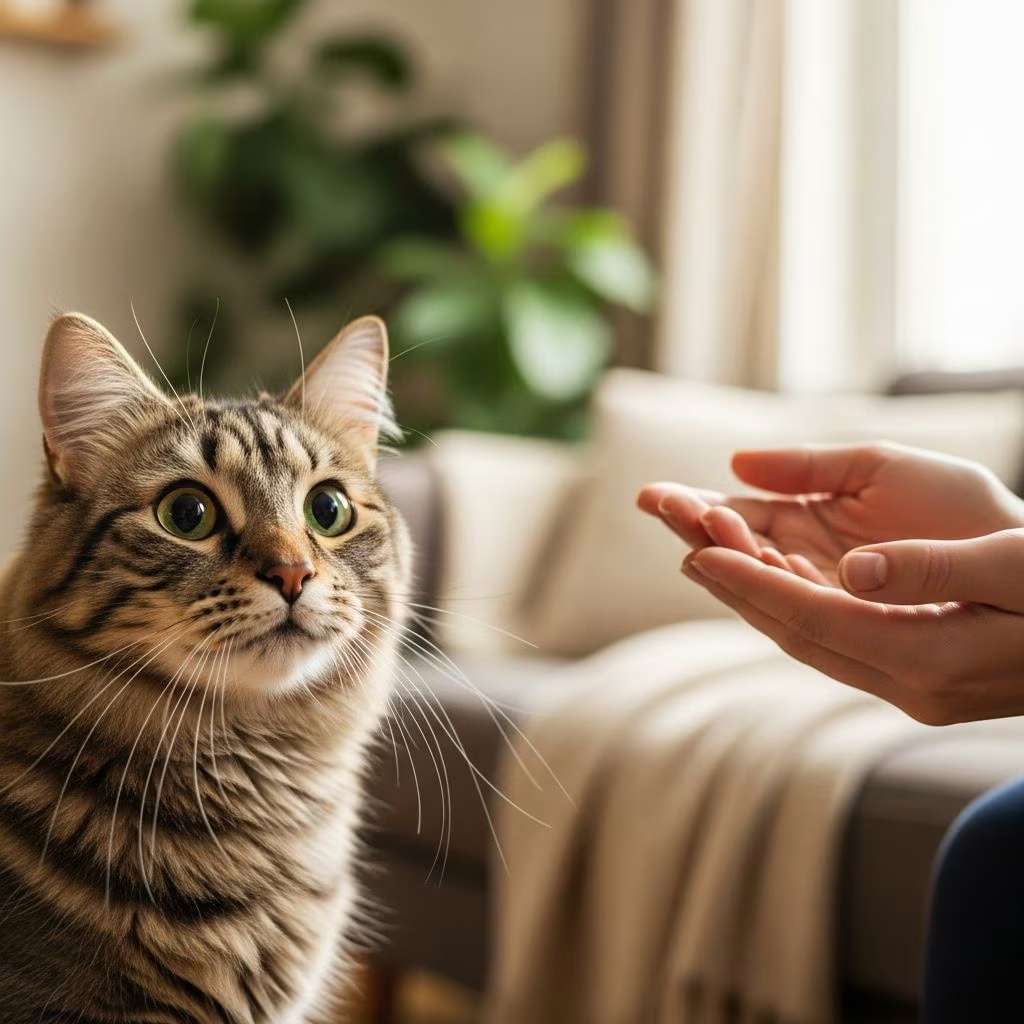
Cats react positively to **baby talk** from their owners, showing increased attention through behaviors like ear turning, pupil dilation, and pausing activities, according to a study published in Animal Cognition. This response, known as pet-directed speech, strengthens the human-cat bond but does not occur with strangers.
What Is Baby Talk (Pet-Directed Speech)?
Baby talk, or pet-directed speech, involves high-pitched voices, extended vowels, short repetitive phrases, and melodic tones, similar to how humans speak to infants. Cat owners instinctively use this when addressing their pets, saying things like “Who’s a good kitty?” or “Do you want a treat?” in exaggerated, sing-song voices.
This speech pattern contrasts with adult-directed speech, which is lower-pitched and more neutral. Research confirms owners naturally switch to pet-directed speech around cats, fostering communication.
Scientific Studies on Cats and Baby Talk
A key study by ethologist Charlotte de Mouzon at Paris Nanterre University tested 16 cats and their owners. Owners recorded phrases in both pet-directed and adult-directed speech, played back in the cats’ homes with owners present but silent.
Cats heard five recordings: the first three in adult-directed speech from owners (reaction scores dropping from 13 to 4), the fourth in pet-directed speech (score rebounding to 14), and the fifth back to adult-directed (dropping to 6). With strangers’ voices, reactions stayed low even for pet-directed speech.
Reactions were scored 0-20 based on subtle cues: head/ear orientation, pausing grooming, pupil dilation, or approaching the sound. This habituation-dishabituation method proves cats discriminate owner pet-directed speech.
Why Do Cats Respond to Baby Talk from Owners?
Cats form selective bonds, responding only to familiar voices in pet-directed style, unlike dogs who react to strangers. Indoor cats have limited stranger exposure, explaining indifference.
Experts like Kristyn Vitale note cats are “always listening,” with this study supporting parent-infant-like bonding. Cats sense owners as caregivers, reinforced by vocal cues.
- Selective attention: Cats tune into owner-specific speech patterns.
- Bond reinforcement: Mimics infant-caregiver communication.
- Subtle responses: Unlike dogs’ overt reactions, cats show nuanced interest.
Do Cats Like When You Talk to Them in General?
Yes, cats enjoy talking, especially high-pitched or melodic tones that comfort them. Calm, soft voices engage attention; loud or distressing tones cause alert or flight responses.
Cats associate tone, words, and body language with positive outcomes like food or play via repetition. They recognize names and key words (e.g., “treat”) but not full sentences.
Do Cats Understand What You’re Saying?
Cats don’t comprehend sentences but learn associations. Positive reinforcement links voices/tones to rewards, strengthening bonds. Baby talk heightens engagement without needing linguistic understanding.
Adult cats meow primarily to humans, evolving purrs with frequencies mimicking baby cries for attention—evidence of mutual adaptation.
How Cats Communicate Back
Cats “talk back” via meows (human-exclusive), purrs, chirps, trills, and body language. Purring has soothing high frequencies; slow blinks signal trust.
- Meowing: Reserved for humans, varying pitch for needs.
- Purring: Comfort or solicitation, evolved for human appeal.
- Chirping/Trilling: Greeting or excitement.
- Tail/ear positions: Mood indicators.
Tips for Talking to Your Cat
Enhance communication with these vet-verified strategies:
- Use pet-directed speech: High pitch grabs attention from you specifically.
- Keep it calm: Soft tones comfort; avoid yelling.
- Repeat key words: Associate “food,” “play” with actions.
- Combine with touch: Pet while talking for bonding.
- Observe responses: Ear perks or approaches mean success.
| Speech Type | Cat Reaction | Best Use |
|---|---|---|
| Pet-Directed (Baby Talk) | High attention (score 14) | Owners only, for engagement |
| Adult-Directed | Low attention (score 4-6) | Neutral conversation |
| Stranger Baby Talk | No rebound (score ~5) | Ineffective |
Benefits of Talking to Your Cat
Regular talking reduces stress, boosts socialization, and prevents issues like litter avoidance or aggression. It signals safety, encourages vocalization, and deepens emotional ties.
Studies show talked-to cats are more responsive, playful, and less fearful, mirroring dog benefits but uniquely owner-focused.
Common Myths About Cat Communication
- Myth: Cats are aloof and ignore talk. Fact: They selectively respond, always listening.
- Myth: All baby talk works. Fact: Only from bonded owners.
- Myth: Cats understand English. Fact: They grasp associations, not syntax.
Frequently Asked Questions (FAQs)
What makes cats react to baby talk?
Cats perk up due to high-pitched, melodic tones from owners, scoring higher in attention tests (14 vs. 4-6).
Will my cat respond to strangers’ baby talk?
No, indoor cats ignore strangers, even in pet-directed speech, due to limited exposure.
Is baby talk beneficial for cat bonding?
Yes, it reinforces caregiver bonds, reduces stress, and encourages play.
How much should I talk to my cat daily?
Regular, short sessions during feeding/play; quality over quantity.
Do all cats like high-pitched voices?
Most do, but observe: fleeing means tone adjustment needed.
Conclusion
Baby talk delights cats when from owners, proven by science to boost engagement and bonds. Talk often, watch cues, and enjoy deeper feline friendship.
References
- Cats React to ‘Baby Talk’ From Their Owners, but Not Strangers — Smithsonian Magazine. 2022-10-25. https://www.smithsonianmag.com/smart-news/cats-react-to-baby-talk-from-their-owners-but-not-strangers-180981007/
- Cats react to ‘baby talk’—but only from their owners — Science | AAAS. 2022-10-25. https://www.science.org/content/article/cats-react-baby-talk-only-their-owners
- Do Cats Like When You Talk to Them? Vet-Verified Benefits — Catster. Recent (pre-2026). https://www.catster.com/lifestyle/do-cats-like-when-you-talk-to-them/



