

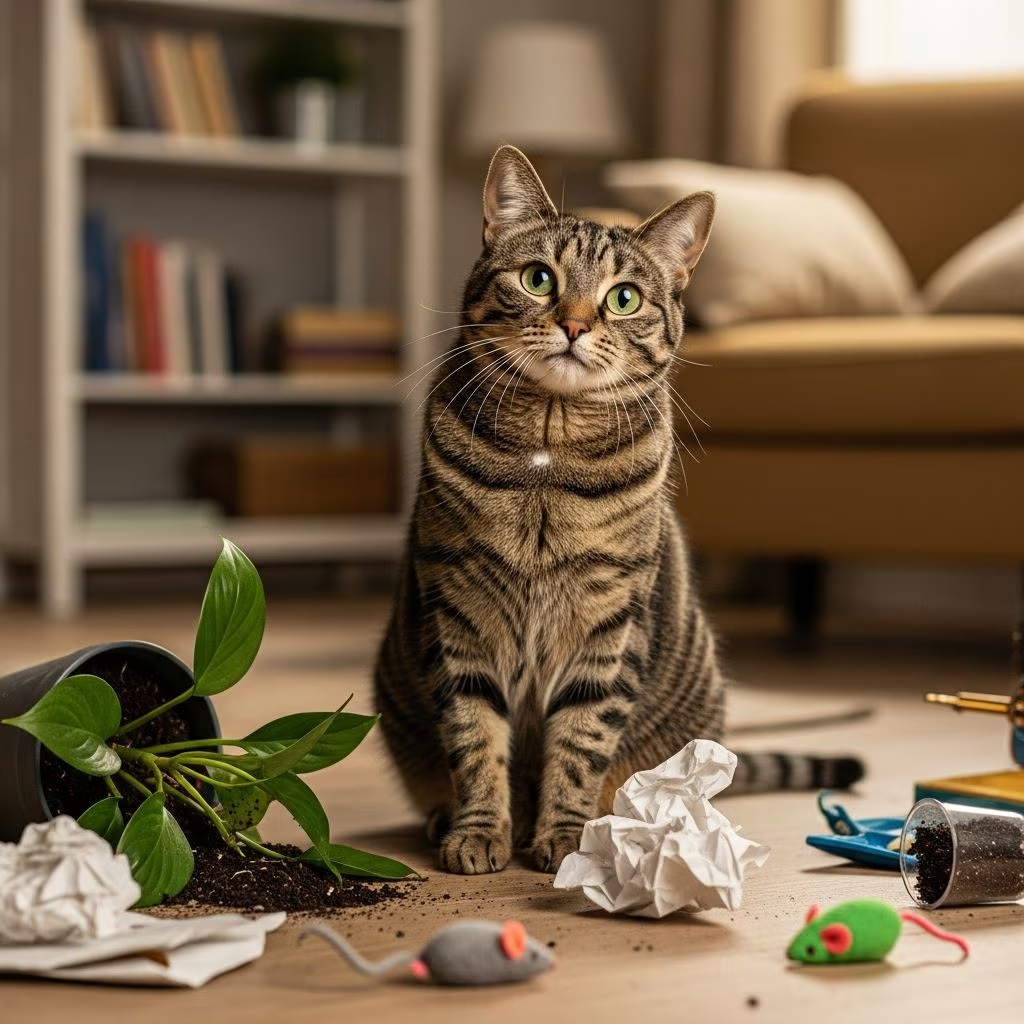
Do Cats Learn From Their Mistakes? Feline Assimilation Facts
People develop and grow from making mistakes and learning from them, but can the same be said for cats? Do cats learn from their mistakes? The answer is more nuanced than a simple yes or no. Unlike humans, cats do not rely on human logic or reasoning patterns. Instead, they operate as natural survivalists guided primarily by instinct and immediate environmental feedback. However, when their basic needs are consistently met and they receive proper training and guidance from their owners, cats demonstrate a remarkable capacity to learn acceptable behaviors and avoid negative ones.
The relationship between cat learning and human responsibility cannot be overstated. Cat owners play a crucial role in shaping their feline companions’ behavior and learning processes. Understanding how cats learn is essential for fostering a harmonious household and improving the overall welfare of your pet. Your actions as a cat owner directly influence the behaviors your cat exhibits, making it equally important to examine your own contributions to your cat’s behavioral patterns.
How Cats Learn
Understanding the mechanisms through which cats acquire new behaviors and modify existing ones is fundamental to effective cat training and household management. Cats learn through multiple interconnected pathways that include environmental observation, exposure to various stimuli, conditioning processes, and learning through observation of other individuals. By grasping these learning methods, cat owners can better influence their pets’ behavior and create a more supportive environment for their feline companions.
Habitat and Environmental Learning
Cats possess an impressive ability to learn about their environment over extended periods. Through repeated exposure to various elements in their surroundings, cats develop a sophisticated understanding of what matters to them and what can be safely ignored. This process of environmental habituation is crucial for their adaptation to indoor and outdoor spaces. A cat may initially fear a particular sound—such as a vacuum cleaner, thunderstorm, or household appliance—but through repeated exposure without negative consequences, they gradually recognize that the stimulus poses no threat. Once they determine that the sound is harmless, they develop the ability to ignore it entirely, redirecting their attention to more relevant environmental cues.
This habituation process demonstrates that cats are capable of rational evaluation of their surroundings. Rather than remaining perpetually fearful of neutral stimuli, cats invest cognitive resources in distinguishing between genuine threats and harmless occurrences. This adaptive learning mechanism helps cats conserve energy and focus their vigilance on truly important environmental factors.
Sensory Learning and Stimuli Response
Cats rely heavily on their sophisticated sensory systems to navigate and understand their world. After repeated exposure to specific stimuli, cats develop increasingly pronounced positive or negative reactions based on their experiences. These reactions can become quite intense and may generalize to similar stimuli. For example, if a cat has had a negative encounter with a particular type of animal, they may develop a negative view of that species or similar-looking animals. This conditioned response can trigger a strong reaction whenever they see that specific animal or one that resembles it.
The intensity and longevity of these sensory-based responses underscore the depth of feline learning. Cats don’t simply react in the moment; they develop associations between sensory experiences and outcomes, which then guides their future behavior. This learning mechanism is so effective that a single traumatic encounter can influence a cat’s behavior for years, demonstrating the power of negative reinforcement.
Three Types of Conditioning in Cat Learning
Behavioral scientists have identified three primary conditioning mechanisms that explain how cats learn from their experiences and modify their behavior accordingly. These conditioning types work in concert to shape feline behavior and determine how successfully cats learn from their mistakes.
Classical Conditioning
Classical conditioning represents learning through association between two stimuli. This type of learning occurs when a cat connects an initially neutral stimulus with an outcome they already understand. The classic example in household cats involves the refrigerator door. When you open the refrigerator, your cat likely becomes excited because they have learned through repetition that this sound and action is reliably followed by feeding time. The opening of the refrigerator door has become associated with the pleasant outcome of receiving food, generating the same emotional response as the food itself.
This conditioning process depends entirely on consistent repetition of the association between the stimulus (refrigerator opening) and the outcome (receiving food). Over time, the neutral stimulus becomes a reliable predictor of the expected outcome in your cat’s mind. Other examples of classical conditioning in cats include the sound of a treat bag, the jingle of a harness, or the rattle of a food can opener—all stimuli that cats learn to associate with positive outcomes.
Operant Conditioning
Operant conditioning involves learning in which behavior is “controlled” through reinforcement and punishment mechanisms. Under this conditioning model, the consequences of a behavior directly influence whether that behavior will be repeated in the future. This principle operates with straightforward logic: if a behavior results in positive consequences for the cat, the behavior becomes more likely to recur; conversely, if a behavior results in negative consequences, the probability of repetition decreases.
Consider a cat that receives a treat when sitting in a particular cat tree. The positive consequence (treat) makes it highly likely that the cat will return to that same cat tree and spend additional time there in the future. In contrast, a cat that was frightened by a dog while sitting at the same cat tree may avoid that location entirely, having learned that the location is associated with fear and negative experiences.
Operant conditioning involves four primary mechanisms:
- Positive reinforcement: Adding something pleasant to encourage behavior repetition (offering a treat when your cat uses the scratching post)
- Negative reinforcement: Removing an unpleasant stimulus to encourage behavior (stopping a loud noise when your cat complies with a command)
- Positive punishment: Adding something unpleasant to discourage behavior (a loud noise when your cat jumps on the counter)
- Negative punishment: Removing something pleasant to discourage behavior (removing a toy or treat when your cat exhibits unwanted behavior)
A critical factor in successful operant conditioning with cats is timing. The connection between the behavior and the response must be immediate and clear for the cat to form the association between their action and its consequences. Delayed consequences rarely result in effective learning, as cats may fail to connect the punitive or rewarding event with the original behavior.
Observational Learning
Observational learning occurs when cats modify their behavior by watching and learning from other cats. Research has documented that both adult cats and kittens can acquire new behaviors through observing other cats. A common example involves cats learning to jump on counters—a behavior that can spread through a multi-cat household as other cats observe and emulate the behavior of pioneering cats.
However, the mechanisms underlying observational learning in cats remain somewhat debated among animal behaviorists. Researchers distinguish between two possible explanations for observed behavior change: the “follower” cat may be directly learning from the “tutor” cat through imitation, or the demonstration may simply draw the follower cat’s attention to a location or object, resulting in independent exploration that leads to the same behavior. The distinction between true imitation and simple attention-focusing remains an active area of research in feline behavioral science.
Limitations of Cat Learning from Human Demonstration
While cats demonstrate clear capacity for learning in many contexts, recent scientific research has revealed important limitations in their ability to learn from human behavior specifically. Studies investigating whether cats can learn to solve problems by observing human demonstrations have found minimal evidence of this type of social learning. This represents a significant difference from dogs, which readily learn problem-solving strategies by watching their human owners.
In controlled experimental settings where humans demonstrated how to obtain rewards through manipulating devices, cats showed no measurable improvement in problem-solving efficiency compared to cats who had not observed any demonstration. The cats in both groups—those who observed humans and those who did not—achieved similar success rates and latency times. This suggests that cats, despite their general intelligence, may be less inclined or less able to extract and apply information from human behavioral demonstrations compared to their canine counterparts.
Factors Influencing Cat Learning Success
Several key factors determine whether cats will successfully learn from their mistakes and modify their behavior accordingly:
- Individual variation: Some cats demonstrate superior memory for their mistakes and learn more effectively than others, suggesting individual differences in learning capacity
- Consistency: Consistent application of consequences improves learning dramatically compared to inconsistent or intermittent reinforcement
- Motivation: Cats learn most effectively when motivated by outcomes they value—typically food, play, comfort, or social interaction
- Natural behavior compatibility: Cats more readily learn tasks that align with their natural behavioral repertoire than tasks requiring unnatural or uncomfortable actions
- Environmental context: The familiarity and comfort level of the learning environment influences whether cats will engage in learning processes
- Owner consistency: Owners must provide consistent, immediate consequences to reinforce or discourage behaviors effectively
The Role of Owner Behavior in Cat Learning
Perhaps the most important insight regarding cat learning is that owner behavior directly shapes cat learning outcomes. Cats learn not just from direct consequences but also from observing patterns in their owner’s responses. When an owner consistently fails to provide clear consequences for behaviors, cats receive no guidance for behavior modification. Conversely, when owners provide clear, immediate, and consistent feedback to cat behaviors, cats learn to modify their actions accordingly.
This mutual learning relationship means that improving your cat’s behavior requires examining your own habits and responses. Are you inadvertently rewarding unwanted behaviors through attention or treats? Are your consequences inconsistent, making it difficult for your cat to form clear associations? By becoming more intentional and consistent in your responses to your cat’s behaviors, you dramatically improve the likelihood that your cat will learn from their mistakes and develop more desirable behavioral patterns.
Frequently Asked Questions
Q: Can cats truly learn from punishments?
A: Cats can learn associations between their behavior and negative consequences, but punishment is often less effective than positive reinforcement. Punishment can create fear and stress without clearly communicating which behavior should change. Positive reinforcement of desired behaviors and removal of rewards for undesired behaviors typically prove more effective.
Q: How long does it take for a cat to learn from a mistake?
A: The timeline varies significantly by individual cat, behavior complexity, and consistency of consequences. Simple associations may form within a few repetitions, while complex behavioral changes may require weeks or months of consistent reinforcement.
Q: Do all cats have equal capacity to learn from mistakes?
A: No, cats display individual variations in learning capacity and memory. Some cats remember mistakes from a single incident, while others require multiple exposures to form lasting associations. Younger cats often learn more quickly than older cats.
Q: Can cats learn from other cats’ mistakes?
A: While cats can observe and learn behaviors from other cats, there is limited evidence that they learn from observing negative consequences experienced by other cats. Each cat typically requires individual experience with consequences to modify their own behavior.
Q: What’s the best way to teach a cat not to repeat a mistake?
A: Consistency is paramount. Use immediate negative consequences (removing something pleasant) or redirect the cat toward desired behavior with positive reinforcement. Ensure all household members apply the same responses to the behavior for maximum effectiveness.
Conclusion
Cats possess genuine intelligence and demonstrable capacity to learn from their mistakes, though this learning ability varies among individual animals. The three primary conditioning mechanisms—classical conditioning, operant conditioning, and observational learning—work together to shape feline behavior and enable cats to modify their actions based on experience. While some cats excel at remembering and avoiding repeated mistakes, others may require additional guidance and reinforcement.
The key to facilitating learning from mistakes is understanding that you, as the cat owner, play an essential role in the process. By providing immediate, consistent, and clear consequences for behaviors, you create an environment in which cats can successfully learn and modify their actions. With proper training, patience, and understanding of feline learning mechanisms, most cats can learn to avoid repeating their mistakes and develop behavioral patterns that promote harmony in your household.
References
- Do Cats Learn From Their Mistakes? Feline Assimilation Facts — Catster. 2024. https://www.catster.com/cat-behavior/do-cats-learn-from-their-mistakes/
- Cats Did Not Change Their Problem-Solving Behaviours after Observing Human Behaviour — National Institutes of Health, PMC. 2023. https://pmc.ncbi.nlm.nih.gov/articles/PMC10044084/
- Do You Speak Cat? Assessing the Impact of a Training Video on Human Ability to Recognize Cat Behavioral Cues — Frontiers in Ethology, University of Adelaide. 2025. https://www.frontiersin.org/journals/ethology/articles/10.3389/fetho.2025.1675587/full



