

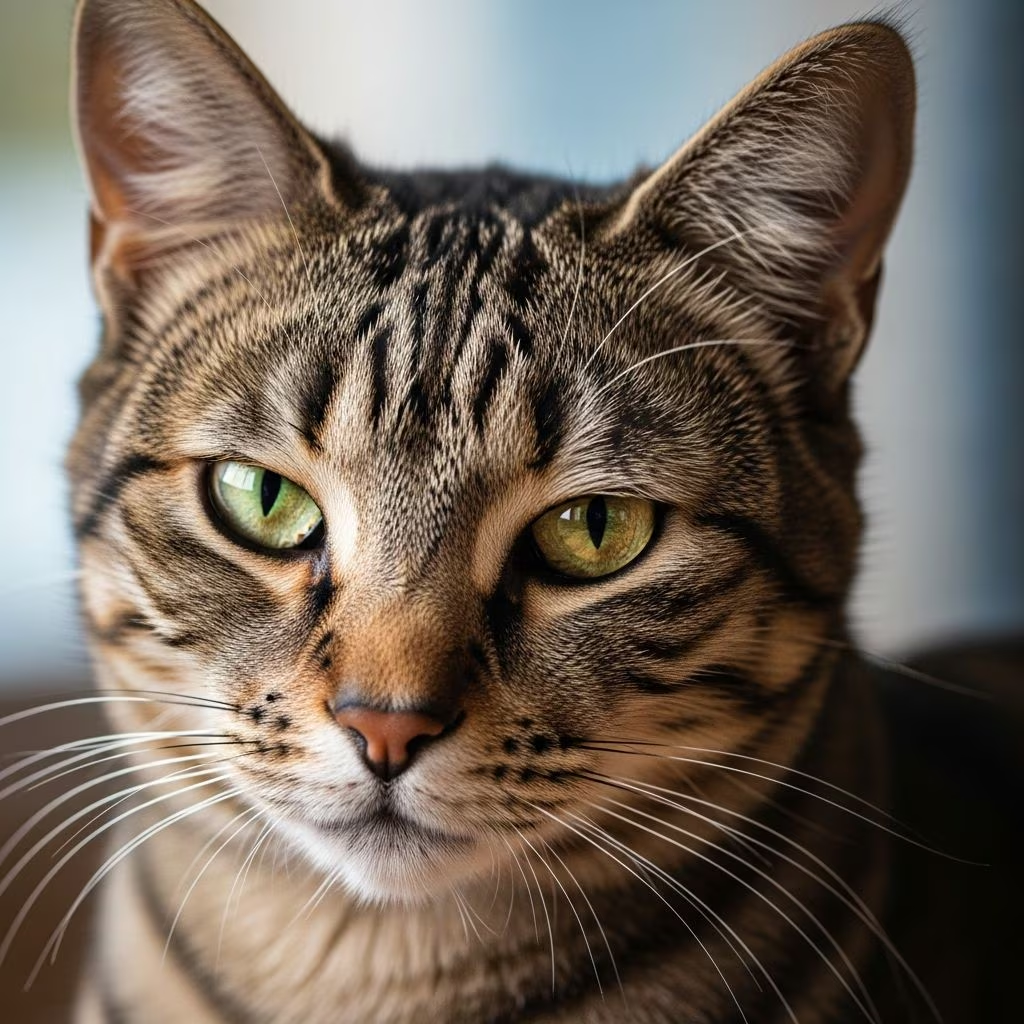
Cats often display behaviors that make owners wonder if their feline companions are harboring resentment, such as avoiding contact, hissing, or glaring after an upsetting incident. However, scientific understanding and expert insights indicate that cats do not hold grudges in the human sense, which involves complex moral judgment and long-term resentment. Instead, these reactions stem from instinctual responses, associative learning, and survival mechanisms.
Table of Contents
- What Is a Grudge?
- Do Cats Hold Grudges?
- Cat Memory and Association
- Signs Your Cat Is Upset
- How Long Does a Cat Remember?
- Can Cats Hold Grudges Against Other Cats?
- How to Make It Up to Your Cat
- Frequently Asked Questions
What Is a Grudge?
A grudge in humans is a persistent feeling of ill will or resentment resulting from a past insult or injury. It requires advanced cognitive processes, including abstract thinking, moral judgment, and rumination over events. Research shows grudges engage multiple brain regions like the dorsal anterior cingulate cortex, cingulate cortex, medial prefrontal cortex, lateral prefrontal cortex, and insula, allowing humans to weigh revenge against relationship maintenance.
Surveys reveal the average person holds about seven grudges, lasting around five years on average, with 15% enduring over 11 years. Common triggers include romantic rejections, job losses, or poor customer service. This emotional complexity serves evolutionary purposes, such as social navigation in group settings.
Cats, however, lack this cognitive sophistication. Their brains prioritize immediate survival instincts over long-term emotional bookkeeping. Behaviors mimicking grudges are typically short-term reactions to stress or negative associations, not vengeful intent.
Do Cats Hold Grudges?
No, cats do not hold grudges. Cat behaviorists emphasize that grudges demand complex abstract thinking and long-term moral judgment, capacities beyond feline cognition. Cats operate on associative memory, emotional responses, and survival instincts.
Mieshelle Nagelschneider, a renowned cat behaviorist, explains: “Their reactions are shaped by survival instincts, associative memory, and emotional responses. If a cat appears upset, it is likely reacting to a specific event or stimulus, rather than harboring resentment.” Similarly, Cats Protection notes that aloof behavior is a protective mechanism to avoid repeat stress, not resentment.
Veterinarian Catherine Barnette DVM adds that while cats may give the cold shoulder, their motivations differ from human grudges, lacking long-term anger. Studies on handling at veterinary clinics reinforce this: cats stressed by full-body restraint show aversion to the method or location but do not target handlers personally long-term.
Cat Memory and Association
Cats possess strong associative memory, linking events, people, or environments with positive or negative outcomes. Stepping on a cat’s tail might lead to temporary avoidance of your feet or proximity, interpreted as a grudge but actually a learned caution.
This memory aids survival: associating pain with a stimulus helps avoid danger. Unlike grudges, it fades without reinforcement. Research from Ontario Veterinary College shows cats prefer areas of passive restraint over full-body after stressful exams, indicating location-based association, not personal grudge.
Cats also use scent-marking for territory, avoiding conflict remotely—a solitary hunter trait unlike social human grudge dynamics. Persistent avoidance signals ongoing issues like pain or environmental stress, not resentment.
Signs Your Cat Is Upset
Recognizing upset signs helps distinguish instinct from myth:
- Avoidance: Hiding or fleeing from specific people or areas.
- Vocalizations: Hissing, growling, or yowling.
- Body Language: Ears back, tail lashing, dilated pupils, lip licking—stress indicators.
- Changes in Routine: Reduced eating, litter avoidance, excessive grooming.
- Aggression: Swatting or biting, often fear-based.
These are immediate responses. If lasting over 48 hours, investigate persistent triggers like health issues or household changes.
How Long Does a Cat Remember?
Cats remember traumatic events potentially for life, especially if linked to threats. A single bath or vet visit might cause lifelong wariness without retraining. However, positive associations can overwrite negatives quickly.
Studies show post-handling aversion is short-lived unless reinforced. Cats quicker to escape after stressful restraint jump off tables faster but approach handlers similarly later, showing no grudge. Typical upset fades in hours to days; longer indicates unresolved stress.
| Event Type | Typical Memory Duration | Rebuild Strategy |
|---|---|---|
| Mild (e.g., loud noise) | Hours | Offer treats, play |
| Moderate (e.g., tail step) | 1-2 days | Slow reintroduction, positive reinforcement |
| Severe (e.g., trauma) | Weeks to lifetime | Professional behaviorist, desensitization |
Can Cats Hold Grudges Against Other Cats?
Inter-cat dynamics follow similar patterns. New cats or conflicts lead to avoidance via scent avoidance or spatial separation, not grudges. Solitary by nature, cats de-escalate by distancing.
Shelter studies show ‘unfriendly’ cats equally averse to handling types, prioritizing safety over payback. Multi-cat homes benefit from resources (litter boxes, food) to prevent tension mimicking grudges.
How to Make It Up to Your Cat
Rebuild trust systematically:
- Give Space: Allow recovery without forcing interaction.
- Positive Associations: Use treats, play, pheromone diffusers.
- Consistent Routine: Maintain feeding, play schedules.
- Desensitization: Gradual exposure to triggers with rewards.
- Vet Check: Rule out pain or illness.
- Enrichment: Scratching posts, vertical space reduce stress.
Patience yields results; cats forgive readily without grudge baggage.
Frequently Asked Questions (FAQs)
Do cats hold grudges against their owners?
No, cats react instinctively to events, not with resentment. Avoidance is protective, not punitive.
How long will my cat hold a grudge?
Typically hours to 2 days; longer suggests ongoing issues.
Why does my cat ignore me after I yelled?
Associative fear; rebuild with gentle positives.
Can cats get revenge?
No, lacking cognitive framework for vengeance.
What if my cat avoids another pet?
Territorial instinct; separate resources, slow intros.
References
- Do Cats Hold Grudges? They Sure Seem To — Kinship. 2023. https://www.kinship.com/cat-behavior/do-cats-hold-grudges
- Do cats hold a grudge? Measuring stress responses to passive or … — What Your Cat Wants (Ontario Veterinary College study reference). 2019. https://whatyourcatwants.com/catrestraint
- How long does a cat hold a grudge? — Cat in the Box LLC. 2023. https://thecatisinthebox.com/blogs/kitty-contemplations/how-long-does-a-cat-hold-a-grudge
- Is your cat really mad at you? — Burgess Pet Care (citing Cats Protection). 2023. https://www.burgesspetcare.com/blog/cat/is-your-cat-really-mad-at-you/
- Do Cats Hold Grudges? Vet-Reviewed Feline Behavior & FAQ — Catster. 2025. https://www.catster.com/cat-behavior/do-cats-hold-grudges/



