

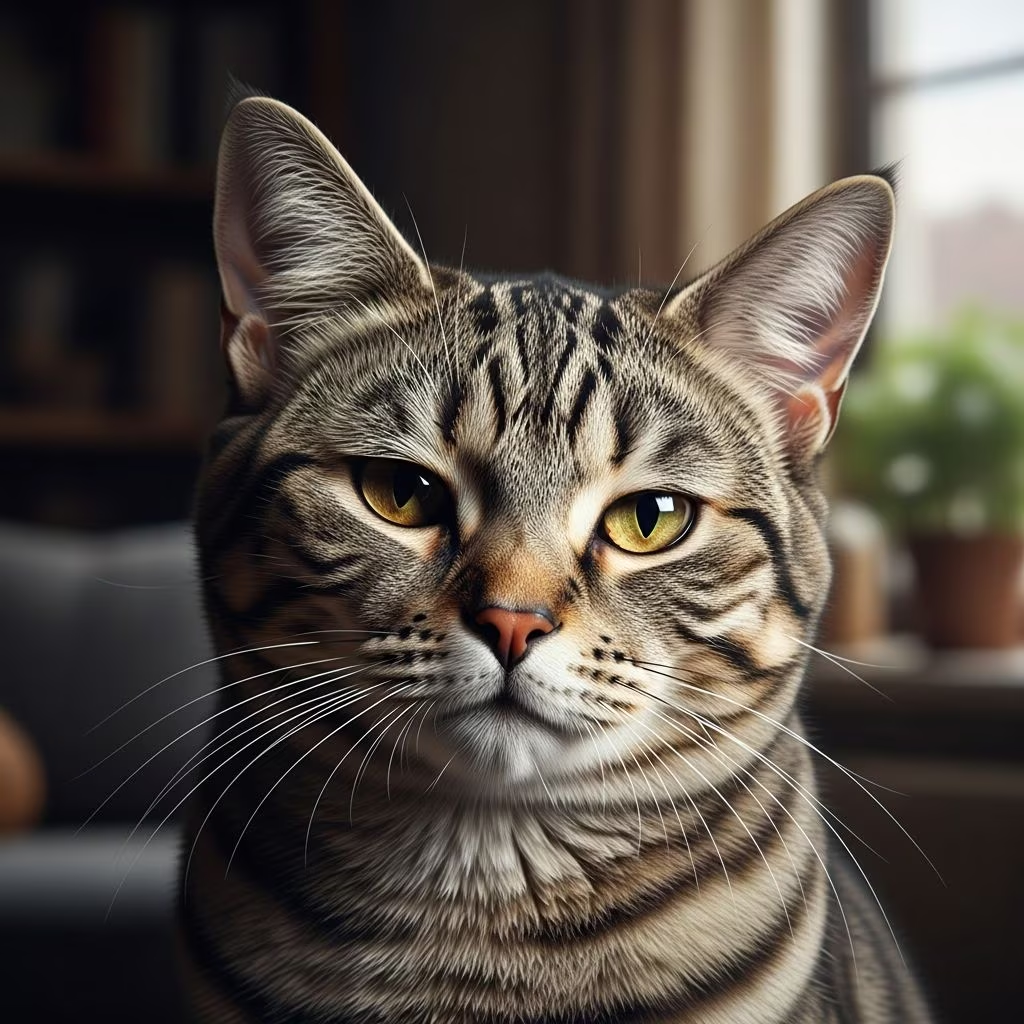
Cats do not hold grudges in the human sense of long-term resentment, but they possess sophisticated memory capabilities that allow them to recall negative experiences for minutes to hours, influencing their behavior toward people or situations.
The Science of Feline Memory
Recent studies reveal that domestic cats exhibit episodic-like memory, similar to humans and dogs, enabling them to remember specific events including “what,” “where,” and “when” details. In experiments with 49 cats, researchers presented food in specific bowls and later swapped them, finding cats recalled uneaten bowls longer, indicating memory retrieval of past events. This suggests cats can access detailed recollections on demand, potentially for self-amusement akin to human daydreaming.
Further evidence comes from obstacle navigation tasks where cats retained spatial memory of barriers for up to 2 minutes, with memory fading progressively within 3-5 seconds post-step if brain areas like posterior parietal cortex area 5 were lesioned, though recovery occurred over weeks. These findings challenge outdated views of short feline memories, pointing to longer retention for salient events.
Signs Your Cat Might Be Upset with You
While not grudges, cats display clear avoidance behaviors after stressful interactions. Common indicators include:
- Avoiding eye contact or physical proximity: Cats may retreat to high perches or hide, signaling discomfort.
- Altered vocalizations: Hissing, growling, or reduced purring instead of usual meows.
- Tail and ear positions: Puffed tail, flattened ears, or rapid swishing indicate agitation.
- Litter box issues: Inappropriate elimination as stress response.
- Appetite changes: Refusing food linked to recent negative events.
These reactions stem from associative learning, where cats link you to discomfort, but they typically resolve quickly with positive reinforcement.
How Long Can Cats Remember Negative Events?
Memory duration varies by event salience and cat’s age/health. Episodic memory tests show retention of food-related events after 15-minute delays. Spatial memories last seconds to minutes in locomotion tasks. Object permanence studies indicate cats expect hidden items to remain, reacting with surprise (longer gazes, exploration) to violations, though not all show search behaviors.
| Memory Type | Duration | Example Study |
|---|---|---|
| Episodic (what/where/when) | 15+ minutes | Food bowl recall |
| Spatial (obstacles) | 1-120 seconds | Walking pause tasks |
| Object permanence | Immediate to short-term | Violation events |
| Social cognition | Declines with age/stress | Home environment tests |
Older cats (7-14 years) show reduced spatial memory and social referencing due to stress and inflammation like IL-1β.
Factors Influencing Cat Memory and Reactions
Several elements modulate how cats process and retain negative experiences:
- Age: Cognitive decline in seniors links to inflammation, impairing memory.
- Stress levels: High cortisol reduces recall and sociability.
- Individual personality: Bold cats recover faster than shy ones.
- Health status: Conditions like hyperthyroidism affect behavior mimicry of grudges.
- Environment: Multi-cat homes amplify tensions via territory disputes.
Understanding these helps distinguish true memory from health issues.
Debunking the Grudge Myth
The notion of cats plotting revenge arises from anthropomorphism. Cats operate on survival instincts, not spite. A study comparing cat intelligence to dogs found felines recall pleasant events like snacks episodically, implying neutral or positive biases over grudges. Negative associations fade without reinforcement, unlike human grudges fueled by rumination.
Cats prioritize safety; avoidance protects from perceived threats, not punishment. Lesion studies confirm brain regions for short-term spatial memory, but no evidence for vengeful long-term storage.
Rebuilding Trust with Your Cat
To mend any perceived rift:
- Give space: Allow 24-48 hours for reset without forcing interaction.
- Use treats and play: Associate yourself with positives via favorite toys/food.
- Slow blinks: Mimic cat calming signals to convey safety.
- Routine consistency: Predictable feeding/handling reduces anxiety.
- Pheromone diffusers: Synthetic feline pheromones soothe stress.
Patience yields results; most cats forgive within hours to days.
Cats vs. Dogs: Memory Showdown
| Aspect | Cats | Dogs |
|---|---|---|
| Episodic Memory | Recalls food events post-delay | Similar in tasks |
| Social Cognition | Declines with age | Stronger human attunement |
| Memory Duration | Minutes for events | Minutes to hours |
| Grudge-like Behavior | Avoidance, short-term | More persistent sulking |
Both species rival in cognition, but cats’ independence shapes subtler expressions.
When to Consult a Vet
Persistent changes beyond 48 hours warrant professional check:
- Sudden aggression or fearfulness.
- Weight loss/appetite refusal.
- Elimination outside box.
- Disorientation or vocalizing at night.
These may signal cognitive dysfunction syndrome (CDS), akin to dementia, affecting 28% of cats over 11 years.
FAQs
Will my cat forget I yelled at them?
Yes, typically within hours if not repeated; focus on positive associations.
Do cats remember abuse long-term?
They form lasting avoidance to abusers but adapt with new safe experiences; memory is event-based, not eternal.
Why does my cat ignore me after vet visit?
Associates carrier/you with stress; use treats to re-link positively.
Can older cats develop grudges easier?
Cognitive decline impairs memory but heightens sensitivity to stress.
How to tell if it’s a grudge or illness?
Monitor duration; vet rules out medical causes first.
Enhancing Your Cat’s Cognitive Health
Promote brain health through:
- Interactive puzzles for mental stimulation.
- Regular vet checkups for early inflammation detection.
- Balanced diet rich in omega-3s.
- Plenty of vertical spaces and hiding spots.
These practices strengthen memory and reduce stress responses.
References
- Cat experiment suggests they remember in ways similar to humans and dogs — Phys.org / Bob Yirka. 2017-01-18. https://phys.org/news/2017-01-cat-ways-similar-humans-dogs.html
- Stress, Inflammation Linked to Cognitive Decline in Older Cats — Morris Animal Foundation. 2025-02-12. https://www.morrisanimalfoundation.org/article/cognitive-decline-cat-pub
- Long-Lasting Working Memories of Obstacles Established by… — NIH / PMC. 2008. https://pmc.ncbi.nlm.nih.gov/articles/PMC6665557/
- Object permanence in domestic cats (Felis catus) using violation-of… — PLOS ONE. 2024. https://journals.plos.org/plosone/article?id=10.1371/journal.pone.0312225
- Cats may be as intelligent as dogs, say scientists — Association for Psychological Science. 2017. https://www.psychologicalscience.org/news/cats-may-be-as-intelligent-as-dogs-say-scientists.html



